Input your truck's payload rating, your trailer's estimated GTW, and your pin weight percentage to see exactly how much margin you're working with before adding passengers and cargo.
🔧
TRAILER & PAYLOAD
What Is a Good Pin Weight Percentage?
A good pin weight percentage for a 5th wheel is 18–22% of the trailer's gross trailer weight. This range delivers stable handling, adequate rear-axle traction, and predictable braking — without overloading the truck.
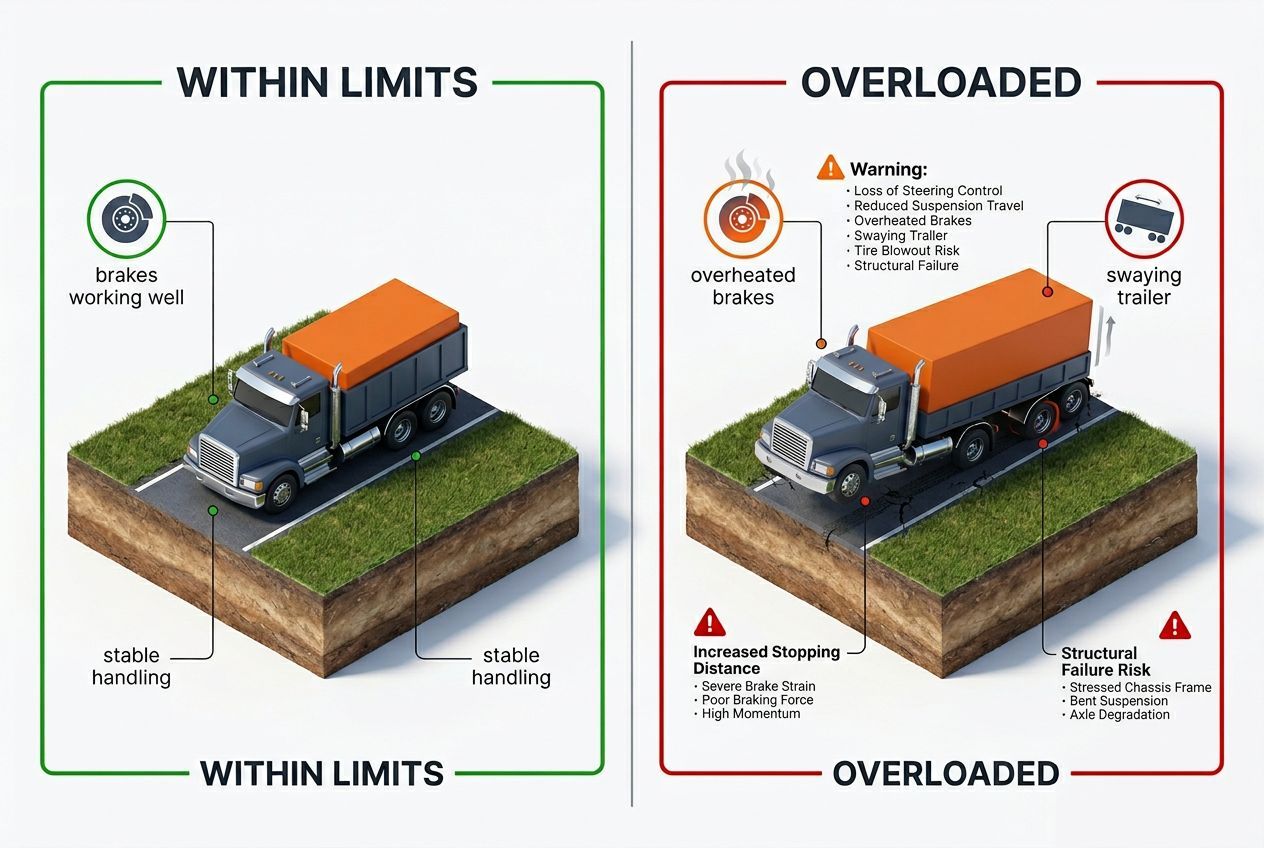
⚠️ Warning: Drop below 15% and the front of the trailer gets too light relative to the rear. That imbalance is a leading cause of trailer sway, especially in crosswinds or when a passing semi creates a pressure wave. The trailer wants to fishtail, and lighter pin weight gives it permission.
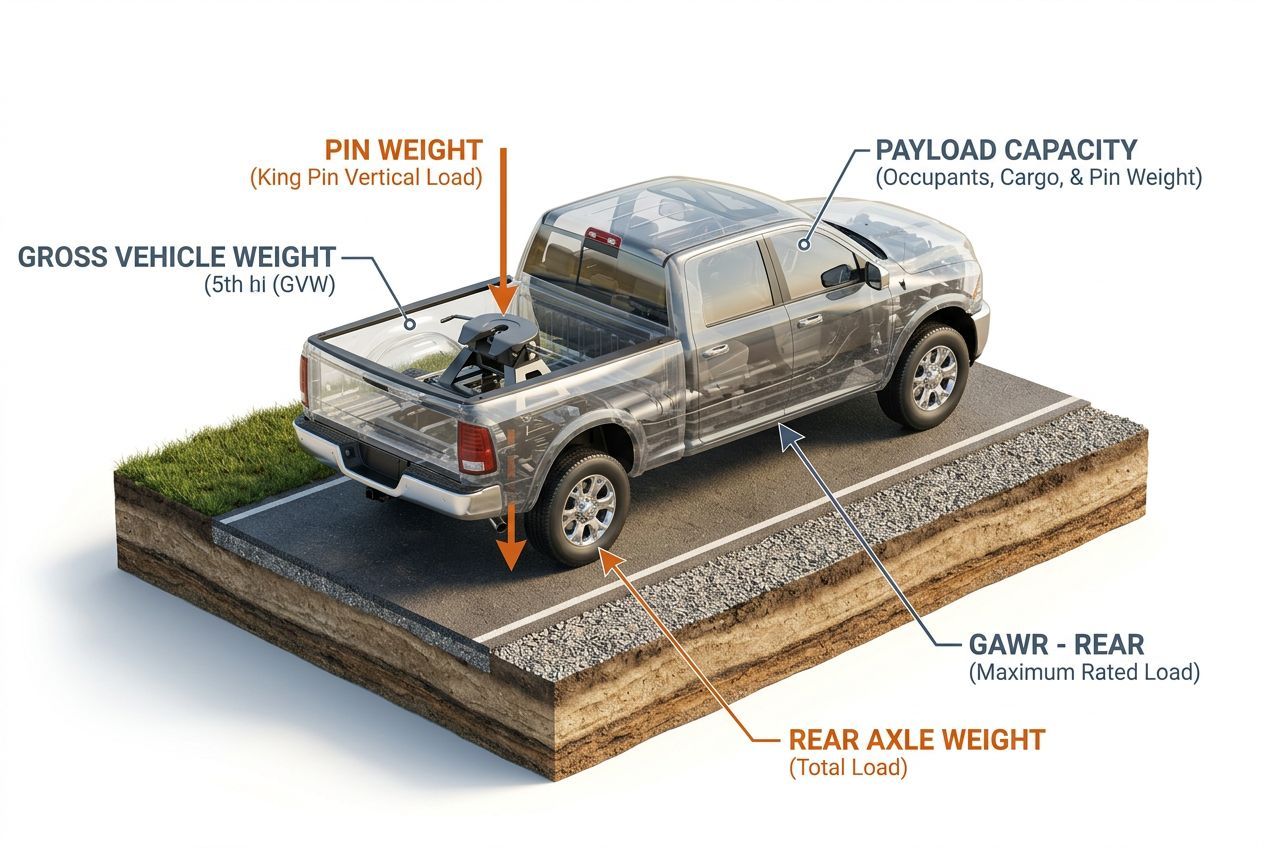
⚠️ Warning: Push above 25% and you're shifting excessive weight onto the truck's rear axle, lifting the front axle, and reducing steering traction. Your front tires lose contact pressure, braking distances increase, and you've potentially exceeded your rear-axle weight rating (RAWR) — which is stamped on the door-jamb sticker on the driver's-side B-pillar.
The ideal 18–22% window exists because the 5th wheel hitch sits directly over or slightly forward of the rear axle. That position lets the truck carry more vertical load than a bumper-pull setup without destabilizing the front end — but only within limits.
What Is a Good Pin Weight Percentage? — data table
| Truck Class |
Typical Payload |
Typical GAWR (Rear) |
Safe Pin Weight Range |
| ½-ton (F-150, RAM 1500) |
1,500–2,100 lbs |
4,000–5,000 lbs |
1,500–2,000 lbs max |
| ¾-ton (F-250, RAM 2500, Silverado 2500HD) |
2,500–3,800 lbs |
6,000–7,500 lbs |
2,000–3,500 lbs |
| 1-ton (F-350, RAM 3500, Silverado 3500HD) |
3,500–7,000+ lbs |
7,500–10,000+ lbs |
3,000–5,000+ lbs |
| 1-ton Dually |
4,000–7,500+ lbs |
9,500–12,000+ lbs |
Up to 6,000 lbs (heavy gooseneck) |
Source: Manufacturer towing guides from Ford, RAM, Chevrolet. Payload varies by configuration — always verify your specific VIN's door-jamb sticker.
🛡️
TRAILER & PAYLOAD
Pin Weight vs. Tongue Weight: What's the Difference?
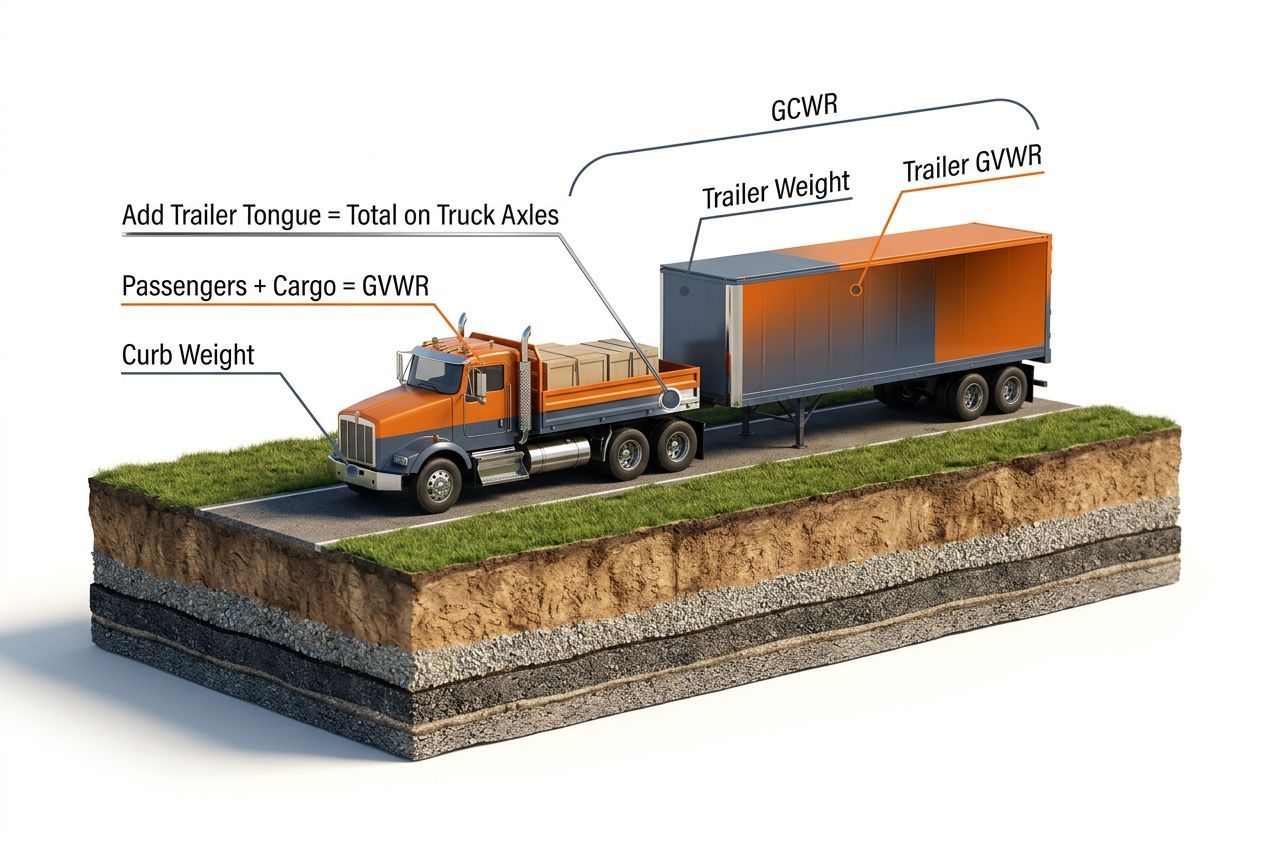
Pin weight and tongue weight measure the same thing — vertical downward load at the hitch point — but they apply to different trailer connections. Tongue weight belongs to bumper-pull trailers with a ball-mount hitch. Pin weight belongs to 5th wheel and gooseneck trailers with a king pin or gooseneck ball coupler.
Hitch Location & Mechanics
The mechanics differ in one important way: the hitch location.
- Bumper-pull ball: Sits behind the rear axle, so tongue weight acts as a lever that can lift the front axle if it's too heavy. That's why tongue weight is limited to 10–15% of GTW — higher percentages destabilize the truck.
- 5th wheel king pin: Sits over the rear axle. That position lets the truck carry a higher percentage (15–25%) without the same lever effect. The load goes straight down into the axle rather than behind it.
For a deeper comparison of how both measurements factor into your setup, the tongue weight guide breaks down bumper-pull math in detail.
💡 Key Takeaway: One thing both share: they count against your truck's payload. A pound of pin weight is a pound less available for passengers, gear, and fuel. That connection to payload capacity explained is the most commonly misunderstood part of 5th wheel ownership.
📋
TRAILER & PAYLOAD
How Do You Measure Pin Weight Without a Scale?
The most reliable way to measure pin weight without a public truck scale is a dedicated pin weight scale — a device specifically designed to read the downward force at the king pin. The Sherline LM-2000 is the most commonly recommended option; you place it under the trailer jack pad with the trailer at ride height and get a direct readout.
Field Estimate (Use with Caution)
✅ Pro Tip: For a rougher field estimate, you can use a hydraulic floor jack placed on a bathroom scale beneath the king pin with the trailer level and the fifth wheel disconnected. The scale reads the pin weight. This method introduces error from jack positioning and scale limitations, so treat it as a ballpark figure only.
Using a CAT Scale for Accuracy
For real-world accuracy, a CAT-certified truck scale is hard to beat.
✅ Pro Tip: At $12–$15 per weigh (find locations at CAT Scale's website), you can weigh your truck solo, then weigh it coupled to the loaded trailer, then subtract. The difference in rear-axle weight from your truck-only baseline is your actual pin weight under load. This also reveals how much your front axle unloads — a key indicator of steering traction loss.
⚠️ Warning: If your rear axle weight while coupled exceeds your GAWR (rear), check the door-jamb sticker — you've got a problem regardless of what the manufacturer's spec sheet says.
⚙️
TRAILER & PAYLOAD
What Happens If Pin Weight Exceeds Truck Payload?
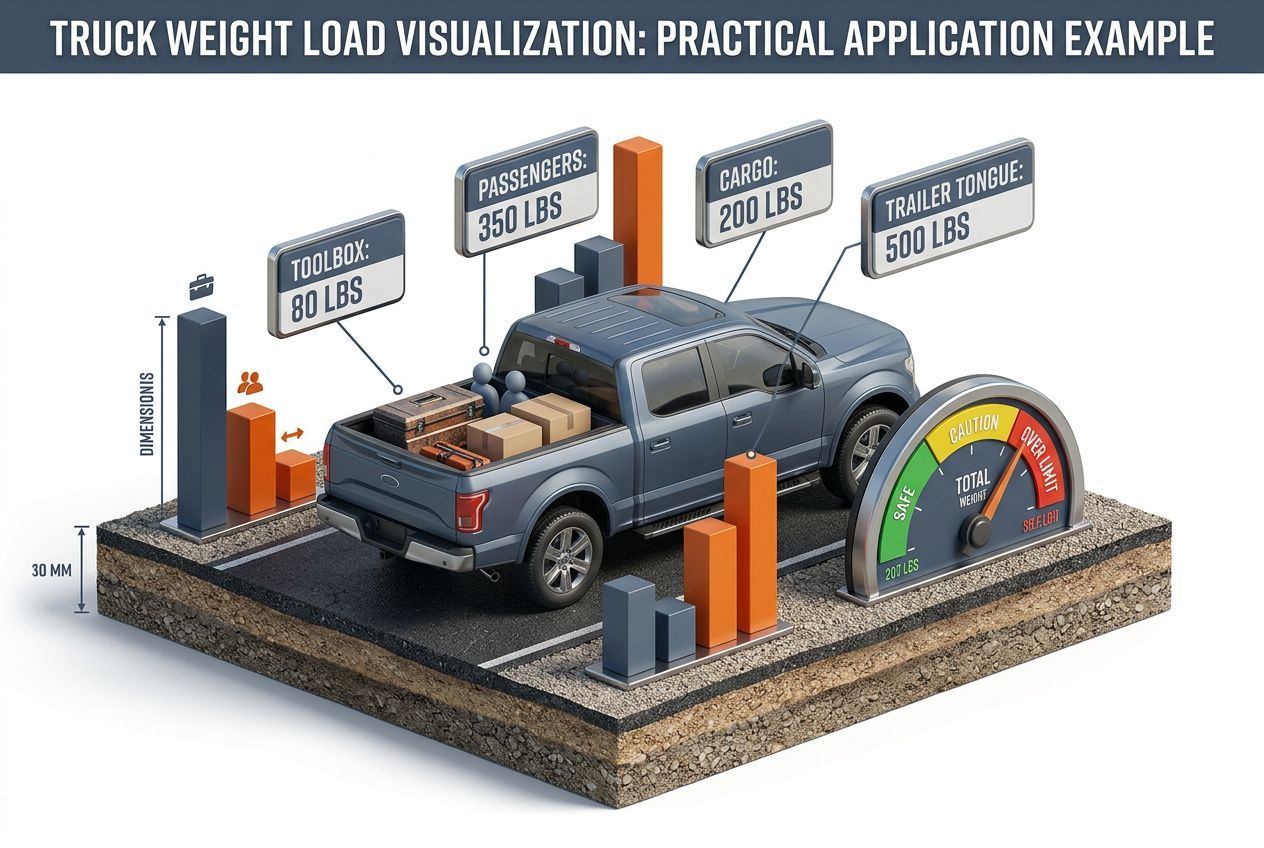
When pin weight exceeds your truck's payload capacity, the rear axle becomes overloaded while the front axle unloads. Less contact pressure on the front tires means reduced steering response and longer stopping distances — exactly the wrong outcome when you're towing 14,000 lbs downhill.
This isn't theoretical. NHTSA's vehicle safety data consistently shows that overloaded rear axles contribute to loss-of-control events, particularly in emergency braking and evasive maneuver scenarios.
The consequences compound beyond handling:
- Warranty Issues: Ford, GM, and RAM all explicitly void drivetrain and suspension warranty coverage for damage resulting from operation beyond GVWR or payload ratings.
- FMCSA Regulations: For applicable vehicles, FMCSA weight violations at roadside inspections carry fines of $100–$500+ per offense. Commercial operators face steeper penalties and out-of-service orders.
- Accelerated Mechanical Wear: Overloaded rear springs, shock absorbers, and wheel bearings wear at an accelerated rate. You'll feel it in ride quality long before you see it in maintenance bills.
A ½-ton truck pulling a large 5th wheel is the most common overload scenario. The risks of an overloaded truck go well beyond a ticket — if something goes wrong mechanically, your insurance carrier will pull the weight records.
⚠️ Warning: Being over-capacity at time of loss is grounds for claim denial.
✅ Pro Tip: The fix is usually a truck upgrade. If your loaded 5th wheel pin weight is hitting 3,000 lbs, a ½-ton is not your truck. A ¾-ton minimum — F-250, Silverado 2500HD, or RAM 2500 — is where 5th wheel towing belongs for most trailers in that weight class.
🚛
TRAILER & PAYLOAD
How Does Gooseneck Pin Weight Differ from 5th Wheel Pin Weight?
Gooseneck pin weight functions identically to 5th wheel pin weight in terms of physics — it's the vertical downward load on the truck — but the connection hardware is different. A gooseneck trailer uses a ball-and-coupler system: a 2⁵⁄₁₆-inch gooseneck ball mounted in the truck bed, with the trailer's gooseneck loop dropping over it. A 5th wheel uses a kingpin locking into a hitch plate.
Duty Cycle and Ratings
Gooseneck setups are common in heavy-duty agricultural, livestock, and flatbed applications. Because of that duty cycle, gooseneck pin weight percentages often run at the higher end of the range — 20–25% of GTW — and the trailers themselves can push 30,000–40,000 lbs loaded. That demands a 1-ton dually as a minimum tow vehicle.
The 5th wheel vs. gooseneck comparison covers the hitch differences in detail, including bed clearance requirements and turning radius tradeoffs.
📊 Quick Fact: One practical difference: gooseneck hitches are rated separately from 5th wheel hitches. A B&W Turnoverball gooseneck hitch, for example, is rated at 30,000-lb GTW and 7,500-lb pin weight — far beyond any Class V 5th wheel hitch on the market. Verify your hitch's pin weight rating (stamped on the receiver or shank) against your actual measured pin weight before any loaded trip.
💡 Key Takeaway: The same payload math applies. Pin weight on a gooseneck counts against your truck's rated payload and rear-axle weight rating. A truck bed weight capacity that seems generous on paper disappears fast once you factor in the gooseneck hitch hardware, toolbox, and a 4,500-lb pin weight from a loaded livestock trailer.