📊
TRUCK TOWING CAPACITY
What Is the Maximum Towing Capacity of a 2017 RAM 1500?
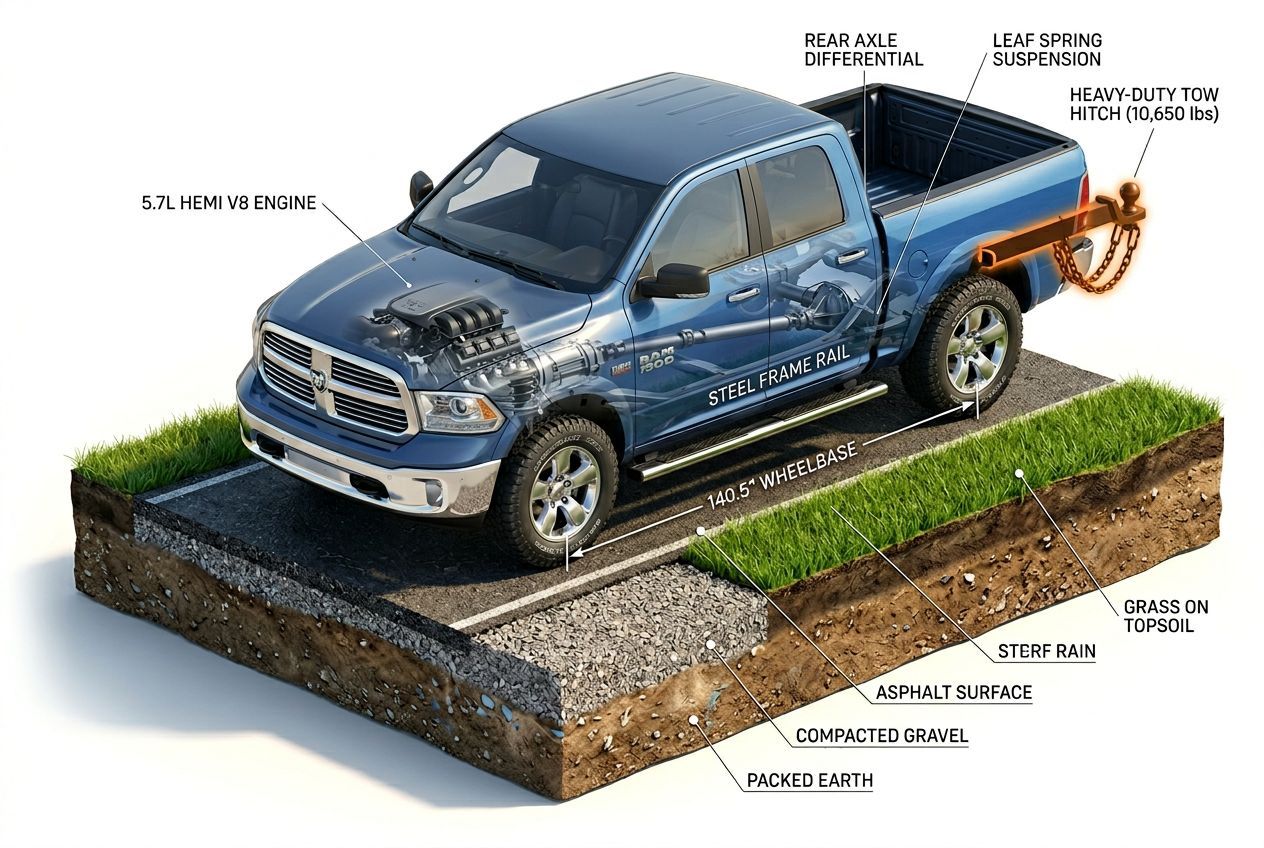
The Max Rating: The 2017 RAM 1500's maximum conventional towing capacity is 10,620 pounds, achieved with the 5.7L HEMI V8, 3.92 rear axle ratio, Regular Cab body, and the Max Tow Package on a 4x2 drivetrain. That figure drops meaningfully with different cab sizes, axle ratios, or the absence of the tow package — often by 1,000 to 3,000 pounds.
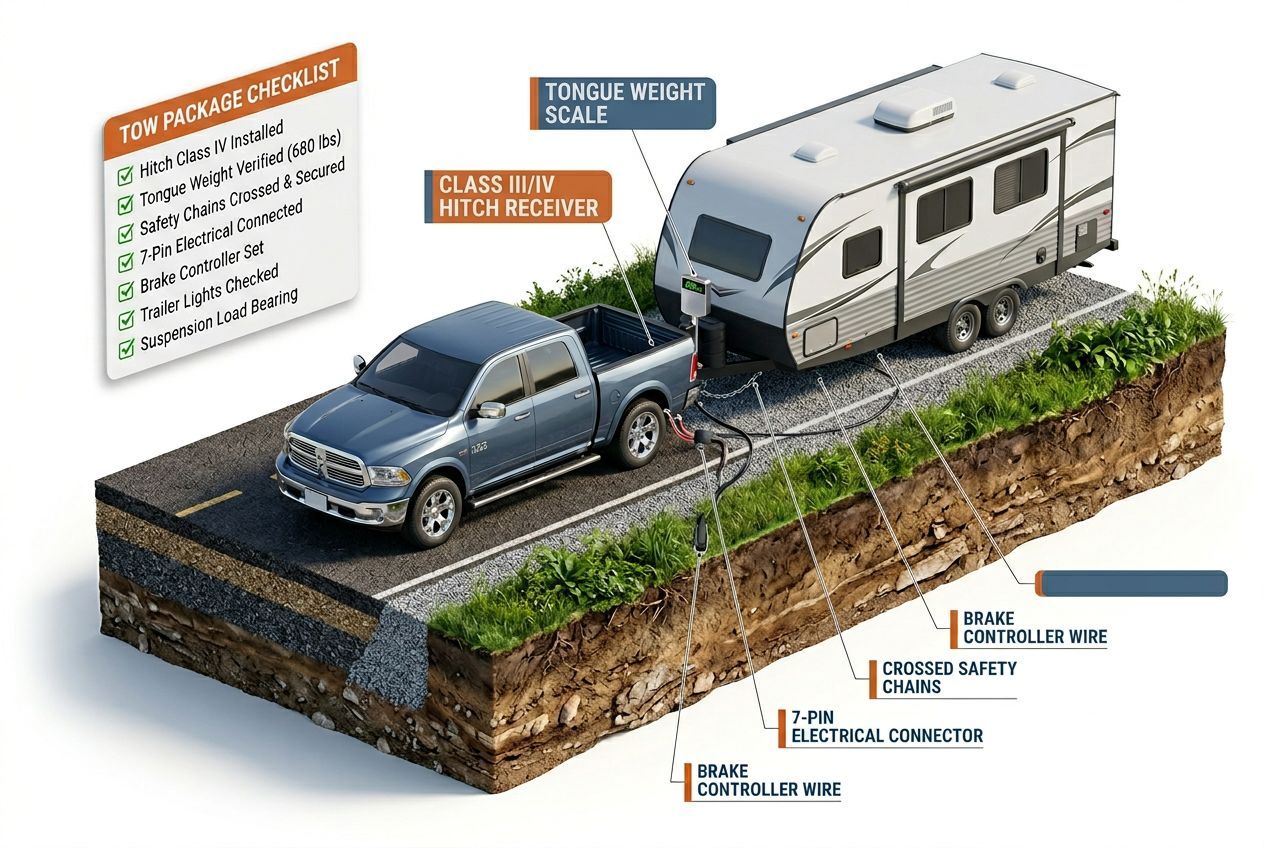
The Max Tow Package: To hit 10,620 lbs, your truck needs the factory Max Tow Package (sales code TRW). This crucial package includes several enhancements to ensure safe and capable towing:
- Class IV receiver hitch
- Integrated trailer brake controller
- 7-pin/4-pin wiring harness
- Full-size spare tire upgrade
- Upgraded 180-amp alternator
✅ Pro Tip: Without the TRW package, even with the same engine and axle combination, RAM's published capacity tables rate the truck lower. Always verify the presence of the Max Tow Package if you're aiming for the highest tow ratings.
The GCWR (Gross Combined Weight Rating) on a maxed-out 2017 RAM 1500 reaches approximately 16,000 lbs. That's the ceiling for combined truck weight plus loaded trailer. If you're not sure what GCWR means for your setup, our GCWR explainer breaks it down clearly. For a side-by-side comparison of what each half-ton truck can realistically pull, the half-ton truck towing capacity guide is worth a read.
🔧
TRUCK TOWING CAPACITY
How Much Can a 2017 RAM 1500 With a 5.7 Hemi Tow?
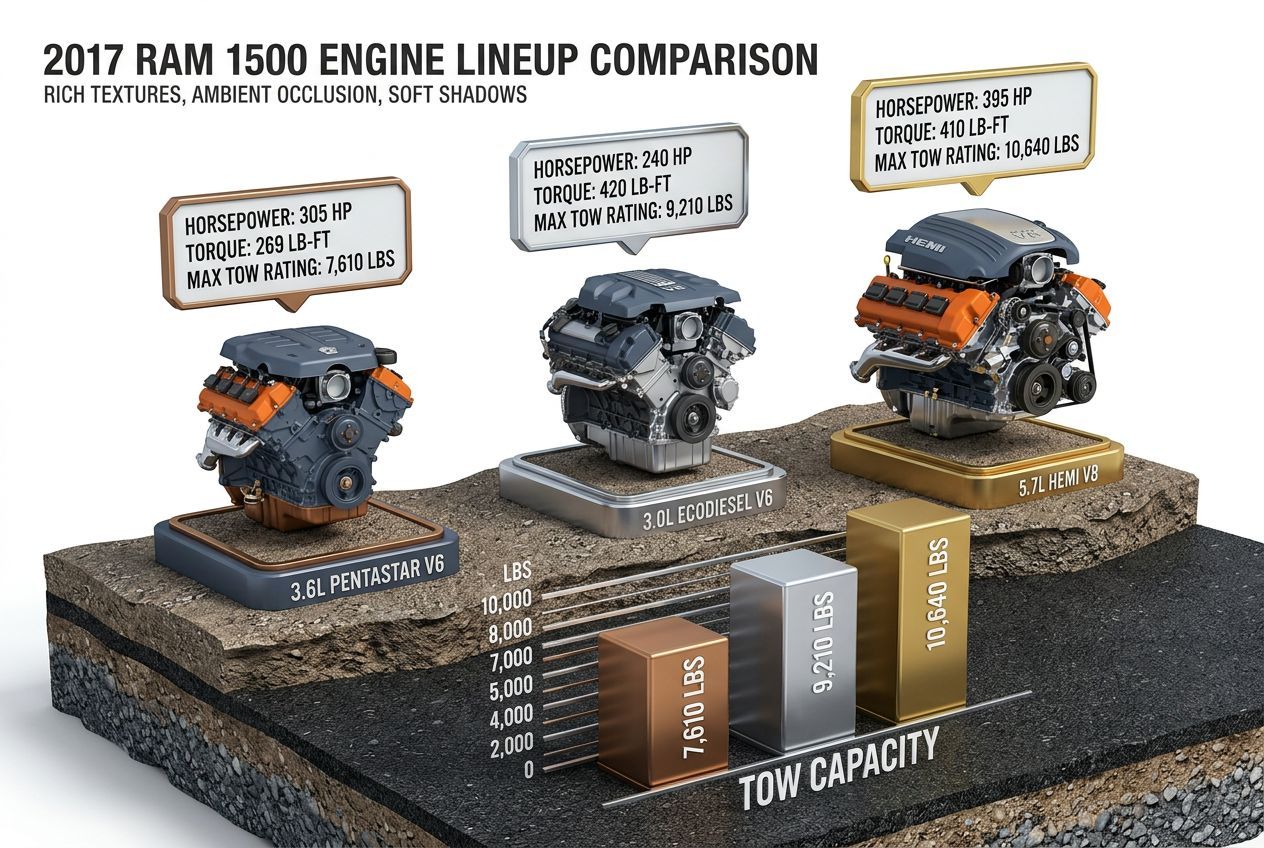
Hemi Power: The 2017 RAM 1500 5.7L HEMI V8 tows between 7,610 and 10,620 pounds depending on configuration, making it the most capable engine available in this truck that year. At 395 horsepower and 410 lb-ft of torque, it's the right choice if you're regularly pulling trailers over 7,000 pounds — anything from a loaded car hauler to a larger travel trailer.
Transmission & Maintenance: The HEMI pairs with RAM's 8-speed TorqueFlite transmission (either the 8HP70 or 8HP75 depending on the build).
- Tow-Haul Mode on this transmission adjusts shift points to keep the engine in its power band on grades and prevents the hunting between gears that wears out transmissions prematurely.
- Before any extended towing season, change the transmission fluid — RAM specifies ATF+4 for the TorqueFlite.
⚠️ Warning: Towing near max capacity with degraded transmission fluid is the primary cause of transmission failure in trucks this age. Regular fluid changes are critical for longevity.
📊 Quick Fact: The 5.7L HEMI delivers a robust 395 horsepower and 410 lb-ft of torque, making it ideal for substantial towing tasks.
Payload is King:
Worked Example: The Fifth-Wheel Dilemma
Say you're towing a 9,500-lb fifth-wheel camper. Pin weight on a fifth-wheel runs 20–25% of trailer weight, so roughly 1,900–2,375 lbs. Now, add your truck's occupants and gear:
- Driver: 200 lbs
- Passenger: 160 lbs
- Gear in cab: 150 lbs
- Total additional weight (excluding pin weight): 510 lbs
Combining these: The pin weight (1,900-2,375 lbs) plus the additional weight (510 lbs) equals roughly 2,410 to 2,885 lbs against a maximum payload rating of 1,880 lbs.
Conclusion: You're over payload before you've added fuel or anything into the camper itself! This truck simply cannot safely handle a 9,500-lb fifth-wheel.
💡 Key Takeaway: Even if technically "within tow rating," a 9,500-lb fifth-wheel often requires a 3/4-ton truck like a RAM 2500 due to significant pin weight and the RAM 1500's payload limitations.
🛡️
TRUCK TOWING CAPACITY
What Is the Towing Capacity of a 2017 RAM 1500 EcoDiesel?
EcoDiesel Performance: The 2017 RAM 1500 3.0L EcoDiesel V6 turbodiesel tows between 7,640 and 9,210 pounds, pairing 240 horsepower and 420 lb-ft of torque with the 8-speed TorqueFlite. The torque advantage over the base V6 is real — 420 lb-ft at relatively low RPM means the EcoDiesel pulls steadily from a stop and holds speed on grades better than the Pentastar at equivalent loads.
💡 Key Takeaway: The EcoDiesel's 3.92 axle ratio is standard, simplifying configuration research for maximum towing capacity on used models.
Fuel Economy Advantage: Fuel economy during long-haul towing is where the EcoDiesel earns its premium.
- Per RAM's data and owner-reported figures cited by Edmunds, the EcoDiesel typically delivers 19–21 mpg highway when unloaded.
- This compares to 14–17 mpg for the HEMI.
- When towing a 7,000-lb trailer, expect a larger drop for both, but the diesel still comes out ahead over 500+ mile trips.
📊 Quick Fact: The 2017 EcoDiesel can offer significant fuel savings on long-distance towing trips compared to the HEMI, despite a lower maximum tow rating.
Important Recall Information:
⚠️ Warning: The EcoDiesel's 2017 vintage had a history of DEF system and software-related issues that resulted in multiple NHTSA recall notices. Before buying a used 2017 RAM 1500 EcoDiesel, run the VIN through NHTSA's recall database to confirm all recall work has been completed.
📋
TRUCK TOWING CAPACITY
Does the 2017 RAM 1500 3.6L V6 Have Enough Power to Tow?
Pentastar V6 Capability: The 3.6L Pentastar V6 supports a maximum towing capacity of 7,610 pounds, producing 305 horsepower and 269 lb-ft of torque. For many owners, this is enough — it handles a single-axle enclosed cargo trailer, a pontoon boat under 6,000 lbs, or a small travel trailer with reasonable margin.
High Altitude Performance: Where the V6 falls short is on sustained grades with loads above 5,000 lbs.
- At 6,000–7,000 lbs and 5,000 feet of elevation, naturally aspirated engines like the Pentastar V6 lose roughly 3% power per 1,000 feet of altitude.
- At 7,000 feet in Colorado or Wyoming, you're pulling with about 15% less effective power than the spec sheet suggests.
- The HEMI's additional torque cushion matters a lot in that scenario, while the EcoDiesel's turbocharger partially offsets altitude effects, giving it another practical edge in mountain terrain.
💡 Key Takeaway: For towing heavy loads in mountainous regions, the naturally aspirated V6 will experience more significant power loss compared to the HEMI V8 or turbocharged EcoDiesel.
Cost-Effective Choice: The Pentastar V6 does offer one real benefit: it's typically paired with a lower purchase price on the used market. If your heaviest load is a 16-foot bass boat at 3,500 lbs, you don't need the HEMI's capability, and you'll save money buying the V6 configuration.
⚙️
TRUCK TOWING CAPACITY
How Does Cab Size Affect 2017 RAM 1500 Towing Capacity?
Weight Impact: Cab configuration directly reduces 2017 RAM 1500 towing capacity because larger cabs add curb weight, which cuts into your available payload and lowers the published tow rating. The Regular Cab reaches the highest figures; the Crew Cab with a 5'7" bed sits at the bottom of the range for each engine.
Practical Implications: Here's what that means practically: a Crew Cab 4x4 with the 5.7L HEMI and 3.92 axle might be rated at 9,570 lbs — over 1,000 lbs less than the Regular Cab equivalent.
💡 Key Takeaway: For most buyers, the Crew Cab's back-seat utility is worth the trade-off in towing capacity. However, if you're right at the edge of what a half-ton can handle, cab choice matters significantly.
See the full towing and payload breakdown in our towing capacity vs. payload guide.
🚛
TRUCK TOWING CAPACITY
What Axle Ratio Do I Need for Maximum Towing in a 2017 RAM 1500?
The Optimal Ratio: The 3.92 rear axle ratio is required to hit maximum towing capacity figures in the 2017 RAM 1500, regardless of engine. This ratio gives the drivetrain greater mechanical advantage when pulling heavy loads from a stop, climbing grades, or recovering on a boat ramp. The 3.21 and 3.55 options reduce tow ratings by 1,000 to 3,000 pounds and are better suited for highway commuting with light trailer work.
✅ Pro Tip: To find the axle ratio on a used 2017 RAM 1500, check the door-jamb sticker on the driver's side B-pillar — it lists the axle code. You can also pull the door sticker's broadcast sheet code: "DFF" indicates the 3.92 axle. Cross-reference this with the Trailer Towing Supplement, which RAM published separately from the standard owner's manual for this generation.
If you want to see how axle ratio interacts with towing capacity across the full RAM 1500 lineup, the RAM 1500 towing capacity hub covers all model years in detail.
📝
TRUCK TOWING CAPACITY
What Payload Can a 2017 RAM 1500 Carry While Towing?
Understanding Payload: The 2017 RAM 1500 carries a maximum payload of 1,880 pounds, but tongue weight from your trailer counts directly against that number. For a conventional trailer, tongue weight runs 10–15% of total trailer weight. Exceed your payload rating — even if you're under the tow rating — and you've created an unsafe, overloaded truck.
Worked Example: Travel Trailer Payload Calculation
You're towing a 7,000-lb travel trailer.
- Tongue weight at 12% is 840 lbs.
- Add a driver (200 lbs)
- Two passengers (340 lbs combined)
- A full tank of fuel (~180 lbs)
- 150 lbs of gear in the bed
Total Payload Used: 840 (tongue) + 200 (driver) + 340 (passengers) + 180 (fuel) + 150 (gear) = 1,710 lbs.
Conclusion: You're at 91% of a 1,880-lb maximum payload rating before you've packed a single bag inside the trailer! There's essentially no margin left. This is how owners unknowingly overload trucks that are technically "within tow rating."
⚠️ Warning: Always prioritize your truck's payload rating. Exceeding payload, even when within the tow rating, leads to unsafe handling, reduced braking performance, and potential damage to your vehicle.
✅ Pro Tip: The payload rating is stamped on the yellow load limit sticker inside the driver's door jamb — not in the owner's manual, not online. That sticker reflects your specific truck's build, not the model average. Use our payload calculator to run your numbers before you load up.
For a deeper look at how payload and towing capacity interact — and why tow rating alone doesn't tell the full story — our towing capacity vs. payload guide walks through the math step by step.

💰
TRUCK TOWING CAPACITY
2017 RAM 1500 Towing Capacity by Engine and Configuration
2017 RAM 1500 Towing Capacity by Engine and Configuration — data table
| Engine |
Max Horsepower / Torque |
Best Axle Ratio |
Max Tow Capacity |
Notes |
| 3.6L Pentastar V6 |
305 hp / 269 lb-ft |
3.55 |
7,610 lbs |
Entry-level; adequate for boats and light campers |
| 5.7L HEMI V8 |
395 hp / 410 lb-ft |
3.92 |
10,620 lbs |
Regular Cab 4x2 w/ Max Tow Package required for peak figure |
| 3.0L EcoDiesel V6 |
240 hp / 420 lb-ft |
3.92 (standard) |
9,210 lbs |
Diesel torque advantage; check NHTSA for open recalls |
| 5.7L HEMI V8 (4x4, Crew Cab) |
395 hp / 410 lb-ft |
3.92 |
~9,570 lbs |
Typical real-world spec for most Crew Cab buyers |
Source: RAM Trucks Trailer Towing Guide 2017, cross-referenced with Edmunds vehicle specifications.
📊
TRUCK TOWING CAPACITY
What Won't the 2017 RAM 1500 Do?
Know Your Limits: The 2017 RAM 1500's 10,620-lb ceiling is firm. If your loaded fifth-wheel, heavy equipment trailer, or large boat exceeds that number, this isn't your truck — and the margin disappears fast when you account for payload, passengers, and gear.
⚠️ Warning: A loaded 10,000-lb fifth-wheel with 2,000 lbs of pin weight, two passengers, and standard gear will push you over payload in nearly every 2017 RAM 1500 configuration. You need a 3/4-ton truck minimum — a RAM 2500, Chevy Silverado 2500HD, or Ford F-250 — for that duty cycle.
Our how to find towing capacity guide explains how to read GCWR, GVWR, and payload together so you can accurately assess any truck.
If you're comparing the 2017 RAM 1500 against what came just after it, the 2018 RAM 1500 carried similar specs before the all-new fifth generation arrived for 2019.

