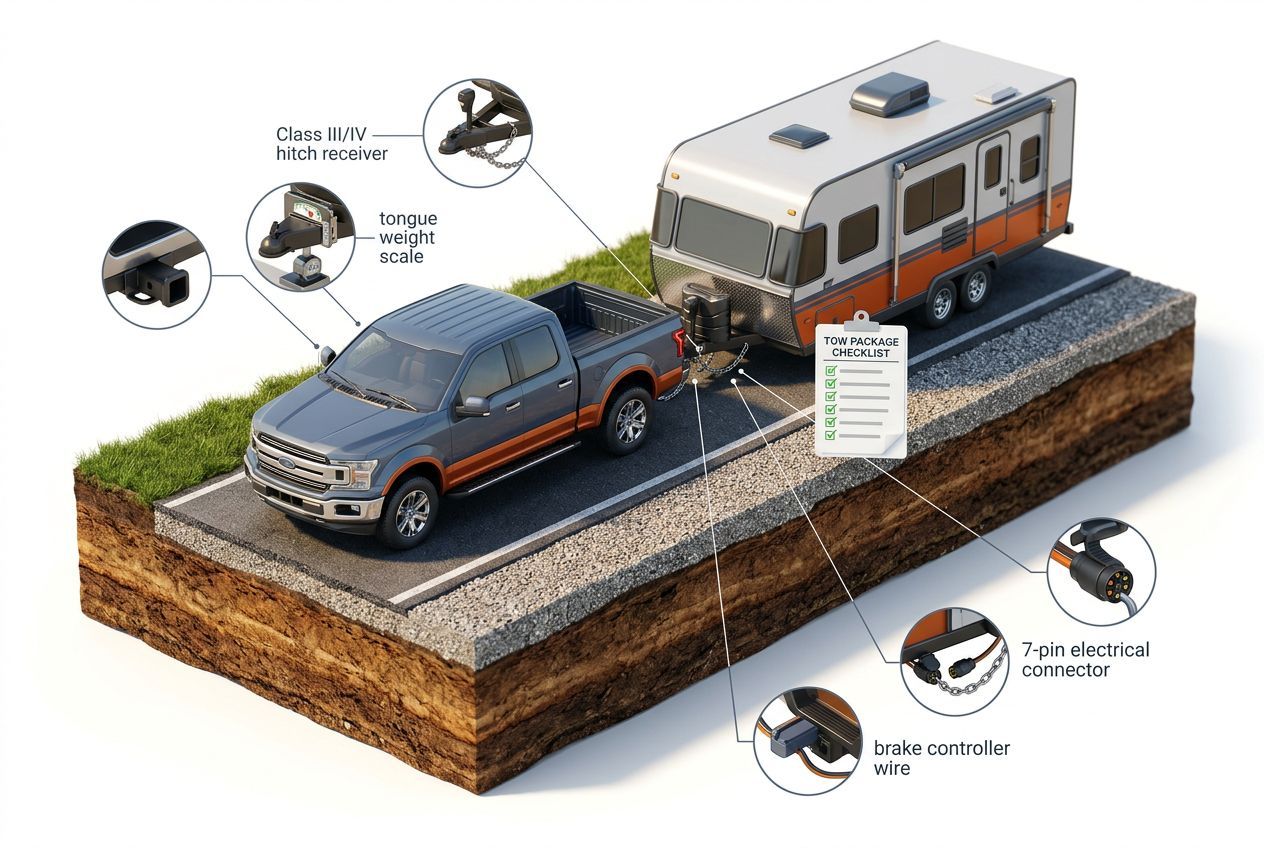
- Always use your camper's loaded weight — not dry weight — when matching it to a truck. Water, gear, and supplies add 1,000–2,500 lbs.
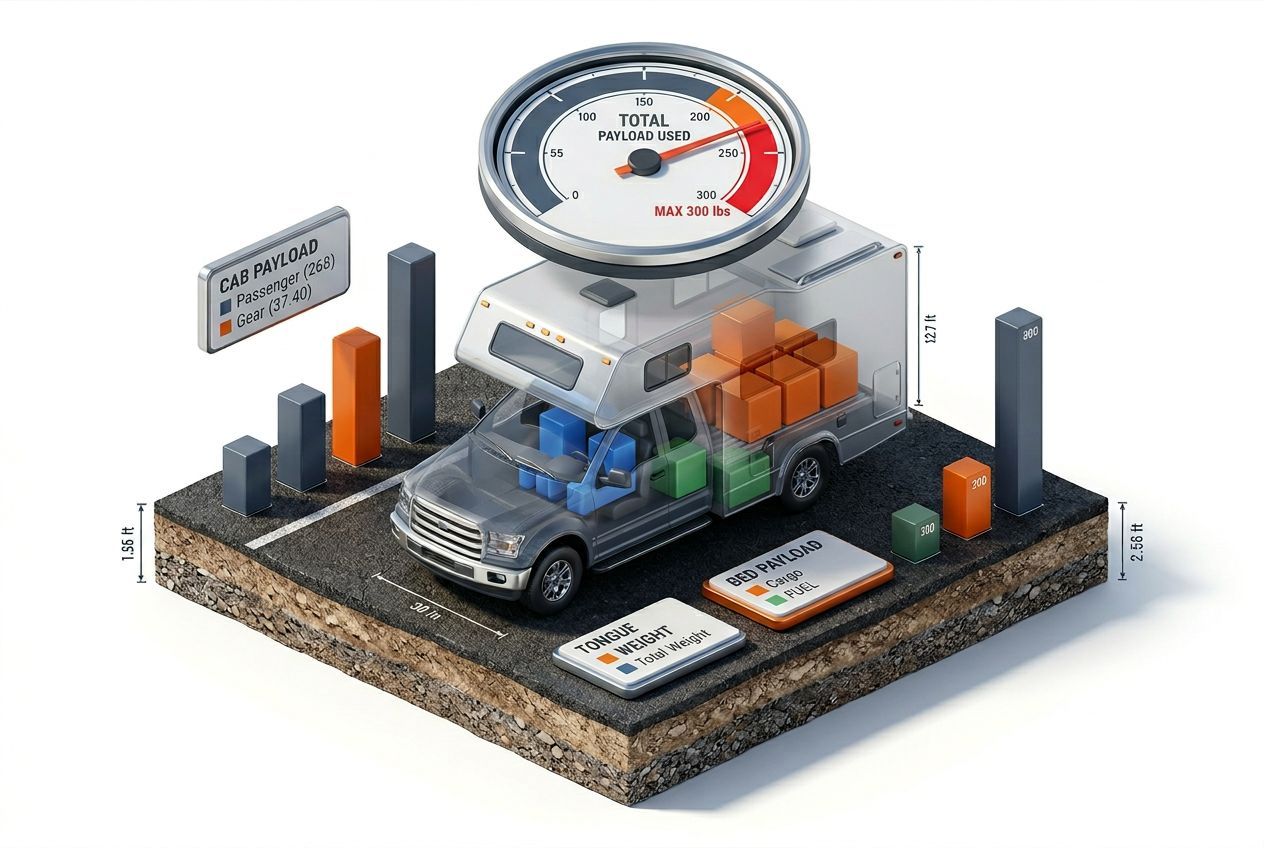
- Payload capacity is often the binding constraint before tow rating. Tongue weight alone can eat 600–1,000 lbs of your truck's payload.
- Half-tons handle most travel trailers up to 8,000 lbs; fifth wheels and large rigs demand a 3/4-ton or one-ton platform.
- Never exceed any single rating — tow rating, payload, or GCWR. Overloading one while staying under the others still creates unsafe conditions.
- A factory trailer tow package is required for published max ratings to apply — aftermarket add-ons don't substitute.
What Size Truck Do I Need to Pull a Camper?
Matching your truck to your camper's true weight is vital. The size truck you need to pull a camper depends entirely on the camper's loaded GVWR, not its dry weight. Lightweight pop-up campers under 3,500 lbs can be managed by a midsize truck like a Toyota Tacoma or Chevy Colorado. Travel trailers from 4,000–8,000 lbs need a properly equipped half-ton. Anything above 10,000 lbs loaded demands a 3/4-ton or one-ton.
💡 Key Takeaway: Always account for all added weight. A 26-foot travel trailer might list a dry weight of 5,800 lbs, but once you've filled the fresh water tank (40 gallons = 334 lbs), loaded camping gear, clothes, food, and a full propane tank, you're easily at 7,200–7,500 lbs. That's the crucial number for matching your truck.
Consider the margin for safety. A midsize truck like the Toyota Tacoma tops out around 6,800 lbs tow capacity (per Toyota's official towing guide) — fine for a small travel trailer, but tight on margin at 7,200 lbs loaded. You'd want a half-ton minimum for that rig, and ideally one with a max-tow package and the right axle ratio.
Our full camper towing capacity guide breaks down specific models and configurations if you want to get deeper into the numbers.
How Do I Calculate Camper Towing Capacity for My Truck?
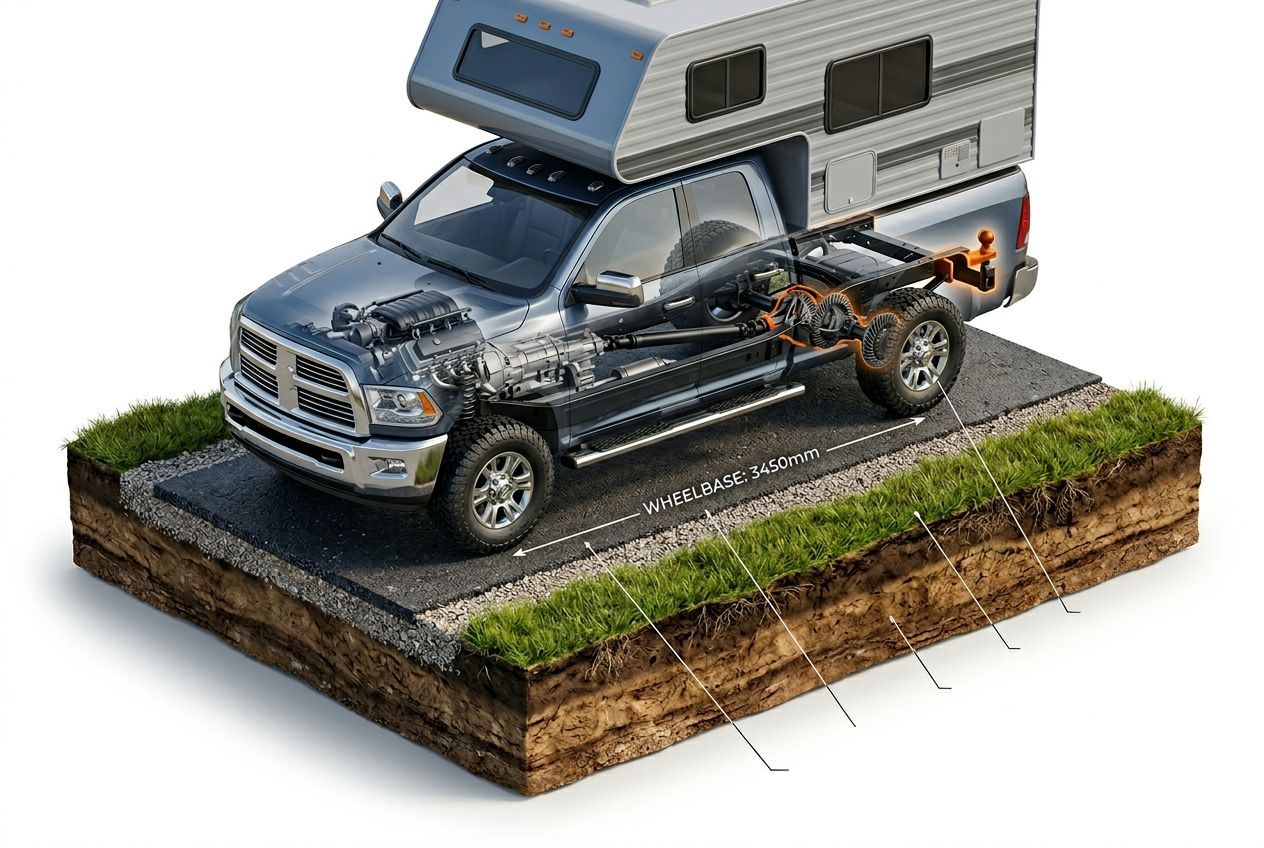
Calculating your true towing capacity involves several factors. You calculate your effective tow capacity by subtracting your truck's curb weight, passenger and cargo weight, and tongue weight from its Gross Combined Weight Rating (GCWR). The result is the maximum trailer weight you can safely pull. Your door-jamb sticker and the Trailer Towing Supplement — published separately by manufacturers like Ford and RAM — list all three ratings.
Understanding the Numbers: A Worked Example
Here's a worked example with real numbers to illustrate the process:
Scenario: A 2024 Ford F-150 with a 3.5L PowerBoost hybrid engine.
- GCWR: 22,000 lbs
- Truck Curb Weight: ~5,200 lbs
Added Weight (Truck-side):
- Driver + passenger: 370 lbs
- Gear in the cab and bed: 150 lbs
- Tongue weight from a 7,000-lb trailer at 13%: 910 lbs
- Total Truck-Side Load: 6,630 lbs
Calculation:
- Subtract the truck-side load from the GCWR: 22,000 lbs - 6,630 lbs = 15,370 lbs of remaining trailer capacity. This appears well above the 7,000-lb trailer.
⚠️ Warning: Don't just look at the tow rating! In this example, while the GCWR looks sufficient, the F-150's payload rating on the door-jamb sticker might be 1,800 lbs. Your tongue weight (910 lbs) plus passengers and gear (520 lbs) totals 1,430 lbs — you're at 79% of payload before you even load anything extra in the bed. Payload is often the binding constraint, not the tow rating.
Finding Your Truck's Ratings: Check the door-jamb sticker on your driver's side B-pillar. It lists GVWR, GAWR (axle ratings), and payload. Then pull the Trailer Towing Supplement for your exact engine/axle combination — Ford, GM, and RAM all publish these as separate PDFs from the owner's manual. Use our payload calculator to run your specific numbers.
Can a Half-Ton Truck Tow a Travel Trailer?
Most half-ton trucks are capable of towing travel trailers. A half-ton truck can absolutely tow most travel trailers between 4,000 and 8,000 lbs — but only when properly configured with the factory trailer tow package. The 2024 Ford F-150 tops out at 13,500 lbs, the Silverado 1500 at 13,300 lbs, and the Ram 1500 at 12,750 lbs (per manufacturer towing guides). Payload capacity, not tow rating, is usually the first limit you'll hit.
⚠️ Warning: Max advertised tow ratings require specific configurations. Those headline tow ratings require very specific setups — usually the max-tow package (option code 53C on recent Ford F-150s, Z82 on GM), the heavy-duty payload package, a specific rear axle ratio (typically 3.73 or 4.10), and the right cab/bed combination. A base-trim F-150 with a 3.31 axle ratio and crew cab long bed isn't towing 13,500 lbs safely — you might be limited to 9,000 lbs in that configuration. Verify your exact build's rating in the Trailer Towing Supplement, not just the max advertised number.
Consider environmental factors. For a travel trailer around 6,500 lbs loaded, a properly equipped half-ton works well on flat to rolling terrain. At altitude — say, heading into Colorado above 7,000 feet — naturally aspirated engines lose roughly 3% power per 1,000 feet of elevation gain. That same F-150 EcoBoost loses some boost efficiency in thin air. You'll feel it on steep grades. See our towing in mountains guide for strategies that help.
Enhance stability with a Weight Distribution Hitch (WDH). Weight distribution hitches are recommended by hitch manufacturers when your trailer exceeds roughly 50% of your truck's weight. For a 6,500-lb trailer behind a 5,200-lb F-150, that threshold is crossed — a Reese Pro Weight Distribution Hitch or Equal-i-zer 4-Point system will improve handling and reduce rear-end squat significantly.
What Is the Difference Between GVWR, GCWR, and Payload for Towing?
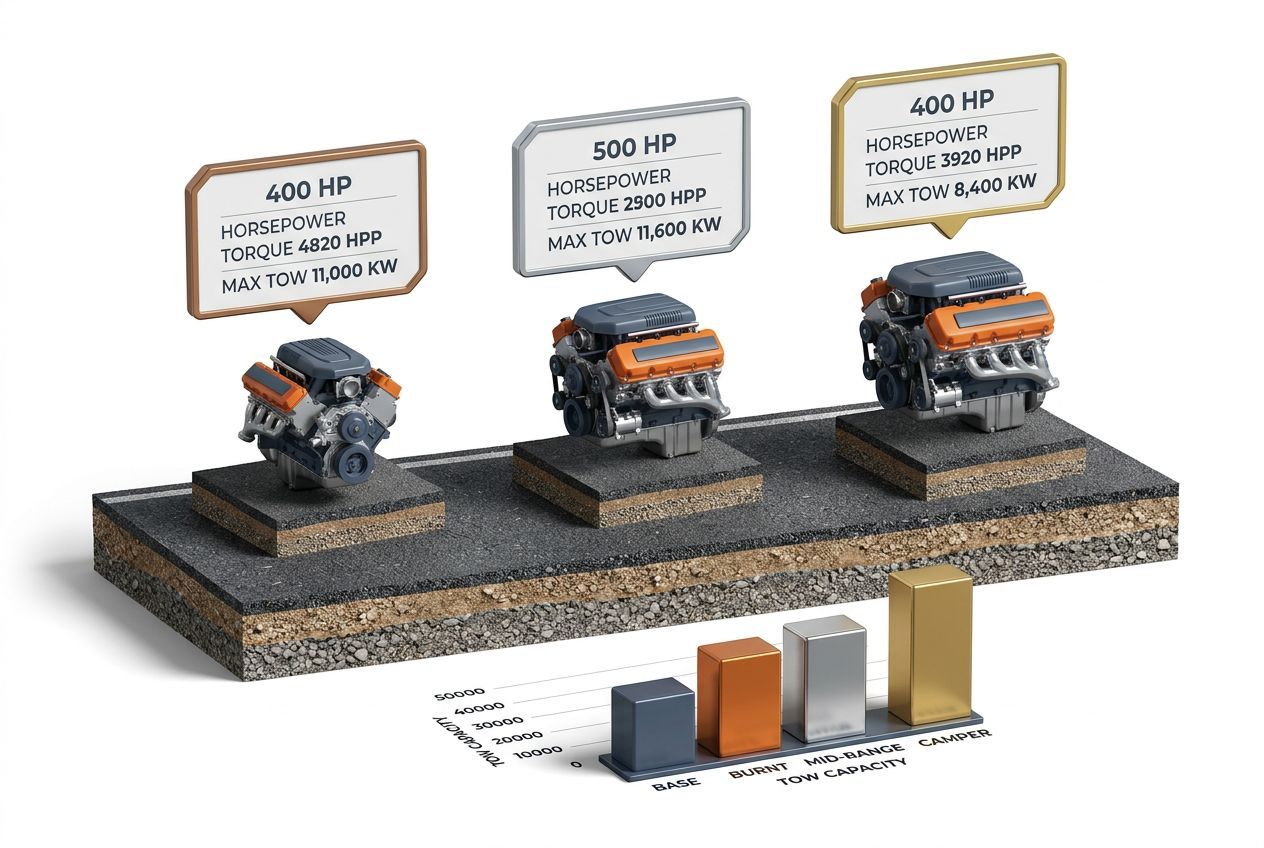
These three ratings are distinct and equally critical for safe towing. GVWR is the maximum the truck itself can weigh when fully loaded with people, cargo, and fuel. GCWR is the combined maximum weight of the truck plus trailer. Payload is the weight the truck can carry in its cab and bed, including tongue weight from the hitch. Camper towing requirements mean you must stay inside all three limits simultaneously — not just one.
Why all three matter: A truck might have a 12,000-lb tow rating and a 15,000-lb GCWR — looks fine on paper. But its payload is only 1,400 lbs. A 10,000-lb trailer with 13% tongue weight puts 1,300 lbs on the hitch. Add two passengers (350 lbs) and some gear (150 lbs) and you're at 1,800 lbs — 400 lbs over payload. The truck is technically overloaded even though the tow rating appears sufficient. Per NHTSA guidance, overloading payload creates stopping distance issues and increases rollover risk.
Our towing capacity guide has a full breakdown of all weight ratings and how they interact.
What Truck Do You Need to Tow a Fifth Wheel Camper?
Fifth wheel campers require heavy-duty trucks. Fifth wheel campers typically weigh 12,000–18,000 lbs loaded, and the minimum platform is a 3/4-ton truck — Ram 2500, Ford F-250, or Chevy Silverado 2500HD. Pin weight runs 15–25% of trailer weight, meaning 1,800–4,500 lbs lands directly on the truck's bed. That's why payload capacity, not just tow rating, is the critical spec for fifth wheel matching.
To use our RV and boat tow estimator, enter your truck and fifth wheel specs below — it'll flag whether you're within all three ratings.