Skip to content
🔗 DIY TOWING & FLAT TOWING

Flat Tow Compatible Vehicles: Complete 2026 List

Published · Updated · 21 min read
MarkUpdated May 11, 2026Ford Motor Company

💡 Key Takeaway: Only vehicles with manufacturer approval in the owner's manual are safe to flat tow — never assume by body style or drivetrain type alone.

✅ Pro Tip: The Jeep Wrangler, Jeep Gladiator, and Ford Bronco are the top-rated flat towable vehicles for ease of setup in 2026.

⚠️ Warning: Electric and most hybrid vehicles cannot be flat towed — regenerative braking and integrated drivetrains make four-down towing a transmission-killing mistake.

📊 Quick Fact: You'll need five pieces of equipment: tow bar, base plate, safety cables, supplemental braking system, and trailer lighting — budget $1,500–$3,500.

⚠️ Warning: Forty-seven states legally require a supplemental braking system when the towed vehicle exceeds a specified weight threshold — check your state before heading out.


💰
DIY TOWING & FLAT TOWING

What Vehicles Can Be Flat Towed Behind a Motorhome in 2026?

Last updated May 2026.

The most popular flat towable vehicles for 2026 include the Jeep Wrangler, Jeep Gladiator, Ford Bronco, Chevrolet Colorado, and GMC Canyon. These vehicles can be towed with all four wheels on the ground behind a motorhome without a supplemental braking system damaging the transmission. Always verify flat-tow compatibility in your owner's manual before towing.

Broad Availability: Over 60 vehicles from Jeep, Ford, Chevrolet, GMC, RAM, and Buick are manufacturer-approved for flat towing in 2026. The most popular models include the Jeep Wrangler, Jeep Gladiator, Ford Bronco, Chevrolet Colorado, and GMC Canyon. It's crucial to remember that approval depends on the specific trim and drivetrain — not just the model name.

Getting Started: You can start narrowing down your choices with our flat-tow-checker tool or browse our flat tow compatible vehicles guide for detailed setup notes on each model.

Here's a snapshot of the most popular flat towable vehicles for 2026, with their approximate curb weights and key setup requirements:

What Vehicles Can Be Flat Towed Behind a Motorhome in 2026? — data table
Vehicle Drivetrain Curb Weight Transfer Case Neutral? Notes
Jeep Wrangler (JL) 4WD 3,970–4,449 lbs Yes Lever-operated; easiest setup
Jeep Gladiator 4WD 4,650–4,850 lbs Yes Same NV241 transfer case as Wrangler
Ford Bronco (2-dr/4-dr) 4WD 4,422–4,922 lbs Yes Manual-T-case shift; no lube pump needed
Chevrolet Colorado (4WD) 4WD 4,342–4,619 lbs Yes Requires specific transfer case position
GMC Canyon (4WD) 4WD 4,355–4,630 lbs Yes Identical platform to Colorado

Source: Manufacturer owner's manuals and towing supplements (Ford, Chevrolet, GMC, Stellantis). Weights reflect base and max-optioned figures.

Sedans and Compacts: The sedan and compact segment has shrunk considerably. With the Chevrolet Spark and Honda Fit both discontinued, there are very few passenger cars left on the approved flat tow compatible vehicles list. Your best options in 2026 are purpose-built SUVs and trucks with part-time 4WD systems.
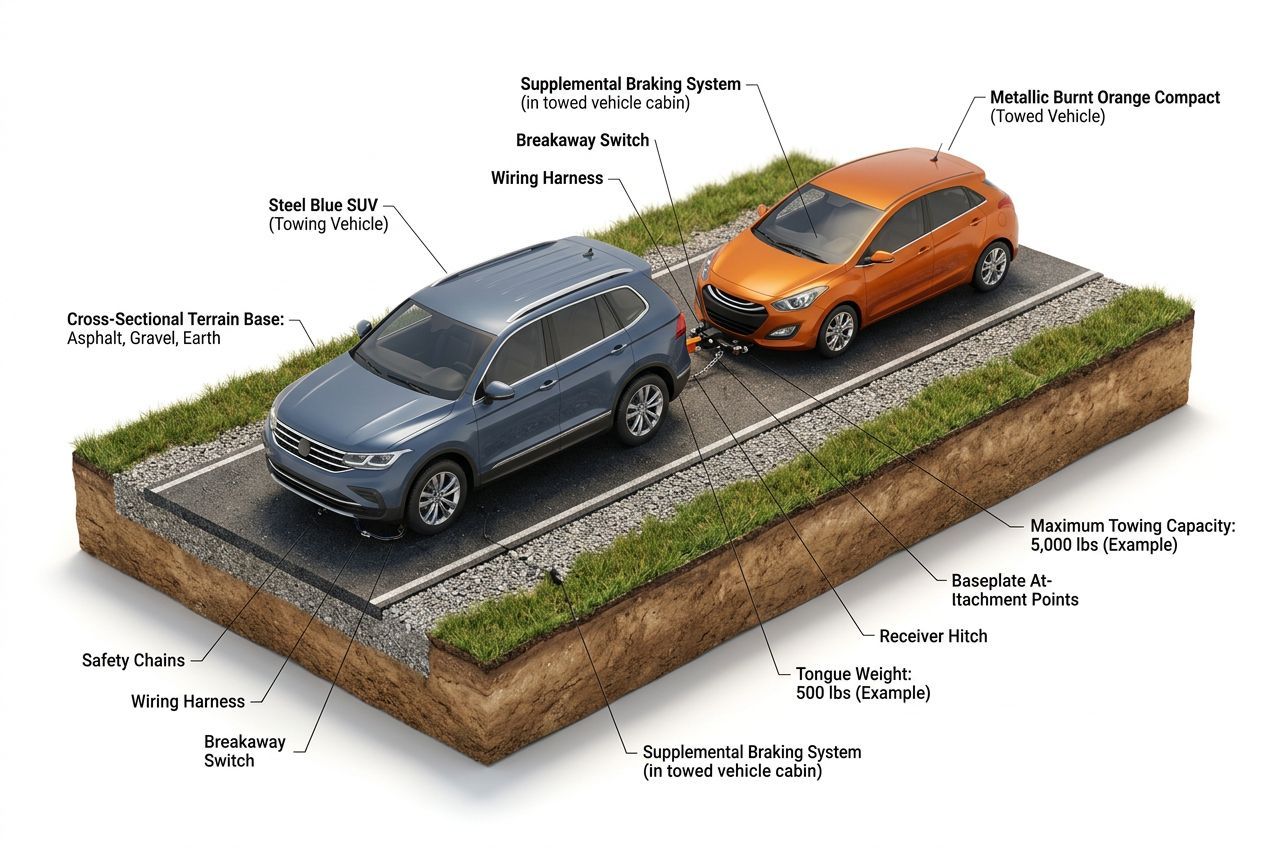

3D isometric diagram showing the flat tow compatible vehicles setup with labeled components
📊
DIY TOWING & FLAT TOWING

How Do You Know If a Vehicle Is Flat Tow Compatible?

Manufacturer Approval is Key: A vehicle is flat tow compatible only if the manufacturer explicitly approves four-down towing in that model's owner's manual — there's no shortcut. You must look for the "recreational towing" or "dinghy towing" section and match your exact model year, trim level, and drivetrain configuration.

Consulting Your Owner's Manual

Finding the Information: Pull out your owner's manual and search the index for "recreational vehicle towing" or "dinghy." If that section exists with clear instructions and speed limits, you're approved. If it doesn't exist — or says "not recommended" — stop there. You can also check the Trailer Towing Supplement, which manufacturers like Ford publish as a separate PDF on their official sites at ford.com.

Key Mechanical Features for Flat Towing

Essential Requirements: Two mechanical features make a vehicle eligible:

  1. A transfer case with a neutral (N) position: This disengages the drivetrain so the transmission doesn't spin without lubrication while you're rolling down the highway.
  2. A transmission-disconnect feature: Some newer automatics (like those in the Jeep Grand Cherokee) include a built-in lube pump that runs when the vehicle is towed, protecting the transmission without requiring the transfer case to be in neutral.

Shopping Used Vehicles

Verify Compatibility: If you're shopping used, cross-reference your VIN against the manufacturer's towing guide for that exact model year.

⚠️ Warning: A 2022 Jeep Grand Cherokee with the 4xe plug-in hybrid powertrain, for example, is not approved for flat towing — even though the standard Grand Cherokee is. Always check the specific trim and powertrain.


🔧
DIY TOWING & FLAT TOWING

What Is the Easiest Vehicle to Flat Tow?

The Jeep Wrangler's Simplicity: The Jeep Wrangler is widely considered the easiest flat towable vehicle because nearly every trim and drivetrain combination is factory-approved, and the setup takes under five minutes. The procedure is straightforward: shift the NV241 transfer case into 4H, then into N, put the transmission in Park, release the parking brake, and you're done — no special tools or electronic overrides required.

Other Easy Options: The Jeep Gladiator uses the same transfer case and follows an identical procedure. The Ford Bronco flat tow setup is equally straightforward — its part-time transfer case shifts to N with a simple lever, and Ford explicitly approves it in the owner's manual for both 2-door and 4-door configurations.

✅ Pro Tip: For RVers logging heavy miles, that simplicity matters. Every time you make a campsite stop, you're reconnecting and disconnecting the tow bar, re-engaging the transfer case, and cycling the ignition. A vehicle that takes 30 seconds to prep beats one that requires a six-step electronic sequence every single time.

One honest limitation: The Wrangler's aerodynamics aren't great, and at freeway speeds behind a Class A, it acts like a sail. You'll feel it in fuel consumption — expect a 10–15% drop in MPG for the motorhome compared to towing a lighter, slipperier vehicle like a Buick Encore GX.
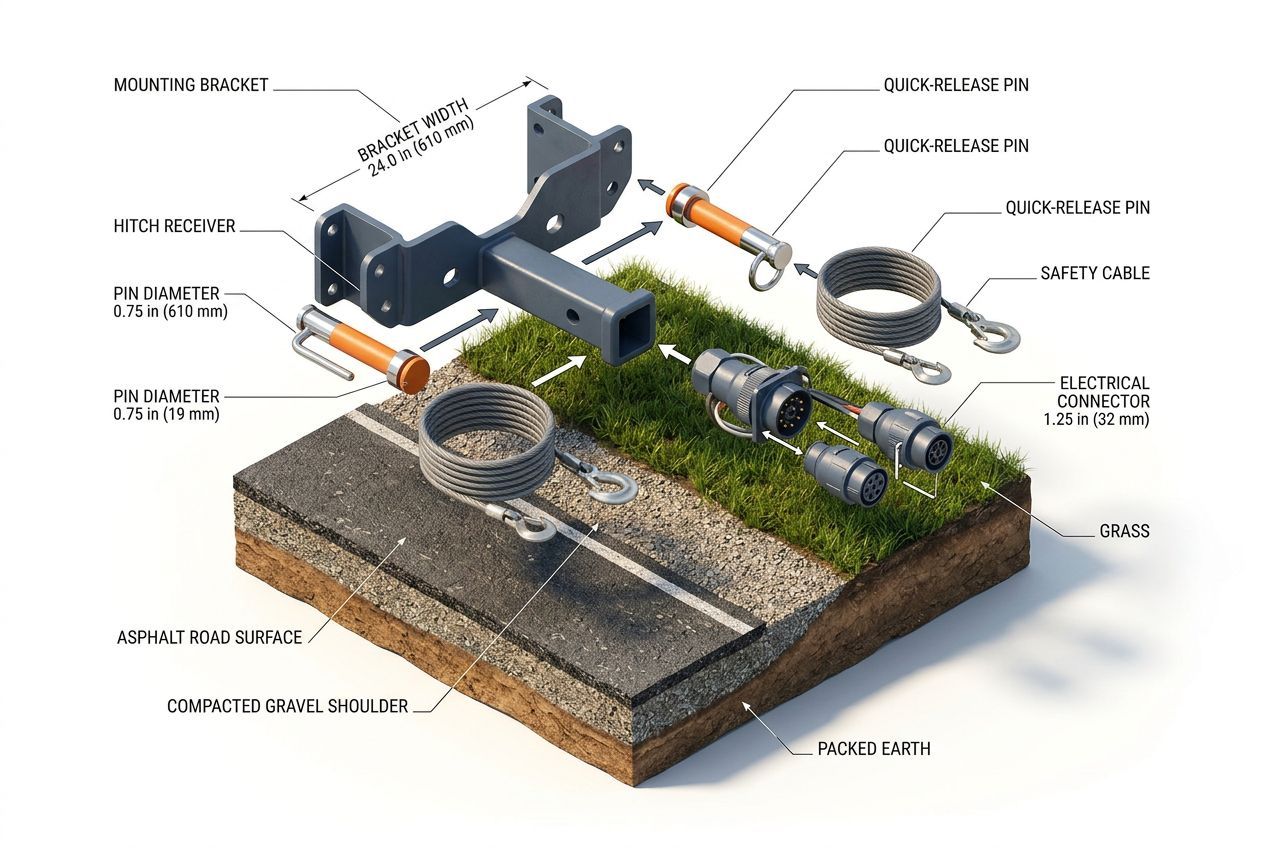

3D exploded view of towing connection hardware and assembly
🛡️
DIY TOWING & FLAT TOWING

Can You Flat Tow an Automatic Transmission Vehicle?

Conditional Approval: Yes — but only specific models with manufacturer approval. Automatic transmission vehicles need either a transfer case in neutral (which fully disengages the transmission) or a factory-installed auxiliary transmission lube pump to protect internal components during towing.

The Risk of Damage: Here's what goes wrong without that protection: automatic transmission fluid is pressurized by an internal pump driven by the engine. When the engine is off and the driveshaft is spinning — exactly what happens during flat towing — there's zero pressure, zero lubrication, and metal-on-metal contact.

⚠️ Warning: According to manufacturer technical bulletins reviewed by Edmunds, transmission damage can occur in as few as 5–15 miles on an unapproved automatic vehicle.

Approved Automatic Systems: The Jeep Grand Cherokee (non-4xe) is a common approved automatic. Its Quadra-Trac transfer case shifts to neutral, fully disconnecting the transmission from the drivetrain. The Chevrolet Equinox 2.0T with AWD uses a different approach — an electronic disconnecting rear axle that effectively eliminates driveshaft rotation. Both are factory-approved in writing.

Further Details: If you want more detail on protecting your automatic during towing, our towing with automatic transmission guide walks through exactly how lube pumps and electronic disconnects work.


📋
DIY TOWING & FLAT TOWING

Which Vehicles Can Be Flat Towed in 2026?

Flat Tow Checker Tool: Use the tool below to check your specific year, make, model, and drivetrain against the current approved list. It pulls directly from manufacturer towing supplements and is updated each quarter as new approvals are published.
Try Our Free Flat Tow Compatibility Checker

Categories to Consider: A few categories are worth calling out before you search:

  • Electric vehicles (EVs): Almost universally not approved. Regenerative braking requires the motor to spin when wheels roll — flat towing creates uncontrolled current generation that can damage motor windings and battery management systems. As of 2026, no major EV manufacturer approves four-down towing.
  • Plug-in hybrids (PHEVs): Same story. The Jeep Grand Cherokee 4xe and Ford Escape PHEV are both explicitly excluded from flat towing in their owner's manuals.
  • Front-wheel-drive vehicles (FWD): Most FWD-only vehicles lack a transfer case and can't disconnect the transaxle during towing. A tow dolly is a better solution for FWD cars.

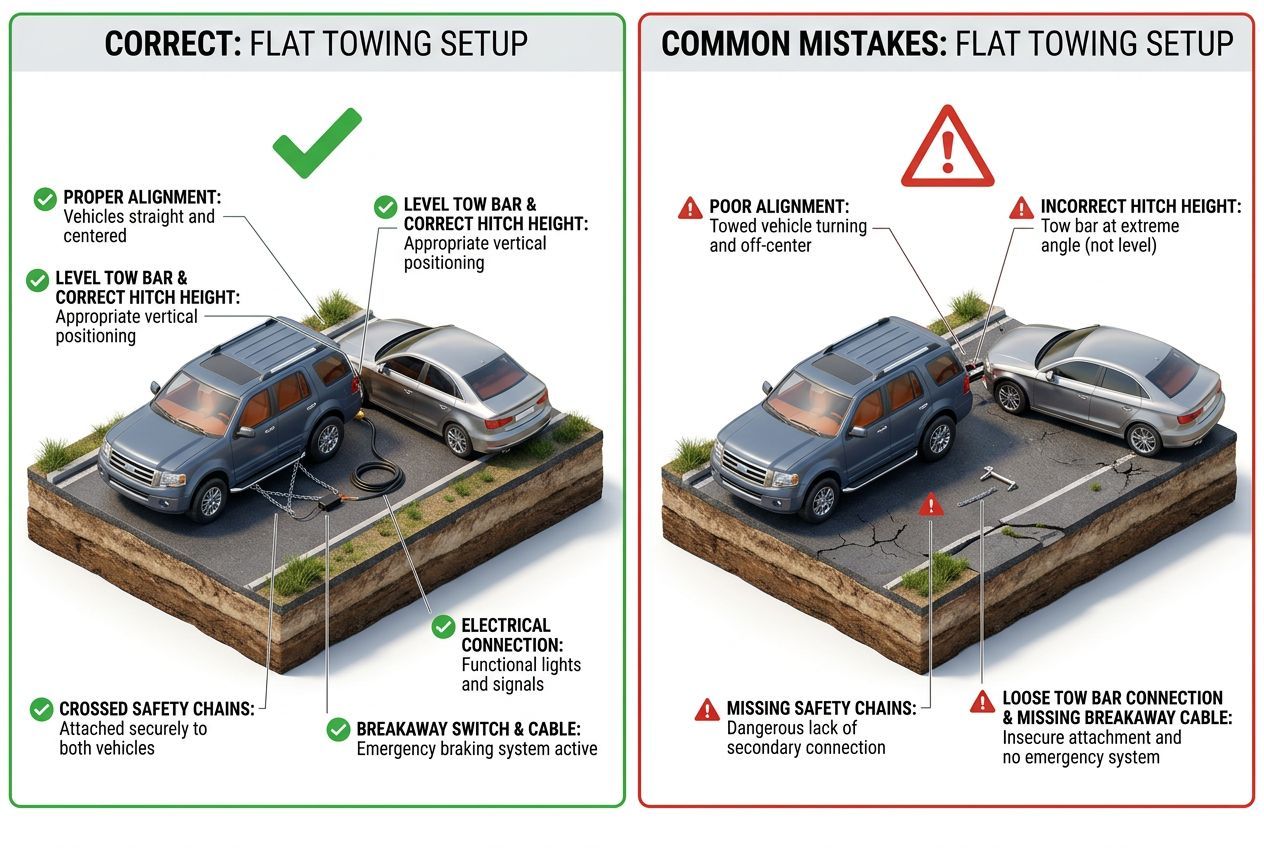
3D comparison of correct towing setup versus common mistakes
⚙️
DIY TOWING & FLAT TOWING

What Equipment Do You Need to Flat Tow a Vehicle?

Five Essential Pieces: Flat towing requires five essential pieces of equipment. Skip any one of them and you're either breaking the law, voiding your warranty, or risking a catastrophic mechanical failure on the highway.

  1. Tow bar: Connects the motorhome's hitch receiver to the dinghy vehicle. Self-aligning tow bars (like the Blue Ox Aventa LX or Roadmaster Falcon) are the easiest to use solo.
  2. Base plate kit: A vehicle-specific bracket welded or bolted to the dinghy's frame. This is what the tow bar actually attaches to. Base plates are model-specific — a Wrangler base plate won't fit a Bronco.
  3. Safety cables: Two independent cables, each rated to handle the full weight of the towed vehicle, crossing under the tow bar per FMCSA cargo securement standards.
  4. Supplemental braking system: A device inside the towed vehicle that applies its brakes when the motorhome brakes. More on this below, but 47 states legally require one above certain weight thresholds.
  5. Lighting wiring harness: Tail lights, brake lights, and turn signals on the dinghy must mirror the motorhome. A diode wiring kit (not a simple plug-in) protects both vehicles' electrical systems.

Total Equipment Cost

Budgeting for Gear: Total cost for quality gear: $1,500–$3,500. Budget setups using used tow bars and basic braking systems land closer to $1,500. Premium setups with a Blue Ox or Roadmaster system plus a Brake Buddy or SMI Stay-IN-Play DUO supplemental braking system run $2,800–$3,500 installed.

Detailed Guides: For a full breakdown, check the supplemental braking systems guide and the tow hitch types guide to make sure your motorhome's receiver is rated for your dinghy's weight.


🚛
DIY TOWING & FLAT TOWING

What Are the Rules and Speed Limits for Flat Towing?

Speed Restrictions: Most manufacturers cap flat towing at 65 mph, and some older manuals specify 55 mph — whichever is lower between the manufacturer limit and the posted speed limit applies. California Vehicle Code §22406 limits vehicles towing trailers to 55 mph regardless of posted freeway speeds. Montana has no such restriction. Check our towing laws by state tool before your route takes you through multiple states.

Supplemental Braking Laws: Supplemental braking laws are where things get complicated fast. Pennsylvania requires brakes on any towed vehicle over 3,000 lbs GVWR. Some states set the threshold at 1,500 lbs — which means even a small SUV triggers the requirement. Canada is simpler: all provinces require supplemental braking, full stop.

📊 Quick Fact: According to NHTSA vehicle safety data, the average dinghy vehicle weighs between 3,200–5,500 lbs, putting nearly every popular flat tow choice above most state thresholds anyway.

Additional Rules: Additional rules to know:

  • Mirrors: Many states require that the tow vehicle driver have a clear view behind the dinghy. Extended tow mirrors on the motorhome are often mandatory.
  • Maximum length: Combined motorhome-plus-dinghy length limits vary by state, typically 65–75 feet.
  • Lighting: Functioning brake lights and turn signals on the dinghy are legally required in all 50 states.

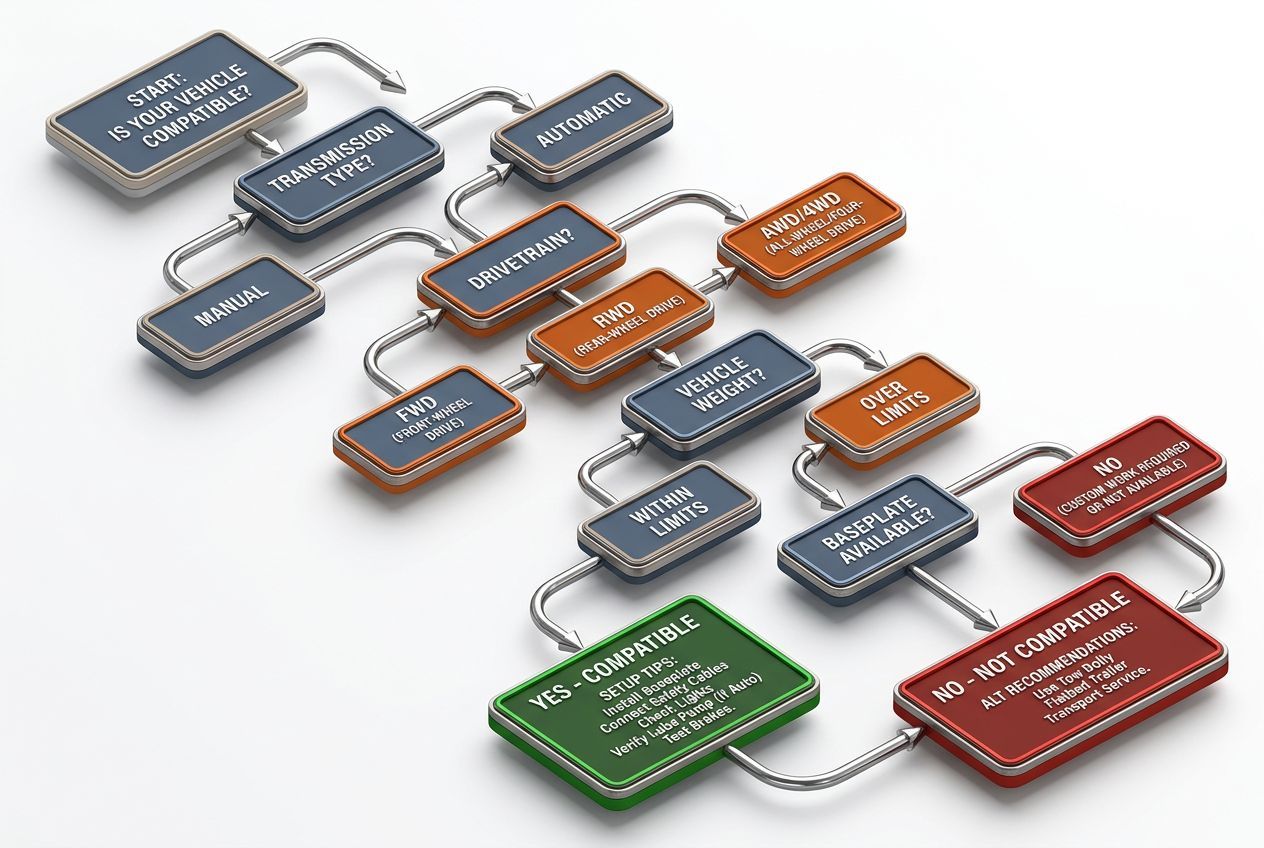
3D flowchart for checking vehicle compatibility with this towing method
📝
DIY TOWING & FLAT TOWING

What Is the Difference Between Flat Towing and Using a Tow Dolly?

Method Comparison: Flat towing moves the dinghy vehicle with all four wheels on the ground. A tow dolly lifts the front wheels onto a small trailer while the rear wheels roll on the pavement. Each method works for a different category of vehicle.

Practical Scenario: Say you own a Honda CR-V with front-wheel drive and no transfer case. It's not on any flat tow compatible vehicles list. You have two options — a tow dolly lifts the front wheels (the drive wheels), which stops drivetrain spin and protects the transmission. Works great. But every time you stop, you need to load and unload the car, secure the straps, and find somewhere to store the dolly at your campsite.

Ease of Use: Flat towing is cleaner for daily use. You unhook the tow bar in 90 seconds and drive off. No dolly storage. No loading ramps. No per-stop strap checks. The tradeoff: your vehicle must be on the manufacturer-approved flat tow compatible vehicles list, and you still need a base plate installed permanently on the dinghy.

💡 Key Takeaway: A tow dolly adds 300–500 lbs of tongue weight from the dolly itself. If your Class A is already close to its hitch weight limit, that margin matters significantly. Our tow bar vs tow dolly breakdown covers the cost and storage tradeoffs in detail.


💰
DIY TOWING & FLAT TOWING

Complete Flat Tow Compatible Vehicle List (2024–2026 Models)

Beyond the top picks, here are additional manufacturer-approved flat tow vehicles organized by category:

Complete Flat Tow Compatible Vehicle List (2024–2026 Models) — data table
Category Vehicle Model Years Base Weight Transfer Case / Setup
Jeeps Wrangler (JL) 2018–2026 4,200–4,600 lbs NV241 — Neutral + 4WD Low
Gladiator 2020–2026 4,650–5,100 lbs NV241 — Same as Wrangler
Trucks Ford Bronco (manual) 2021–2026 4,400–4,700 lbs 2H Neutral procedure
Chevrolet Colorado ZR2 2023–2026 4,700–4,900 lbs AutoTrac transfer case
GMC Canyon AT4X 2023–2026 4,700–4,900 lbs Same as Colorado
Ford F-150 (4WD manual TC) Select years 4,700–5,300 lbs Manual transfer case only
SUVs Chevrolet Tahoe/Suburban (4WD) 2021–2026 5,600–6,000 lbs Neutral + 4WD Low
Chevrolet Equinox (AWD) 2024–2026 3,200–3,500 lbs Electronic disconnect
Buick Encore GX (AWD) 2024–2026 3,100–3,300 lbs Electronic disconnect
Sedans Chevrolet Malibu (discontinued) 2019–2024 3,100–3,200 lbs Front-wheel only

Always verify with your specific vehicle's owner's manual. Manufacturer approval changes by model year.

📊
DIY TOWING & FLAT TOWING

State-by-State Supplemental Braking Requirements

47 states require a supplemental braking system when flat towing, but the weight thresholds and specific requirements vary:

State-by-State Supplemental Braking Requirements — data table
Requirement Level States Threshold
Required for all towed vehicles CT, IA, ME, NV, NY, PA, VT + 12 others Any weight
Required above 1,000–1,500 lbs AL, AZ, CO, FL, GA, IL, IN, KY, OH, TX + others Varies by state
Required above 3,000 lbs CA, MO, NJ, WA 3,000–4,000 lbs
No statewide requirement SD, WI, WY No state law (federal may apply)

A supplemental braking system typically costs $800–$1,800 installed and is legally required in most states regardless of your towed vehicle's weight. The SMI Stay-IN-Play DUO ($900–$1,200) and Roadmaster InvisiBrake ($1,200–$1,500) are the most popular options for RV flat towing setups.

Sources & Methodology

Flat tow compatibility information was verified against manufacturer towing supplements and owner's manual recreational towing sections for model year 2026. State law references reflect publicly available state DOT codes as of Q1 2026.

  1. 1.
    Ford Motor Company — 2026 Bronco Owner's Manual and Trailer Towing Supplement. ford.com
  2. 2.
    Stellantis (Jeep/RAM) — 2026 Wrangler and Gladiator Owner's Manuals, Recreational Towing sections. ramtrucks.com
  3. 3.
    Chevrolet/GMC — 2026 Colorado and Canyon Owner's Manual Towing Supplements. chevrolet.com
  4. 4.
    FMCSA — Cargo securement and safety cable standards for recreational towing. fmcsa.dot.gov
  5. 5.
    NHTSA — Vehicle weight specifications and safety data. nhtsa.gov

TowingServiceHub is reader-supported: we may earn money from ads and from some links on this page. See our editorial policy.

Mark — Founder & Editor

Mark

Founder & Editor

Mark is the founder and editor of TowingServiceHub, which he launched in 2026 after struggling to find clearly sourced towing costs and truck specs. He works in enterprise technology and tows his own boats, trailers, and equipment, so he knows the questions drivers actually ask.

Read full bio →

Need a tow truck right now?

Browse vetted local providers in your area. Real Google ratings, verified business info, free to use.

Or browse all 50 states from our directory

Frequently Asked Questions

No. As of 2026, no major EV manufacturer approves four-down towing. Flat towing spins the electric motor, generating uncontrolled current that can damage motor windings and the battery management system. PHEVs like the Jeep Grand Cherokee 4xe are also explicitly excluded.

No — the odometer and engine are both off during flat towing. However, the tires and wheel bearings do accumulate wear from road contact. Most manufacturers account for this

The most popular flat towable vehicles for 2026 include the Jeep Wrangler, Jeep Gladiator, Ford Bronco, Chevrolet Colorado, GMC Canyon, Jeep Cherokee (with Active Drive Lock), Ford F-150 (4WD with transfer case in neutral), and Chevrolet Tahoe (4WD). Always verify in your owner's manual as flat tow compatibility varies by drivetrain configuration.

Some automatic transmission vehicles can be flat towed, but only those specifically approved by the manufacturer. Vehicles must have a transfer case that can be placed in neutral to disconnect the transmission from the wheels. Most front-wheel-drive automatics cannot be flat towed without a tow dolly. Check your owner's manual for your specific vehicle.

The Jeep Wrangler is widely considered the easiest vehicle to flat tow because its transfer case has a dedicated neutral position designed for flat towing. Setup requires simply shifting to neutral, engaging the transfer case neutral, and connecting the tow bar. No additional modifications or disconnects are needed.

Most manufacturers recommend flat towing at speeds no higher than 65 mph. Some vehicles have lower limits — typically 55 mph. Always check your specific vehicle owner's manual. Exceeding the manufacturer's recommended flat tow speed can damage the transmission, transfer case, or drivetrain components and may void your warranty.

Yes, in most states. Nearly all US states require a supplemental braking system on any towed vehicle over 3,000 lbs. Even in states that don't legally require it, a supplemental brake system significantly reduces stopping distances and wear on the motorhome's brakes. Popular options include the SMI Stay-IN-Play DUO and InvisiBrake.

Related Articles

Explore More Towing Guides

Browse all 157 expert guides and 10 free tools.