🔧
DIY TOWING & FLAT TOWING
What Equipment Do You Need to Flat Tow a Car?
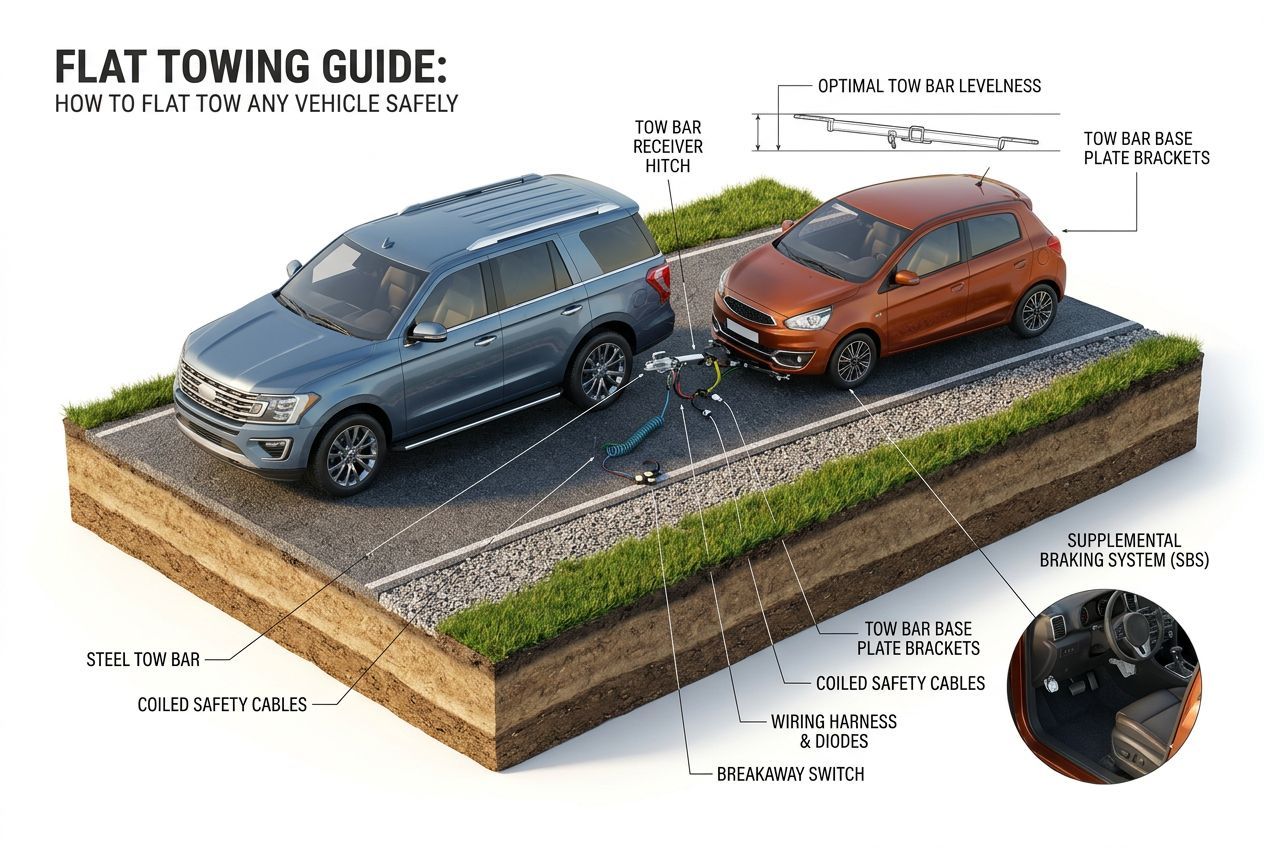
Essential Components: A complete flat tow setup has five non-negotiable components. Miss one, and either the vehicle gets damaged or you're violating traffic law.
1. Tow Bar
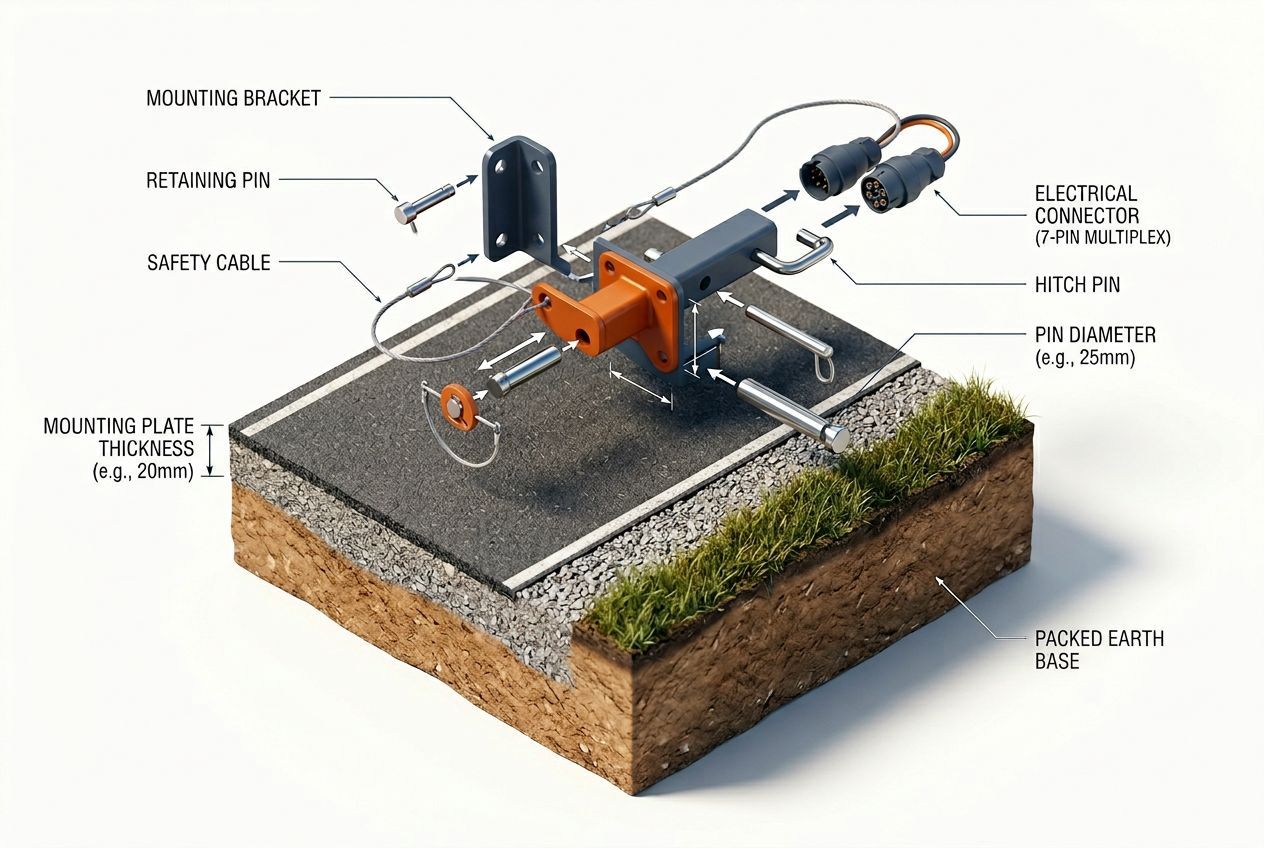
Purpose: The tow bar is the rigid (or self-aligning telescoping) arm that connects your motorhome's hitch receiver to the towed vehicle.
Ratings: Most are rated Class III (5,000 lbs) or Class IV (10,000 lbs) gross trailer weight. The rating is stamped on the receiver collar or the tow bar arm itself — look for "GTW 5,000" or similar.
Popular Brands: Blue Ox, Roadmaster, and SMI.
Ease of Use: Self-aligning models (like the Blue Ox Aladdin or Roadmaster Sterling All-Terrain) make solo hookups dramatically easier because the arms pivot independently until they're latched.
⚠️ Warning: Verify your hitch receiver on the motorhome is rated for the tow bar's GTW. A Class IV tow bar in a Class III receiver is a mismatch that could shear the receiver at the welds under emergency braking. The rating is stamped on the receiver tube near the pin hole.
2. Baseplate Kit
Purpose: The baseplate is a vehicle-specific steel mounting bracket that bolts to the towed vehicle's frame or unibody subframe behind the front fascia.
Specificity: These are not universal — a Jeep Wrangler baseplate (say, a Blue Ox BX1128) is drilled for completely different bolt points than a Ford Bronco baseplate.
Installation: Installation requires bumper or fascia removal and typically takes a professional 2–4 hours. Plan on $300–$600 for the baseplate hardware plus installation labor.
3. Supplemental Braking System
Function: We'll cover the legal requirements in detail below, but from a hardware standpoint: a supplemental braking system activates the towed vehicle's factory brakes in sync with the motorhome.
Types: The two main types are proportional systems (which match braking intensity to the lead vehicle's deceleration) and surge/inertia systems (which apply a fixed pressure when deceleration is detected).
Recommendation: Proportional systems like the SMI Stay-IN-Play DUO or Demco SBS are considered the standard for dinghy towing. Expect to pay $450–$900 for a good proportional unit.
4. Safety Cables
Attachment: Two steel safety cables attach from the tow bar or motorhome hitch to the towed vehicle's baseplate in a crossed pattern (left-to-right and right-to-left).
Purpose: The crossing creates a cradle that catches the tow bar if a latch fails.
Rating: Per FMCSA guidance at fmcsa.dot.gov, safety chains or cables on towed vehicles must be rated to control the towed unit's gross weight.
⚠️ Warning: Don't substitute light chain — use cables rated to at least the vehicle's GVWR.
5. Flat Tow Wiring Harness
Function: Your towed vehicle's brake lights, turn signals, and running lights must function and mirror the motorhome's signals.
Connection: A flat tow wiring harness plugs into both vehicles' 6-pin or 7-pin connectors.
Diode Kits: Some harnesses are pass-through; others require a diode kit wired into the towed vehicle's tail lamp circuit to prevent backfeed from damaging the BCM.
📊 Quick Fact: NHTSA regulations at nhtsa.gov require all towed vehicles on public roads to display functioning brake and signal lights.
Full Setup Cost Summary
Full Setup Cost Summary — data table
| Component |
DIY Cost Range |
Installed Cost Range |
Notes |
| Tow bar (self-aligning) |
$450–$900 |
$450–$900 |
Labor minimal; mounts to motorhome hitch |
| Baseplate kit |
$250–$500 |
$500–$900 |
Professional install recommended |
| Supplemental braking system |
$450–$900 |
$600–$1,100 |
Proportional units preferred |
| Safety cables |
$30–$80 |
Included in most kits |
Cross-pattern; rated to GVWR |
| Wiring harness + diode kit |
$80–$200 |
$150–$350 |
May require BCM protection diodes |
| Total |
$1,260–$2,580 |
$1,700–$3,250 |
Prices from retailer averages, 2025–2026 |
Source: Retailer pricing averages from etrailer.com and Camping World, 2025–2026.
🛡️
DIY TOWING & FLAT TOWING
How Do You Flat Tow a Car Step by Step?
Pre-Departure Sequence: Here's the full pre-departure sequence. Do this in order every single time — skipping steps is how transmissions die.
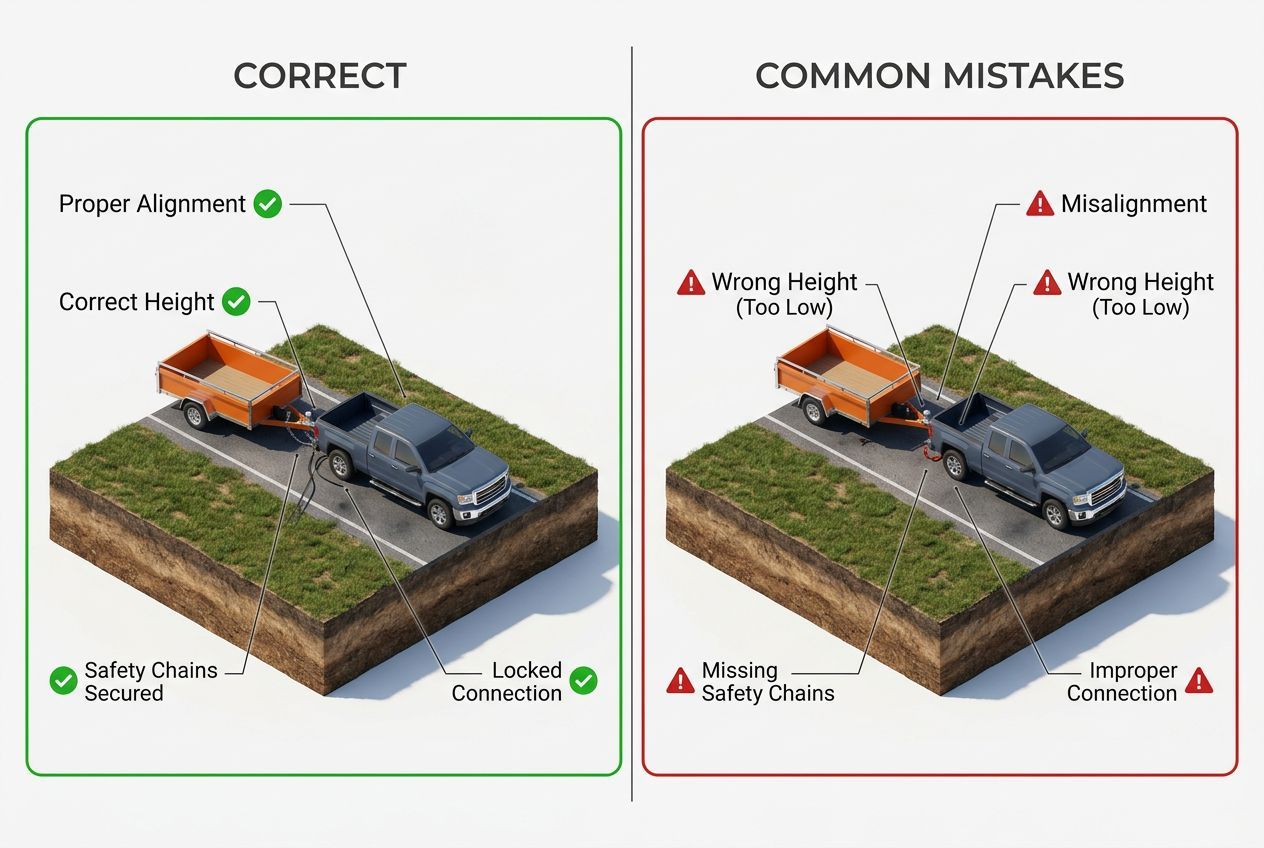
Step 1: Position the vehicles. Pull the motorhome straight — not at an angle. Flat tow hookup requires the vehicles to be roughly aligned. Back the towed vehicle into position or drive it nose-toward the motorhome.
Step 2: Attach the tow bar to the motorhome. Insert the tow bar shank into the motorhome's hitch receiver, insert the hitch pin, and secure with a clip or locking pin. Confirm the tow bar receiver is properly seated.
Step 3: Connect tow bar arms to the baseplate. Extend the tow bar arms and connect each arm's coupler to the corresponding baseplate loop or pin on the towed vehicle. You'll hear/feel a click or latch. Verify both sides are locked.
Step 4: Cross the safety cables. Attach the left cable to the towed vehicle's right baseplate anchor and the right cable to the left anchor. Both cables should pass underneath the tow bar in an X. Clip all hooks with safety clips.
Step 5: Plug in the wiring harness. Connect the 6-pin or 7-pin wiring harness between the motorhome and towed vehicle. Turn on the motorhome and have someone confirm the towed vehicle's brake lights, turn signals, and running lights all work before you move.
Step 6: Activate the supplemental braking system. Each system has a slightly different activation procedure — the SMI Stay-IN-Play DUO, for example, requires the breakaway cable to be connected to the motorhome frame and the system to be armed via a cab-mounted switch. Confirm the system is active before proceeding.
Step 7: Set the towed vehicle's drivetrain. This is the most vehicle-specific step. For a Jeep Wrangler JL with the 4WD system, the procedure is: engine on → shift transfer case to NEUTRAL (4WD Neutral position, not 2WD) → shift automatic transmission to PARK → engine off → confirm transfer case is in neutral by attempting to roll the vehicle slightly by hand. For vehicles that require a specific ignition position (key to ACC or ON without engine running), follow that exactly. Our flat towing a Jeep Wrangler guide covers that full procedure in detail.
Step 8: Release the parking brake. This sounds obvious, but it's the most common first-mile mistake. The towed vehicle's wheels must turn freely.
Step 9: Confirm ignition position. Most towed vehicles need the ignition in ACC or ON (without the engine running) so the steering column doesn't lock. A locked steering column means the towed vehicle can't self-steer through corners — it'll scrub the tires and fight the motorhome in every turn.
Step 10: Final walk-around. Walk around both vehicles. Check every connection point. Tug each safety cable. Look under the tow bar for ground clearance. Pull away slowly for the first 50 feet, then stop and re-check everything.
Real-World Example: Say you're heading from Phoenix to Sedona — about 115 miles — towing a Jeep Wrangler JL Unlimited (GVWR: 5,000 lbs) behind a Class A motorhome. With the SMI Stay-IN-Play DUO active, your stopping distance at 60 mph is close to the motorhome's unloaded baseline. Without it, FMCSA-referenced braking studies show stopping distance increases 25–40% — at 60 mph, that's an extra 40–65 feet of stopping distance on a downhill grade. On the climb to Sedona on AZ-89A, that matters a lot.
Speed and Interval Notes: Most manufacturers cap flat towing speed at 55–65 mph. Check your owner's manual — some explicitly state 55 mph. A few older models (certain Jeep Cherokee XJ configurations) require stopping every 200 miles to start the engine briefly and run the transmission pump for 5 minutes. Know your vehicle's specific interval requirements.
📋
DIY TOWING & FLAT TOWING
Do You Need a Braking System to Flat Tow?
Legal Requirements: Yes — in 47 of 50 states plus Washington D.C. and all Canadian provinces, a supplemental braking system is legally required when the towed vehicle's weight exceeds a specified threshold. That threshold is most commonly 1,500 lbs GVWR, which means virtually every passenger car, SUV, or truck qualifies. A few states set the threshold higher (some at 3,000 lbs), but counting on a higher limit to skip the braking system is a gamble you don't want to take with your insurance coverage or your life.
State-Specific Rules: You can check the exact threshold for every state using our towing laws by state tool.
Why Proportional Systems Excel: Proportional braking systems are the gold standard because they mirror the motorhome's deceleration rate. When the motorhome brakes hard, the towed vehicle brakes proportionally hard — not a fixed pressure that either under-brakes or over-brakes depending on the situation.
Popular Proportional Systems:
- The Demco SBS and Blue Ox BrakePro are portable units that sit on the driver's floorboard and push the brake pedal mechanically.
- The SMI Stay-IN-Play DUO uses a pneumatic actuator that connects directly to the brake pedal mechanism and stays permanently mounted in the vehicle.
Deeper Dive: For deeper coverage of how each system works and how to choose one, our supplemental braking systems guide has full reviews and installation notes.
Mountain State Caveat
Critical for Safety: In Colorado, Utah, and West Virginia, supplemental brakes aren't optional in practice — they're critical. The towed vehicle has no engine braking (engine is off), no vacuum boost to amplify the supplemental system's input, and no traction control active. On a 6% downgrade at 7,000 feet elevation, the physics get steep fast. The SMI Stay-IN-Play DUO uses the towed vehicle's own brake system with factory vacuum assist, which is why it's often the preferred choice for mountain routes.
⚙️
DIY TOWING & FLAT TOWING
Can You Flat Tow a Car with an Automatic Transmission?
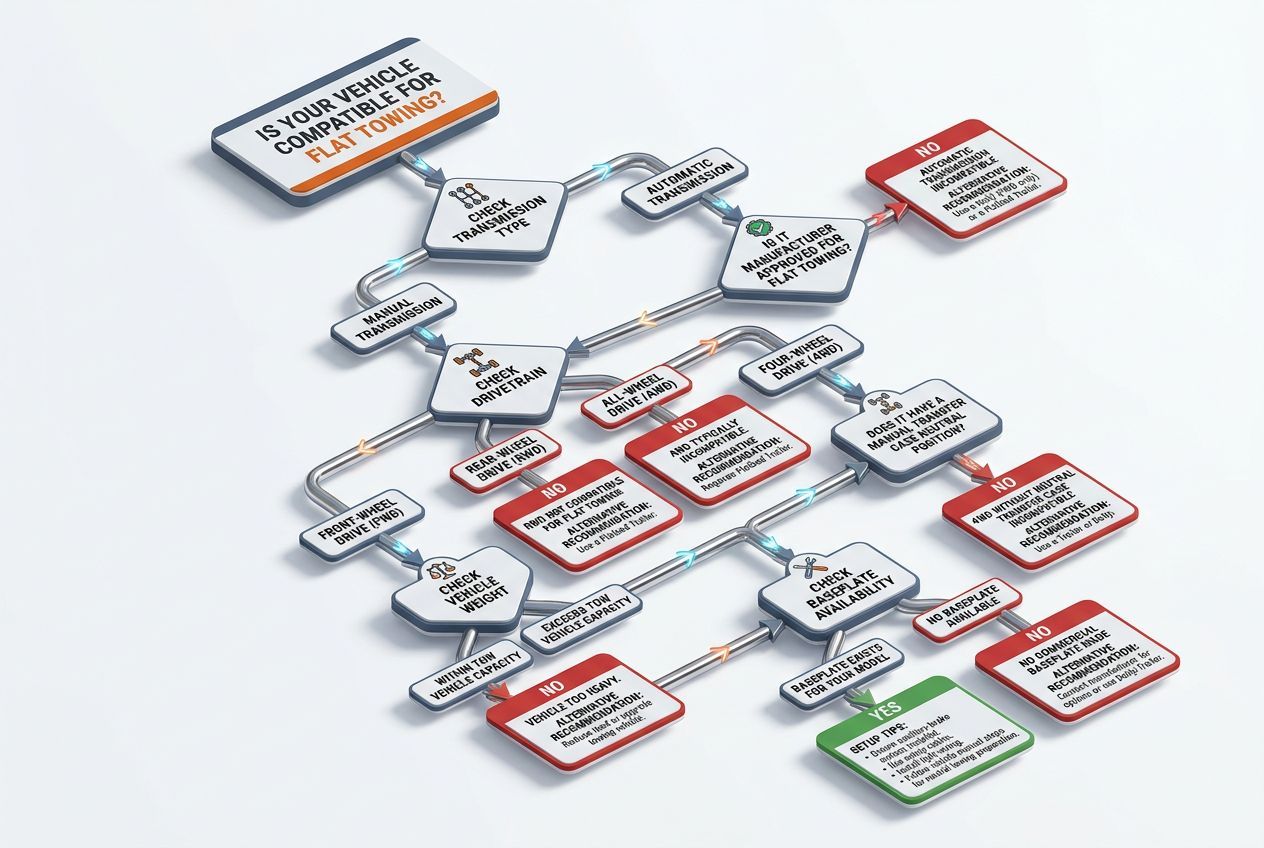
Manufacturer Approval is Non-Negotiable: Flat towing a car with an automatic transmission is possible — but only when the manufacturer explicitly approves it. The approval isn't a gray area. It's either in the owner's manual or it isn't.
Why Transmission Damage Occurs: Here's why it matters: most conventional automatic transmissions use a hydraulic pump driven by the engine's torque converter input shaft. When the engine isn't running, the pump doesn't run. The transmission fluid that lubricates clutch packs, bearings, and the valve body isn't circulating. Tow the vehicle 40 miles like that and you've cooked a $3,500–$6,000 transmission.
How Approved Automatic Transmissions Work
Vehicles that are approved for flat towing with an automatic typically handle this one of three ways:
- Transfer case neutral bypass: The transfer case decouples the rear driveshaft completely, so the automatic transmission input shaft never spins. The transmission fluid sits static and safe. This is how the Jeep Wrangler with the 8HP75 8-speed automatic works.
- Electric auxiliary lube pump: Some vehicles (certain Ford F-150 variants) include an electric transmission fluid pump that runs independently of the engine. It keeps fluid circulating even with the engine off.
- Transmission disconnect system: A few AWD vehicles include an electronically controlled clutch pack that disconnects the rear axle from the transmission entirely when flat tow mode is activated.
Drivetrain Protection: For more detail on transmission considerations and how to protect your drivetrain during towing, see our guide on towing with an automatic transmission.
What Won't Work: Front-wheel-drive vehicles with conventional automatic transmissions are almost universally not approved for flat towing. The transaxle's differential and transmission share a fluid circuit, and without the engine running, nothing is lubricated. A Honda Civic, Toyota Camry, or Nissan Rogue with a CVT? None of them belong on a flat tow bar. A tow dolly or enclosed trailer is the right call for those vehicles.
🚛
DIY TOWING & FLAT TOWING
What Is the Difference Between Flat Towing and Using a Tow Dolly?
Key Distinction: Flat towing places all four wheels on the ground behind the lead vehicle. A tow dolly lifts the front two wheels onto a small, axle-equipped platform trailer while the rear wheels roll on the road. Both methods get a car from A to B, but they suit different situations and have different equipment, cost, and legal profiles.
Flat Towing vs. Tow Dolly Comparison
Flat Towing vs. Tow Dolly Comparison — data table
| Feature/Method |
Flat Towing (Four-Down) |
Tow Dolly |
| Wheels on Ground |
All four |
Rear two (front two on dolly) |
| Trailer Storage |
No trailer to store |
Dolly needs storage |
| Hook-up Time |
Faster once setup is installed |
Slower; involves loading/securing vehicle |
| Tongue Weight |
Lower (vehicle weight distributed) |
Higher (dolly + front vehicle weight) |
| Maneuverability |
Can be backed up carefully |
Cannot be backed up (jackknifes) |
| Vehicle Compatibility |
Only manufacturer-approved vehicles (often 4WD/AWD with neutral) |
Works with most FWD vehicles, many RWD |
| Upfront Cost |
$1,700–$3,250 (installed) |
$1,000–$2,000 |
| Baseplate Required |
Yes (vehicle-specific) |
No |
| Aerodynamics |
Cleaner profile |
Adds drag/height |
| Licensing |
Generally no separate license plate needed for towed vehicle |
Dolly may require its own license/registration in some states |
Concrete Example: Say you're an RVer with a Honda CR-V AWD (2023 model with drivetrain disconnect — approved for flat towing per Honda's towing guide at toyota.com) versus a 2022 Honda Civic FWD (not flat-tow-approved). The CR-V owner installs a Blue Ox baseplate and SMI braking system once, then hooks up in under 10 minutes per trip. The Civic owner rents or owns a dolly, loads the front wheels, and deals with storage at every campsite.
Further Resources: For a full side-by-side breakdown with real setup times and cost comparisons, our tow bar vs tow dolly guide covers every variable. If you're deciding between flat towing and a full car trailer, our DIY car trailer tips guide walks through when a trailer makes more sense — particularly for AWD vehicles or valuable collector cars you don't want rolling on their own wheels for 2,000 miles.
📝
DIY TOWING & FLAT TOWING
Flat Towing Costs: What Should You Budget?
Initial Investment: The full flat tow setup isn't a cheap weekend project, but it pays for itself quickly if you're an active RVer. The equipment is largely permanent on both vehicles, so you pay once and use it for years.
Ongoing Maintenance: Beyond initial setup, budget for periodic maintenance:
- Tow bar pivot points need grease every season.
- Safety cable inspections every trip.
- Baseplate hardware torque checks after the first 500 miles.
✅ Pro Tip: Some baseplate mounting bolts work loose from vibration in the first season — check them at 500 miles and annually after that.
Roadside Assistance: For ongoing cost comparisons and whether professional roadside coverage makes sense if something goes wrong on the road, the AAA roadside assistance guide at aaa.com breaks down what's covered for towed vehicles under different membership tiers. It's worth knowing before you're stranded at mile marker 47 with a disconnected tow bar.
Trip Cost Estimation: If you want to estimate total trip towing costs before you commit to the RV lifestyle, plug your setup into our RV and boat tow estimator for fuel and wear-cost projections over a full season.