💡 Key Takeaway: Always prioritize your vehicle's manufacturer tow rating; a higher hitch class never increases your vehicle's towing limit.
- Classes I and II share a 1.25-inch receiver; Classes III and IV both use a 2-inch receiver; Class V steps up to a 2.5-inch opening.
- "Dead weight" and "with weight distribution" are two separate ratings — never assume you can reach the upper number without the system installed.
- Your vehicle's manufacturer tow rating is always the hard ceiling — a heavier hitch class can't override it.
- Tongue weight should stay between 10–15% of gross trailer weight regardless of hitch class.
- If your hitch has no label, measure the receiver tube opening and check the part number stamped near the pin hole to confirm the class.
What Are the Different Classes of Tow Hitches?
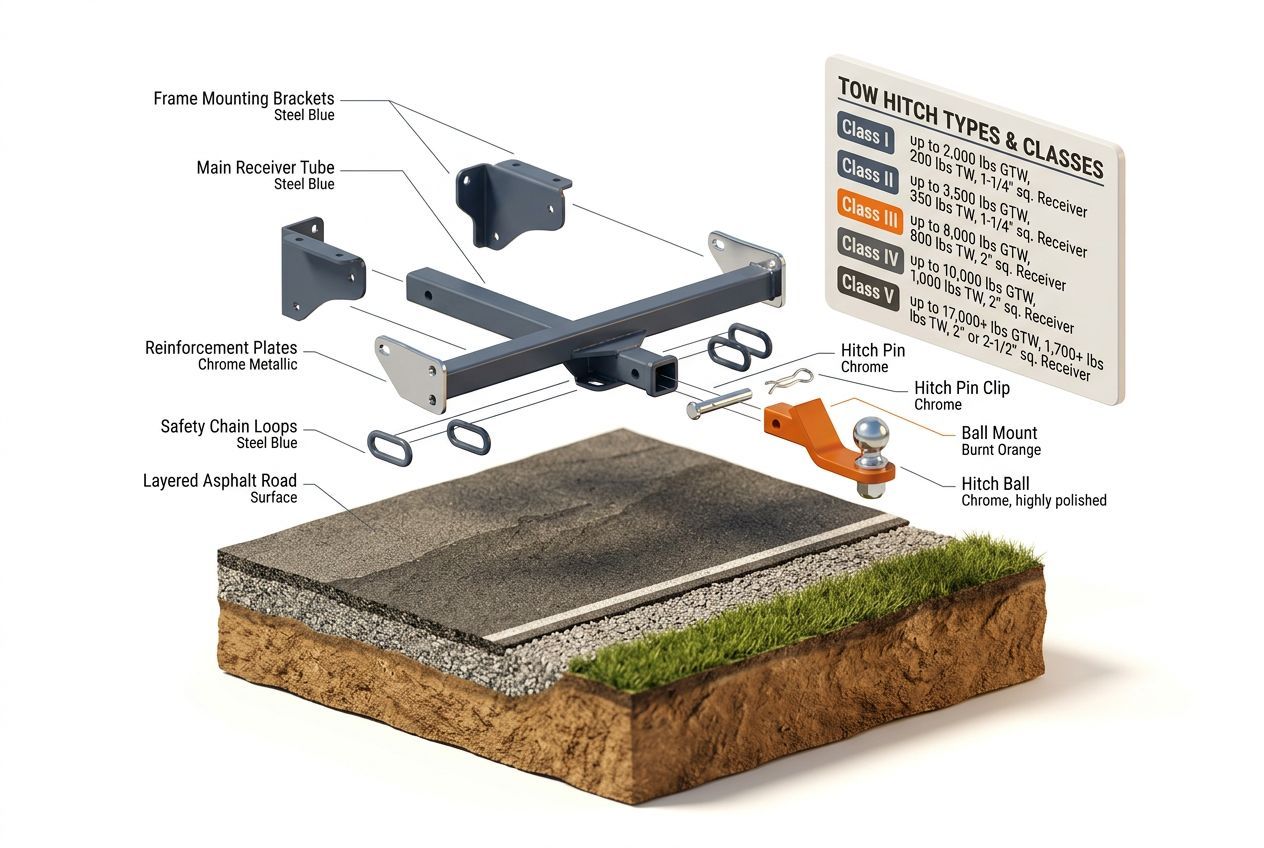
Tow hitch types are categorized from Class I through Class V, each specifically defined by its gross trailer weight (GTW) capacity and receiver tube diameter. Class I hitches, for instance, top out at 2,000 lbs GTW and are best suited for small cars, while Class V hitches are engineered for heavy-duty trucks, handling up to 17,000 lbs with a weight distribution system. Each progression in class signifies the use of heavier-gauge steel and more robust mounting hardware for increased strength and durability.
Here's how the five trailer hitch types stack up side by side:
| Hitch Class | Receiver Size | Max GTW (Dead Wt.) | Max GTW (w/ WD) | Max Tongue Weight | Typical Vehicles |
|---|---|---|---|---|---|
| Class I | 1.25 in | 2,000 lbs | N/A | 200 lbs | Sedans, hatchbacks |
| Class II | 1.25 in | 3,500 lbs | N/A | 350 lbs | Crossovers, minivans |
| Class III | 2 in | 5,000 lbs | 8,000 lbs | 500 / 800 lbs | Midsize trucks & SUVs |
| Class IV | 2 in | 7,500 lbs | 12,000 lbs | 750 / 1,200 lbs | Full-size trucks & SUVs |
| Class V | 2.5 in | 12,000 lbs | 17,000 lbs | 1,200 / 1,700 lbs | HD trucks, chassis cabs |
Source: CURT Manufacturing hitch class specifications; cross-referenced with NHTSA towing guidelines at https://www.nhtsa.gov
Notice the shared receiver sizes between classes. Classes I and II both feature a 1.25-inch receiver opening. This means accessories like a bike rack purchased for a Class II hitch will seamlessly fit into a Class I receiver without requiring an adapter. Similarly, Classes III and IV share the same 2-inch opening, which can sometimes lead to confusion.
⚠️ Warning: Do not be fooled by shared receiver sizes. Despite identical openings, the steel thickness and mounting points of hitches in different classes are distinct. Always verify the class by checking the rating stamps on the receiver tube.
For a broader look at how hitches fit into a complete towing setup, the towing capacity guide at TowingServiceHub walks through vehicle ratings in detail.
What Is the Difference Between a Class 3 and Class 4 Hitch?
The primary distinction between a Class 3 and Class 4 hitch lies in their weight capacity and structural build. While both utilize a 2-inch receiver, a Class III hitch has a maximum Gross Trailer Weight (GTW) of 8,000 lbs with weight distribution, whereas a Class IV hitch can accommodate up to 12,000 lbs GTW. Class IV hitches are constructed with heavier-gauge tubing and more substantial mounting flanges, often integrated directly into the frame on full-size trucks, rather than being a bolt-on accessory.
Consider a real-world towing scenario. Imagine you're towing a loaded car hauler. If the trailer weighs 2,800 lbs empty and you're loading a 4,200-lb sedan, your total weight is 7,000 lbs. A Class III hitch rated at 8,000 lbs GTW technically covers you, but with minimal headroom. Your tongue weight, at 12% of GTW, would be 840 lbs, which is right at the Class III weight distribution ceiling of 800 lbs. This tight margin can lead to an uncomfortable and potentially unsafe towing experience. A Class IV hitch, rated to 12,000 lbs GTW (1,200 lbs tongue weight with WD), provides a much safer margin, offering peace of mind on the road.
⚠️ Warning: Even if you upgrade to a Class IV receiver, you can never exceed your vehicle's manufacturer-specified maximum tow rating. For example, a Toyota Tacoma with a Class IV hitch still cannot tow 12,000 lbs if its max tow rating is 6,800 lbs. The vehicle's chassis, transmission, and brake limits are the absolute ceiling.
For vehicles bordering Class III and Class IV capacities, such as the Ford F-150 or Chevrolet Silverado 1500, it's essential to consult the door-jamb sticker on the driver's side B-pillar for GVWR and payload information. Additionally, cross-reference this with the specific Trailer Towing Supplement published by manufacturers like Ford and GM. This supplement provides precise hitch class recommendations for your particular engine, axle, and package configuration.
What Class Hitch Do I Need for My Vehicle?
Determining the correct hitch class depends on the lower of two crucial figures: your vehicle's rated tow capacity and your trailer's fully loaded gross weight. Generally, compact cars and crossovers require Class I or II hitches, midsize trucks and SUVs typically fall into Class III, and full-size or heavy-duty trucks will need Class IV or V. Remember, selecting a higher class hitch will not increase your vehicle's inherent towing capability; the vehicle itself sets the maximum limit.
Here's a quick decision tree to guide your choice:
- Under 2,000 lbs towing (e.g., bike rack, small cargo carrier): Class I
- 2,001–3,500 lbs (e.g., jet ski, small utility trailer): Class II
- 3,501–8,000 lbs (e.g., boat, camper, midsize travel trailer): Class III
- 8,001–12,000 lbs (e.g., large travel trailer, car hauler): Class IV
- 12,001–17,000 lbs (e.g., gooseneck prep, heavy equipment): Class V
Use the tow vehicle matchmaker tool to confirm your specific vehicle's factory rating before you buy anything.
📊 Quick Fact: Factory hitches on crossovers are often Class I or II, even if the vehicle itself can tow more.
Many buyers overlook the specifications of factory-installed hitches. For example, a Toyota RAV4 Adventure might be rated to tow 3,500 lbs, but its factory receiver is a 1.25-inch Class II. While perfectly matched to the vehicle's rating, you cannot simply attach a Class III ball mount and expect to tow heavier loads.