Heavy-Duty Towing Rate Overview
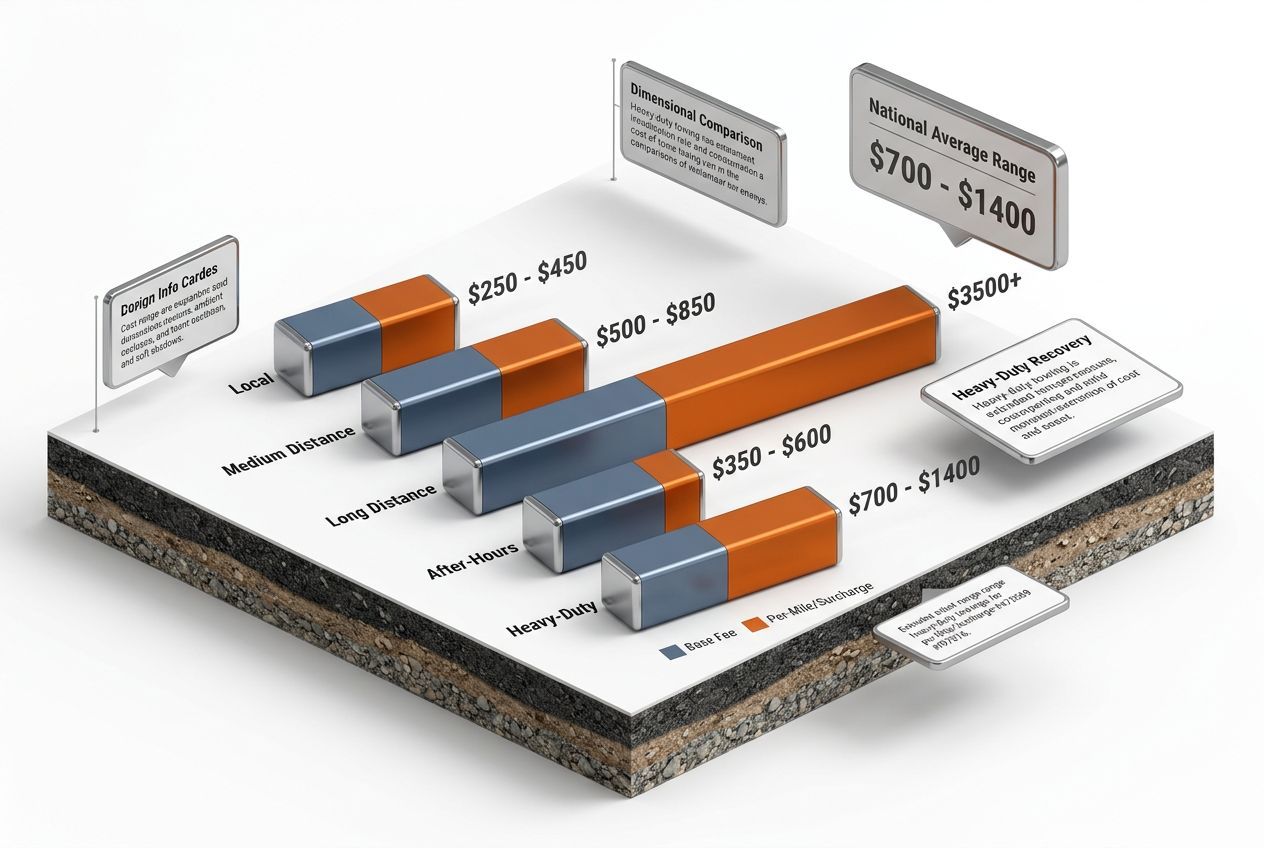
Heavy-Duty Towing Rate Overview — data table
| Vehicle Type |
Weight Range (GVWR) |
Hookup Fee |
Per-Mile Rate |
Typical 25-Mile Total |
| Class 3–5 truck (F-350, box truck) |
10,001–19,500 lbs |
$300–$600 |
$5–$9/mi |
$425–$825 |
| Class 6–7 truck (dump truck, bus) |
19,501–33,000 lbs |
$450–$800 |
$7–$12/mi |
$625–$1,100 |
| Class 8 semi (tractor only) |
33,001–80,000 lbs |
$600–$1,200 |
$10–$15/mi |
$850–$1,575 |
| Class A motorhome |
20,000–30,000 lbs |
$400–$900 |
$7–$12/mi |
$575–$1,200 |
| Heavy construction equipment |
20,000–100,000+ lbs |
$500–$1,500 |
$5–$12/mi |
$625–$1,800 |
TowingServiceHub editorial estimates. Actual rates vary by market.
📊
TOWING COSTS
How Much Does It Cost to Tow a Semi Truck?
The cost to tow a semi truck averages $500–$1,500 for a straightforward highway tow under 25 miles when the tractor is unloaded or the trailer has been separated. For a fully loaded 80,000-lb combination (tractor plus trailer), this range increases to $800–$2,500 for the same distance. Complex accident recovery, which might involve cargo offloading and managing lane closures on an interstate, can exceed $10,000.
While the FMCSA regulates commercial vehicle operations under federal motor carrier safety rules (fmcsa.dot.gov), towing rates themselves are largely unregulated at the federal level. This means pricing can vary significantly by market, especially in rural corridors where heavy wreckers are less common.
Cost Factors Specific to Semi Trucks
A few critical cost factors specific to semis that most people don't initially consider include:
- Trailer separation fees: Before a tractor can be towed, a loaded trailer often needs to be unhitched and secured. Expect a labor charge of $150–$400 for this step alone.
- Rotator crane response: A jackknifed semi blocking a freeway often necessitates a rotator — a specialized crane-wrecker hybrid. Industry data indicates rotators typically bill at $500–$750 per hour, often with a 2-hour minimum, meaning the crane portion alone can cost $1,000–$1,500 before mileage.
- Cargo transfer: If the trailer's contents must be unloaded and reloaded onto another trailer at the scene, expect costs ranging from $1,500–$4,000+, depending on the type of cargo. Hazardous materials will trigger additional regulatory requirements and significantly higher costs.
- State highway incident management fees: Some states levy mandatory fees for heavy wrecker responses on limited-access highways. These charges, sometimes called "incident management" or "expedited clearance" fees, can add $500–$2,000 to your bill and are separate from the towing company's invoice.
⚠️ Warning: Do not assume your commercial auto policy fully covers heavy-duty semi-truck recovery costs. Many policies have caps (e.g., $5,000) that are easily exceeded by complex semi-truck incidents, leaving you responsible for the difference.
For additional context on how semi tow rates compare to standard vehicles, please see our tow truck cost per mile breakdown.
🔧
TOWING COSTS
What Does RV Towing Cost?
RV towing typically costs $350–$1,000 for distances under 25 miles, but the class of RV significantly impacts the final price. For instance, a Class C motorhome on a gas chassis (with a GVWR around 14,500 lbs) generally falls into medium-duty towing territory. However, a Class A diesel pusher, weighing between 26,000–30,000 lbs, requires a heavy-duty wrecker — and its pricing reflects this.
Here's a breakdown of RV towing costs by type:
- Travel trailers and fifth wheels (under 15,000 lbs): Expect $250–$600 for short, local tows. These vehicles are usually light enough for a medium-duty wrecker.
- Class B and C motorhomes (14,000–20,000 lbs): Costs are typically $350–$800 for distances under 25 miles. This category includes Class C gas coaches built on Ford E-Series or Ram ProMaster chassis.
- Class A gas motorhomes (20,000–26,000 lbs): These generally cost $500–$1,000 for under 25 miles, with most requiring a heavy wrecker.
- Class A diesel pushers (26,000–33,000 lbs): For these larger RVs, expect $700–$1,500 for under 25 miles. Diesel pushers often exceed the 26,001-lb GVWR threshold, which the FHWA defines as Class 7, thus necessitating purpose-built heavy towing equipment.
Long-distance RV tows, such as transporting a unit 100+ miles back home from a campground, average $3.50–$7.00 per mile for Class A units. A 200-mile tow for a 28,000-lb diesel pusher could realistically cost $1,500–$2,500. For a more detailed look at multi-state rates, consult our long-distance towing cost guide.
⚠️ Warning: Always confirm the towing company has experience towing your specific RV chassis type, especially for older diesel pushers with tag axles. Improper rigging can lead to severe drivetrain damage. Ask explicitly about their tag-axle handling procedures.
Remote campground and off-road extractions typically incur surcharges of $200–$500, varying with terrain and access difficulty. Mountain recovery in states like Colorado or West Virginia usually runs 20–40% above flatland rates due to increased risks associated with steep grades.
If you're considering AAA for RV roadside coverage, their RV Plus membership offers higher towing limits than standard plans. Comparing these benefits against potential out-of-pocket heavy-duty towing rates before your next trip is a smart move. For a full tier-by-tier breakdown of AAA towing cost — including which weights and vehicle types AAA standard plans exclude (commercial trucks and vehicles over 10,000 lbs GVWR) — see our AAA pricing guide.
🛡️
TOWING COSTS
How Much Does Heavy Equipment Towing Cost?
Heavy equipment towing costs typically range from $500–$3,000+ per single machine move, with the exact price depending on the equipment's weight and whether it's self-propelled or requires specialized rigging. For items like excavators, bulldozers, and motor graders, lowboy trailer transport is usually required, costing $5–$12 per mile after an initial hookup fee of $500–$1,500.
Permitting Overhead for Heavy Equipment Moves
Unlike standard vehicle towing, heavy equipment moves often involve significant permitting overhead:
- Oversize/overweight permits: Most state DOTs require permits for loads that exceed 80,000 lbs gross vehicle weight or specific width/height thresholds. Permit costs generally vary by state, typically $20–$150 per state for single-trip permits. However, processing time and potential route restrictions can add to the logistical cost.
- Pilot car requirements: Loads exceeding 14 feet in width or certain height limits usually require one or two pilot cars. Pilot car rates range from $1.50–$3.50 per mile, and you might need both a leading and a trailing vehicle.
- Non-running equipment surcharge: If the machine cannot be driven onto the lowboy trailer under its own power, additional rigging and loading labor charges, typically $300–$800, will be added to the base cost.
Here's an example to illustrate: Moving a 45,000-lb excavator 80 miles across two counties.
- Base hookup fee: $800
- Transport at $8/mile × 80 miles: $640
- Two pilot cars at $2.50/mile × 80 miles: $400
- State permit: $75
- Total estimated cost: $1,915. If the machine won't start, add a non-running surcharge, pushing the total closer to $2,700.
💡 Key Takeaway: Heavy equipment towing often incurs significant additional costs beyond the tow itself due to state permits, pilot cars, and specialized loading requirements.
The types of tow trucks required for heavy equipment moves differ significantly from standard wreckers. Most require RGN (removable gooseneck) or hydraulic lowboy trailers specifically rated for 40–70+ tons.
📋
TOWING COSTS
How Are Heavy-Duty Towing Rates Calculated?
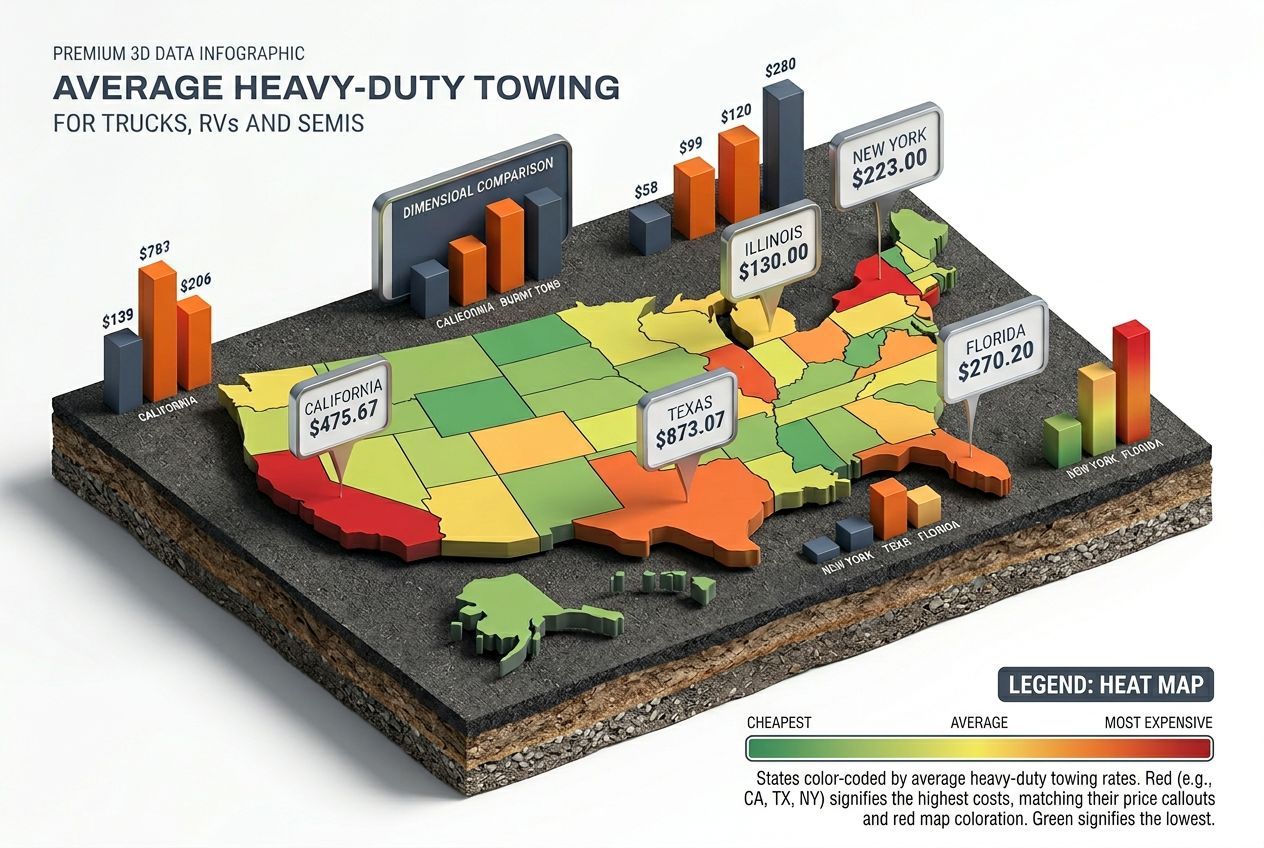
Heavy-duty towing rates are typically calculated using a base hookup fee combined with a per-mile charge, which is tiered based on the vehicle's Gross Vehicle Weight Rating (GVWR) class. The FHWA categorizes Class 7 vehicles as 26,001–33,000 lbs and Class 8 as 33,001–80,000 lbs. These weight thresholds serve as the primary pricing gates for most towing companies.
Beyond just the weight class, dispatchers also factor in several other elements:
- Number of axles: More axles indicate greater rigging complexity and a higher potential for drivetrain damage if not handled correctly. Multi-axle tows frequently carry a per-axle surcharge of $50–$150.
- Loaded vs. unloaded: A loaded 53-foot trailer attached to a tractor approximately doubles the difficulty of the tow. Most companies itemize tractor-trailer combinations as separate charges.
- Winch-out labor: Recovery from off-road areas or ditches requiring a power take-off winch adds $250–$750, depending on the time and complexity involved. Severe off-road extractions that need multiple anchor setups can reach $1,500.
- Road conditions: Mud, ice, and steep grades increase both rigging time and equipment wear. Expect a 15–25% surcharge during declared winter weather conditions or following major weather events.
- Mileage from the dispatch yard: Most towing companies charge for the wrecker's travel to your location (often called "deadhead" or "response mileage"), not just the distance of the loaded tow. Always inquire if the quoted price includes this response mileage.
To compare rates across your state before committing to a quote, use our towing cost by state tool or review our towing fees breakdown guide.
⚙️
TOWING COSTS
Does Insurance Cover Heavy-Duty Towing?
While commercial auto insurance and motor truck cargo policies often include towing coverage, the reimbursement limits frequently fall short of actual heavy-duty towing costs. Standard commercial policies commonly cap towing reimbursement at $500–$5,000 per incident. This amount is usually sufficient for a light-vehicle tow but proves inadequate for a full semi-truck recovery. For passenger-vehicle context, our insurance towing coverage cost guide breaks down GEICO, State Farm, Progressive, USAA, and Allstate roadside add-on pricing — useful for fleet managers comparing personal and commercial coverage.
According to the U.S. Department of Transportation (transportation.gov), commercial vehicle operators are responsible for thoroughly understanding the terms of their motor carrier policies, including any towing endorsements. Many fleet operators unfortunately only discover these significant coverage gaps after a claim has been filed.
Realistic Options for Heavy-Duty Towing Coverage
Your realistic options for covering heavy-duty towing costs include:
- Commercial roadside assistance programs: Providers like AAA Commercial (aaa.com), Allstate Motor Club, or specialized trucking associations offer fleet-specific programs with towing coverage ranging from $10,000–$25,000 per incident. For operators running Class 8 equipment, this gap coverage can often be more cost-effective annually than a single uninsured recovery.
- Trucker-specific riders: Some commercial auto insurers provide a "towing and labor" rider tailored for heavy trucks. Limits of $5,000–$15,000 are available, but these require an explicit endorsement and are not typically included in basic commercial auto policies.
⚠️ Warning: Standard passenger vehicle roadside assistance plans, including basic AAA memberships, explicitly exclude commercial vehicles and those exceeding specific GVWR thresholds (usually 10,000–12,000 lbs). Do not assume your personal roadside plan will cover a company truck or a rental box van above these limits.
After-hours heavy-duty towing typically costs 25%–50% more than standard daytime rates. Emergency dispatches occurring between 10 PM and 6 AM often include a flat $150–$350 surcharge, in addition to the percentage premium on the base rate. For the passenger-vehicle equivalent — a full breakdown of after-hours towing cost by time window with tactics to negotiate the surcharge — see our after-hours pricing guide.
Weekend rates average 15%–30% higher than weekday pricing. Holiday weekends, such as Memorial Day, Fourth of July, and Labor Day, are peak demand periods for both RV towing and construction equipment. This means some markets experience full 50% premiums and significantly extended wait times.
✅ Pro Tip: For fleet managers, pre-negotiating after-hours rates with a regional towing provider can secure a 10–20% discount on emergency dispatches and guarantee priority response, a crucial advantage when a driver is stranded overnight.
Average wait times for a heavy wrecker usually run 45–90 minutes under normal conditions, according to dispatch industry estimates. In rural areas or during adverse winter weather, this window can stretch to 2–4 hours. Furthermore, some regions simply do not have a qualified Class 8 wrecker available within a 60-mile radius.
Highway incident management fees add another layer of expense. Several states, including Illinois and parts of the I-95 corridor, impose mandatory quick-clearance fees for heavy wrecker responses to interstate accident scenes. These state-assessed charges can add $500–$2,000 to the final invoice and are non-negotiable, irrespective of your chosen towing company's base rate.
For context on how distance affects cost on these emergency runs, our 100-mile towing cost guide provides a breakdown of long-haul rates that are often relevant when the nearest qualified heavy wrecker is not local.