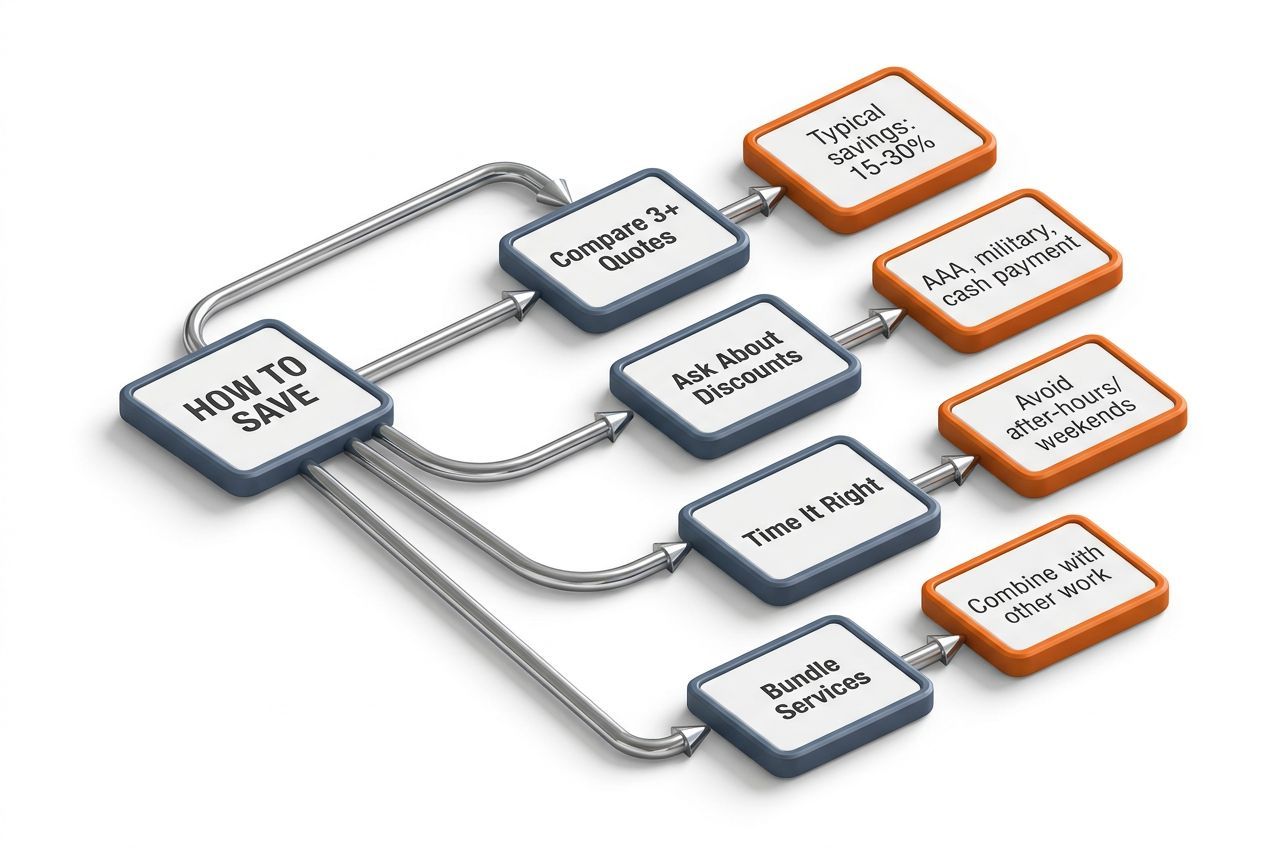
📊
TOWING COSTS
How Much Does It Cost to Tow a Car 100, 200, or 500 Miles?
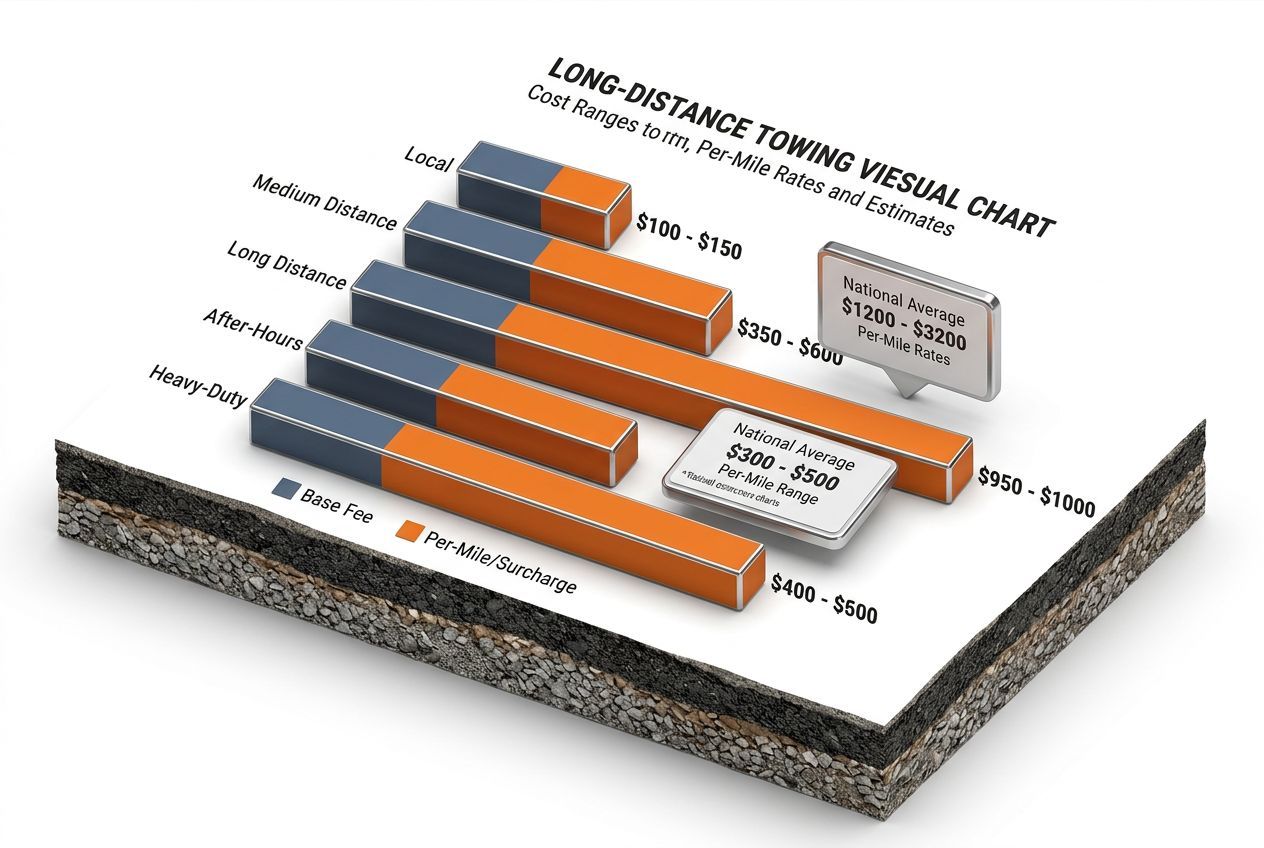
A 100-mile tow for a standard sedan costs approximately $300–$600, a 200-mile tow averages $500–$1,000, and a 500-mile tow typically runs $1,000–$2,500. Every quote starts with a $50–$150 hook-up fee before the per-mile rate kicks in, so short tows feel more expensive on a per-mile basis than long ones.
A Concrete Cost Example: Let's work through a concrete example. Say your sedan breaks down in Nashville and you need it towed to Atlanta — about 250 miles by I-24. At a mid-range rate of $4 per mile plus a $100 hook-up fee, your total is roughly $1,100. Add a $75 fuel surcharge (common when diesel tops $4/gallon) and you're at $1,175. If the breakdown happens on a Saturday night, that $100–$150 after-hours surcharge pushes you past $1,300. That's the realistic all-in number — not the base rate you might see advertised.
For a more granular look at the 100-mile scenario specifically, see our dedicated guide on how much it costs to tow 100 miles. And if you want to see how rates vary by state on that 250-mile Nashville-to-Atlanta run (or any other route), the towing cost by state tool can show you what local operators charge along your corridor.
Here's a quick reference table for distance-based estimates:
How Much Does It Cost to Tow a Car 100, 200, or 500 Miles? — data table
| Distance |
Estimated Cost (Sedan) |
Estimated Cost (SUV/Truck) |
Per-Mile Rate Range |
Notes |
| 50 miles |
$175–$400 |
$220–$550 |
$2.50–$7/mile |
Hook-up fee dominates total |
| 100 miles |
$300–$600 |
$380–$800 |
$2.50–$5.50/mile |
Flatbed standard above this distance |
| 200 miles |
$500–$1,000 |
$650–$1,350 |
$2.25–$4.75/mile |
Fuel surcharge often added |
| 500 miles |
$1,000–$2,500 |
$1,300–$3,400 |
$1.75–$4.50/mile |
Overnight driver cost may apply |
| 1,000+ miles |
$2,000–$6,500 |
$2,600–$8,500 |
$1.50–$3.50/mile |
Consider auto transport as alternative |
Source: TowingServiceHub.com editorial research, 2026.
🔧
TOWING COSTS
What Factors Affect Long-Distance Towing Rates?
Understanding the Main Cost Drivers: The biggest cost drivers for long-distance towing are total distance, vehicle size and weight, tow method, time of service, terrain, and current fuel prices. Oversize vehicles — think full-size pickup trucks, large SUVs, or dually configurations — typically add 20–40% to the base rate because they stress the tow truck's capacity and burn more fuel per mile.
Vehicle Type and Size
How Vehicle Type Impacts Cost: Vehicle type matters more than most people expect. A standard sedan rides at the base rate. An F-250 Super Duty or a Chevy Suburban pushes the operator into a heavier-duty unit, which costs more to operate and may require a Class IV or Class V hitch receiver rated for higher gross trailer weights. Some operators charge a flat heavy-vehicle surcharge ($100–$300), others just fold it into a higher per-mile rate — ask which method they use before you confirm the job.
Terrain and Route Complexity
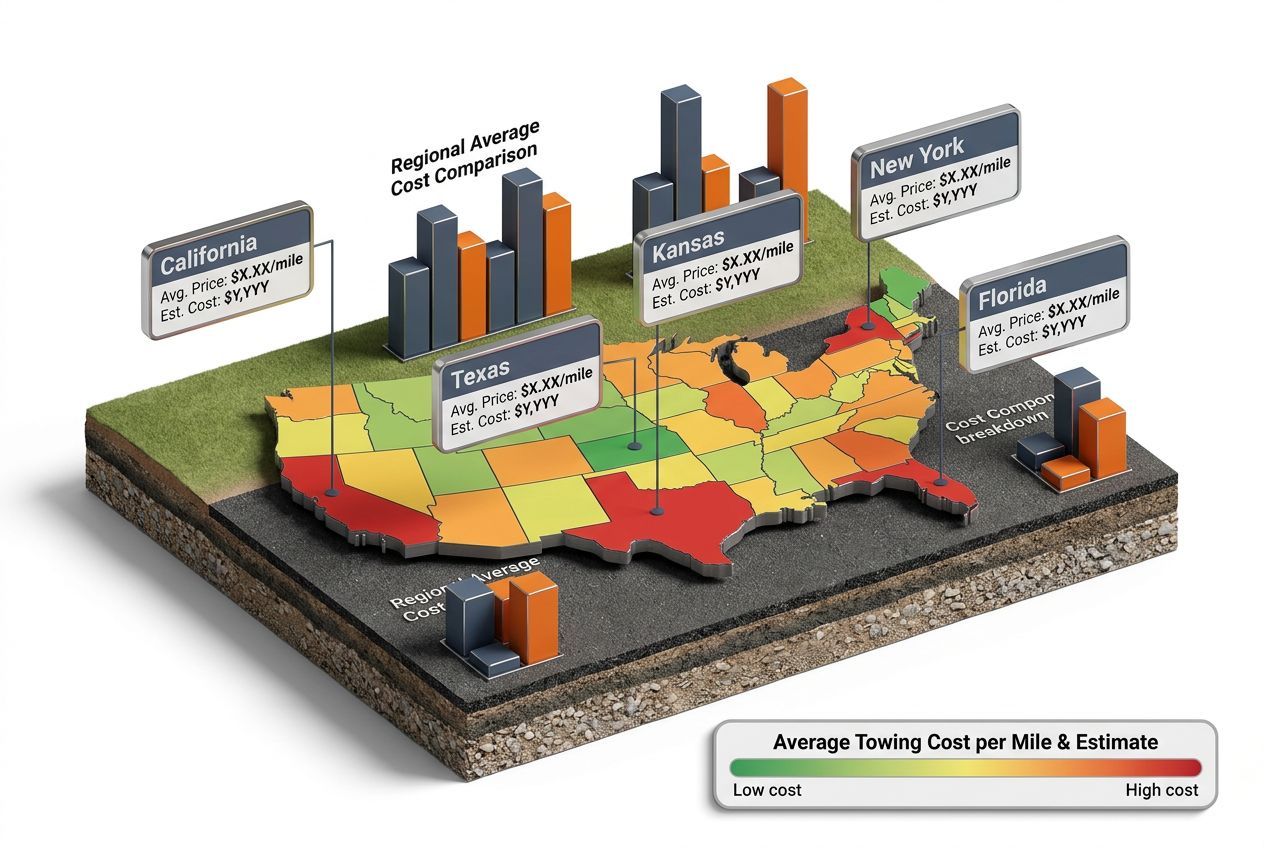
The Influence of Terrain: Terrain and route add real cost. A tow through the Rocky Mountains or Appalachians isn't priced the same as a flat interstate run through Kansas. Steep grades stress the tow truck's transmission and brakes, slow average speed, and increase fuel consumption. Operators who know a mountain route well price accordingly. Toll roads are another line item — on major corridors like I-95 or the Pennsylvania Turnpike, toll costs are usually passed directly to you, adding anywhere from $20 to $100+ on a long haul.
Timing of Service
Why Timing Affects Your Bill: Timing can swing your bill by $100–$250. After-hours service (typically 10 PM–6 AM), weekends, and federal holidays all carry surcharges. Roadside call volume also spikes on holiday weekends, which can slow response times.
✅ Pro Tip: If your situation isn't a true emergency, scheduling a weekday morning tow is the single easiest way to trim long-distance towing costs.
If you need a full breakdown of every line item you might see on a towing invoice, our towing fees breakdown guide walks through each charge individually.
🛡️
TOWING COSTS
Is Flatbed Towing More Expensive for Long Distances?
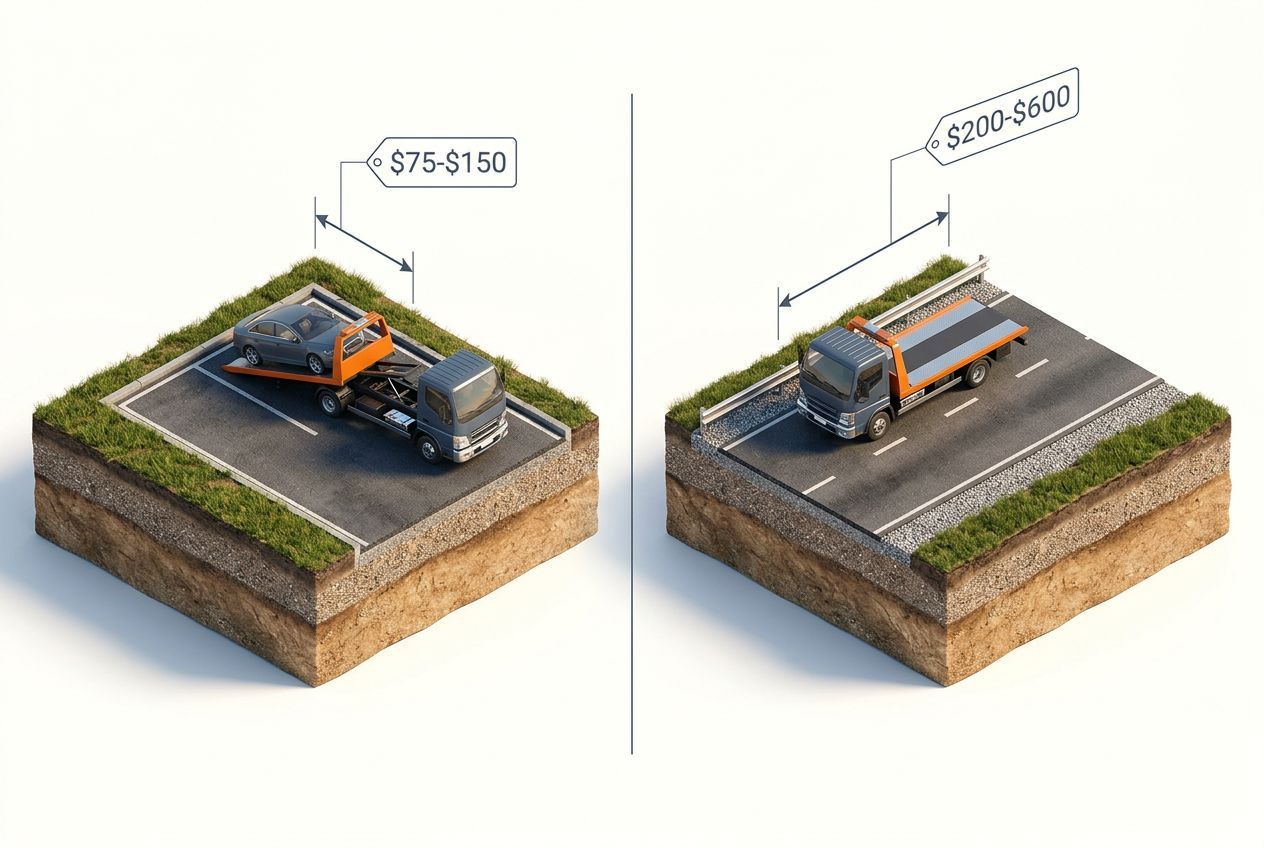
Flatbed Towing Costs Explained: Flatbed towing costs 15–30% more than dolly or wheel-lift towing for long-distance jobs, typically adding $1–$2 per mile to your rate. Despite the higher price, flatbed is the recommended method for any tow over 100 miles.
💡 Key Takeaway: Flatbed towing eliminates drivetrain wear, protects the vehicle from road debris, and reduces the risk of damage from bumps and vibration on extended highway runs, making it ideal for long distances.
The price difference becomes meaningful fast. On a 300-mile tow at $4/mile, flatbed might run you $1,200 versus $950 for a wheel-lift — a $250 premium. For most vehicle owners, that's cheap insurance against a $3,000 transmission repair caused by towing an AWD vehicle with the wrong method.
Drivetrain & Vehicle Protection
What Flatbed Won't Fix: If your vehicle's suspension is already damaged in an accident, loading it onto a flatbed can still cause additional stress if the operator doesn't use proper soft straps and wheel nets. The FMCSA cargo securement regulations (49 CFR Part 393) require specific tie-down methods based on vehicle weight. A reputable operator will know and follow them.
⚠️ Warning: Always ask to see how the tow operator is strapping your car before the truck leaves, especially for accident-damaged vehicles, to ensure proper securement.
Vehicles Requiring Flatbed Transport: Certain vehicles have no choice and require flatbed transport, including:
- AWD and 4WD vehicles (to prevent drivetrain damage)
- Lowered cars
- Vehicles with inoperable steering
- Vehicles with inoperable brakes
Putting a Subaru Outback on a tow dolly with the front wheels up while the rear driveshaft spins can destroy the center differential within miles. For more detail on flatbed-specific pricing, see our flatbed towing cost guide.
📋
TOWING COSTS
How Much Does Cross-Country Towing Cost?
Cross-country towing cost for a standard sedan runs $2,000–$6,500 for trips of 1,000–2,500 miles, and a true coast-to-coast tow (roughly 2,800 miles from Los Angeles to New York) typically lands between $4,000 and $7,000 by flatbed. Per-mile rates compress significantly at these distances, often dropping to $1.50–$3.00 per mile — but the raw dollar amount is substantial.
Cross-Country Cost Example: You're relocating from Phoenix to Chicago — approximately 1,800 miles. At $2.50 per mile (a reasonable rate for a long, well-traveled corridor) plus a $100 hook-up fee, your base cost is $4,600. A fuel surcharge at 10% adds $460. The driver needs a layover — most operators charge $150–$300 per overnight stop on multi-day hauls. Your realistic all-in cost: $5,200–$5,400.
At that price point, auto transport becomes a serious conversation — which we cover in the next section. For cross-country towing specifically, our long-distance towing cost pillar page aggregates current rate data across major interstate corridors.
Limitations and Broker Fees: One honest limitation to acknowledge: not every towing company will take a cross-country job. Many local operators don't have the licensing, insurance, or driver capacity for multi-state runs. You'll typically need to contact a national towing broker or a dedicated long-haul towing service. That added layer sometimes means a middleman fee of $100–$300 on top of the driver's rate. Ask whether you're dealing directly with the operator or a dispatcher who's brokering the job.
For heavy-duty vehicles — dually trucks, cargo vans, or large SUVs — cross-country costs jump another 30–50%. Our heavy-duty towing cost guide covers those scenarios specifically.
⚙️
TOWING COSTS
Does AAA Cover Long-Distance Towing?
AAA covers long-distance towing only with Plus or Premier membership tiers. AAA Classic covers tows up to 3–7 miles, depending on the club. AAA Plus covers up to 100 miles per service call, and AAA Premier covers one tow a year of up to 200 miles. Beyond those limits, members pay standard out-of-pocket per-mile rates — AAA does not cover full cross-country tows under any membership tier.
If you're using AAA Plus and your breakdown is 150 miles from home, they'll tow you 100 miles and you'll pay the per-mile rate for the remaining 50. That 50-mile gap at $4/mile plus fees could run $250–$300 — still less than a full out-of-pocket tow, but worth factoring into your expectations.
Is AAA Premier Worth It for Towing? According to AAA, Premier membership costs roughly $119–$164 per year depending on your regional club. If you tow once under Premier instead of paying $500+ out of pocket for a 150-mile tow, the membership pays for itself immediately.
✅ Pro Tip: AAA Premier membership can pay for itself with a single long-distance tow, especially if you frequently drive older vehicles or travel in areas with limited roadside infrastructure.
What AAA Membership Won't Cover: One thing AAA membership won't do: it won't cover a planned long-distance move of a vehicle. The benefit applies to breakdowns and disabled vehicles, not voluntary relocations. If you're moving and want to tow your second car across the country, you're paying out of pocket regardless of your membership level.
🚛
TOWING COSTS
Is It Cheaper to Tow a Car or Ship It Long Distance?
For distances over 300 miles, auto transport is typically 30–50% cheaper than towing, costing $0.50–$1.50 per mile on an open carrier versus $2–$7 per mile for a tow truck. On a 1,000-mile move, that difference can mean $1,500–$4,000 in savings. But shipping requires 3–14 days of lead time and doesn't work for emergency situations or inoperable vehicles that can't be driven onto a multi-car carrier.
Here's a realistic comparison for a 500-mile sedan transport:
Is It Cheaper to Tow a Car or Ship It Long Distance? — data table
| Factor |
Tow Truck (Flatbed) |
Open Auto Transport Carrier |
Enclosed Auto Transport (Luxury/Exotic) |
| Estimated Cost (500 miles) |
$1,100–$2,500 |
$500–$900 |
$900–$1,500 |
| Lead Time |
Immediate for emergencies |
3–14 days |
3–14 days |
| Emergency Use |
Yes |
No |
No |
| Inoperable Vehicles |
Yes |
Sometimes (extra charge) |
Sometimes (extra charge) |
| Vehicle Exposure |
Minimal |
Exposed to weather/debris |
Protected |
| Delivery Guarantee |
Usually specific |
Estimated windows |
Estimated windows |
Savings and Tradeoffs: The savings on open transport are real — but the tradeoffs matter. Your car sits on a multi-vehicle carrier, exposed to weather and road debris, and delivery windows are estimates, not guarantees. If you're moving a daily driver and the timeline is flexible, shipping wins on price. If you need the car at a specific destination by a specific date, or it's coming off an accident scene, towing is the only option.
Dealing with Auto Transport Brokers: Also worth knowing: auto transport brokers sometimes quote low to win your business and then struggle to find a carrier at that price. Get a quote directly from an asset-based carrier (one that owns their own trucks), not just a broker, whenever possible.
For motorcycle-specific long-distance cost comparisons, our motorcycle towing cost guide covers both shipping and towing options — rates and logistics differ significantly from standard passenger vehicles.
If you're comparing options for a planned move, the towing cost calculator and the rv-boat tow estimator can both help you model total cost across different vehicle and distance combinations before you commit.