Skip to content
💰 TOWING COSTS

Tow Truck Cost Per Mile: Complete Rate Breakdown

Published · Updated · 13 min read
MarkUpdated Mar 2, 2026AAA (aaa.com)
Key Takeaways
  • Per-mile towing rates run $2.50–$7.00 for most passenger vehicles, with a separate $50–$125 hook-up fee added to every bill.
  • Heavy-duty and commercial tows cost $5.00–$15.00+ per mile and require specialized equipment.
  • After-hours and holiday towing typically adds a 20–50% premium to standard per-mile towing rates.
  • AAA Plus covers up to 100 free tow miles per incident — making membership worth it after a single mid-range breakdown.
  • About 20 U.S. states cap rates on police-initiated tows; private calls are usually unregulated.

💰
TOWING COSTS

How Much Does a Tow Truck Cost Per Mile on Average?

Understanding the average per-mile cost: The average tow truck cost per mile for a standard passenger vehicle runs $2.50 to $7.00 across the U.S., with most bills landing between $3.00 and $5.00 per mile in typical suburban and metro markets. That mileage charge is always separate from the hook-up fee — so your true minimum cost before the truck even starts moving is $50 to $125.

💡 Key Takeaway: The mileage charge is always separate from the hook-up fee, meaning your true minimum cost is $50 to $125 before the truck even moves.

Calculating a typical tow: Say your sedan breaks down 12 miles from the nearest shop. At a $75 hook-up fee and $4.50/mile, you're looking at $75 + $54 = $129 total. That same scenario in a rural area — with a $100 hook-up fee and $6.50/mile — becomes $100 + $78 = $178. The mileage rate matters, but so does the base fee.

Regional variations significantly impact towing rates. Urban markets tend to sit at the lower end of the range because competition keeps prices honest. Rural and mountainous regions push toward the higher end, partly because response times are longer and fewer providers operate in those areas. For a broader look at what you'll pay from start to finish, see our full towing cost breakdown guide.

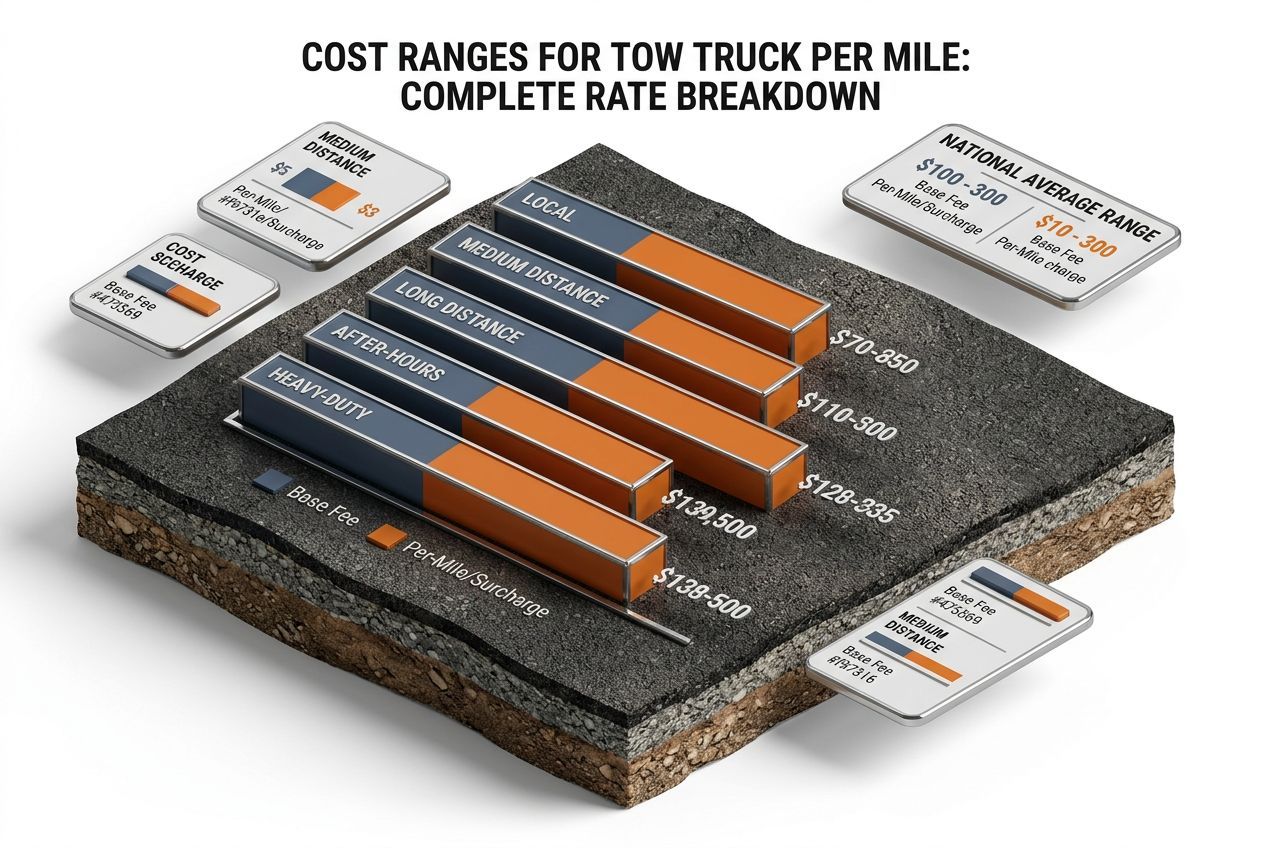
3D bar chart showing tow truck per mile: complete rate breakdown cost ranges by service type

Per-Mile Towing Rates by Region

Per-Mile Towing Rates by Region — data table
Region Avg. Hook-Up Fee Avg. Per-Mile Rate Notes
Urban / Metro $50–$85 $2.50–$4.00 High competition, shorter hauls
Suburban $65–$100 $3.00–$5.00 Moderate availability
Rural $85–$125 $4.00–$7.00 Fewer providers, longer response
Mountain / Remote $100–$200 $5.00–$10.00+ May require winching or off-road recovery
States with rate caps (FL, CA, TX) Statutory limits Varies by statute Caps apply to police-dispatched tows only

Source: State DOT rate schedules; industry surveys.


📊
TOWING COSTS

What Is the Hook-Up Fee for a Tow Truck?

The hook-up fee, a critical upfront charge, sometimes called a drop fee, service fee, or base charge, covers dispatching the truck, driving to your location, and securing your vehicle for transport. For standard cars, it runs $50 to $125. For heavy-duty or commercial vehicles, expect $100 to $300 or more.

💡 Key Takeaway: This initial charge covers dispatch, travel to your location, and securing your vehicle, ranging from $50–$125 for standard cars and $100–$300+ for heavy-duty vehicles.

Many drivers are surprised by the hook-up fee's impact. A 3-mile tow sounds cheap at $4/mile — that's only $12 in mileage — but add a $100 hook-up fee and you're paying $112 for what felt like a short trip down the road. Even if the truck sits at a red light for 10 minutes, that base charge doesn't change.

To avoid unexpected costs, some companies advertise a low per-mile towing rate to win the call and then make up the difference with a higher hook-up fee. Always ask for both numbers before authorizing any service. Our towing cost by state tool can help you cross-check local rates before you pick up the phone.

✅ Pro Tip: Always ask for both the hook-up fee and the per-mile rate before authorizing any towing service.


🔧
TOWING COSTS

How Much Does a Tow Truck Charge Per Mile for Long Distances?

Long-distance towing, typically over 100 miles, tends to run $2.00 to $4.00 per mile, which is lower per-mile than short hauls. The math makes sense: the hook-up fee is a fixed cost that gets spread over more miles, so the blended rate drops as distance increases.

📊 Quick Fact: A 200-mile tow, with a $100 hook-up fee and $3.00/mile, results in a total of $700. The blended rate drops as distance increases.

For extended hauls or interstate movements, carriers often offer flat-rate pricing rather than per-mile quotes. Get at least three quotes and ask each carrier whether they charge for deadhead miles — the distance the truck drives to reach you. Some do, some don't, and it can add $0.50–$1.50 per mile to your bill on remote pickups. For more detail on planning multi-state hauls, check out our long-distance towing cost guide.

⚠️ Warning: Some carriers charge for "deadhead miles" (the distance to reach you), which can add $0.50–$1.50 per mile to your bill for remote pickups.

Use the tool below to estimate your total towing cost based on your distance and vehicle type before calling a provider.

Try Our Free Towing Cost Calculator

Enter your pickup location, destination, and vehicle weight class in our towing cost calculator to get an instant estimate — no phone call required.


3D comparison of local versus long-distance tow truck per mile: complete rate breakdown costs
🛡️
TOWING COSTS

Does Tow Truck Cost Per Mile Vary by Vehicle Type?

Indeed, your vehicle's type is a major determinant in your per-mile towing rate. Heavier, wider, or more complex vehicles require specialized equipment, and that equipment costs more to operate. A flatbed rated for a loaded pickup costs significantly more per dispatch than a wheel-lift rig built for compact cars.

General Per-Mile Rates by Vehicle Class

Here's the general range by vehicle class:

  • Motorcycles: $2.00–$4.00/mile (specialty cradle or wheel-lift required)
  • Sedans and compact cars: $2.50–$5.00/mile
  • SUVs, crossovers, and light trucks: $3.50–$6.00/mile
  • Heavy-duty trucks, vans, and commercial vehicles: $5.00–$15.00+/mile

Motorcycle towing rates, while sometimes lower per mile, often come with a higher base fee ($100–$150) due to the specialized equipment and careful loading involved. See our motorcycle towing cost guide for the specifics.

At the heavy-duty end of the spectrum, a Class 8 semi-truck or loaded RV can run $10–$15 per mile or more, plus a heavy-duty hook-up fee of $200–$500. That's not a misprint. Rotating or uprighting an overturned commercial rig can push the total bill past $10,000. For those situations, review our heavy-duty towing cost breakdown before you call — rates vary more in that segment than in any other.

⚠️ Warning: Towing a Class 8 semi-truck or loaded RV can easily exceed $10–$15 per mile, with total bills potentially pushing past $10,000 for complex recoveries.

It's crucial to understand the type of tow truck dispatched. Flatbed towing isn't always the right call even when it's offered. Flatbeds protect all-wheel-drive and four-wheel-drive vehicles from driveline damage during transport — a wheel-lift tow on an AWD vehicle can spin the rear differential and cause real damage. But for a standard front-wheel-drive sedan over a 5-mile hop to the shop, a wheel-lift is cheaper and perfectly safe. Ask your provider which method they're dispatching, and why. Our types of tow trucks guide explains the tradeoffs in detail.

✅ Pro Tip: For AWD or 4WD vehicles, always request flatbed towing to prevent driveline damage. For standard FWD sedans on short trips, a cheaper wheel-lift is usually safe.


📋
TOWING COSTS

Are Towing Rates Higher at Night or on Weekends?

Expect to pay a premium for after-hours service. After-hours, weekend, and holiday towing rates are typically 20% to 50% higher than standard daytime rates — and that premium can show up as a higher per-mile rate, a flat surcharge, or both. A $3.50/mile daytime rate can become $5.25/mile at midnight on a Saturday.

Towing companies implement these surcharges because demand is often higher during these times, and staffing costs increase. Some companies add a flat after-hours surcharge of $50–$75 on top of their normal rate structure instead of adjusting the mileage charge. Either way, the total bill goes up. Major holidays — Memorial Day weekend, Fourth of July, Labor Day — see the sharpest spikes because demand is highest and staffing is thinnest.

Seasonal conditions also play a role. Winter months add another layer. In snow-belt states, demand surges during December through February, and response times can stretch from 45 minutes to several hours. Some operators charge a weather surcharge of $25–$75 during declared weather emergencies — entirely legal in most states.

⚠️ Warning: During declared weather emergencies in snow-belt states, expect potential weather surcharges of $25–$75, which are legal in most areas.

Strategic timing can lead to significant savings. If you have any flexibility, schedule your tow before 5 PM on a weekday and avoid holiday weekends. That single decision can save you $75–$150 on a standard urban tow. When you have no choice, confirm the after-hours rate in writing (text message is fine) before giving the dispatch your authorization.

✅ Pro Tip: If your vehicle is safely off the road, waiting to schedule a tow before 5 PM on a weekday can save you $75–$150 compared to an after-hours or holiday call.
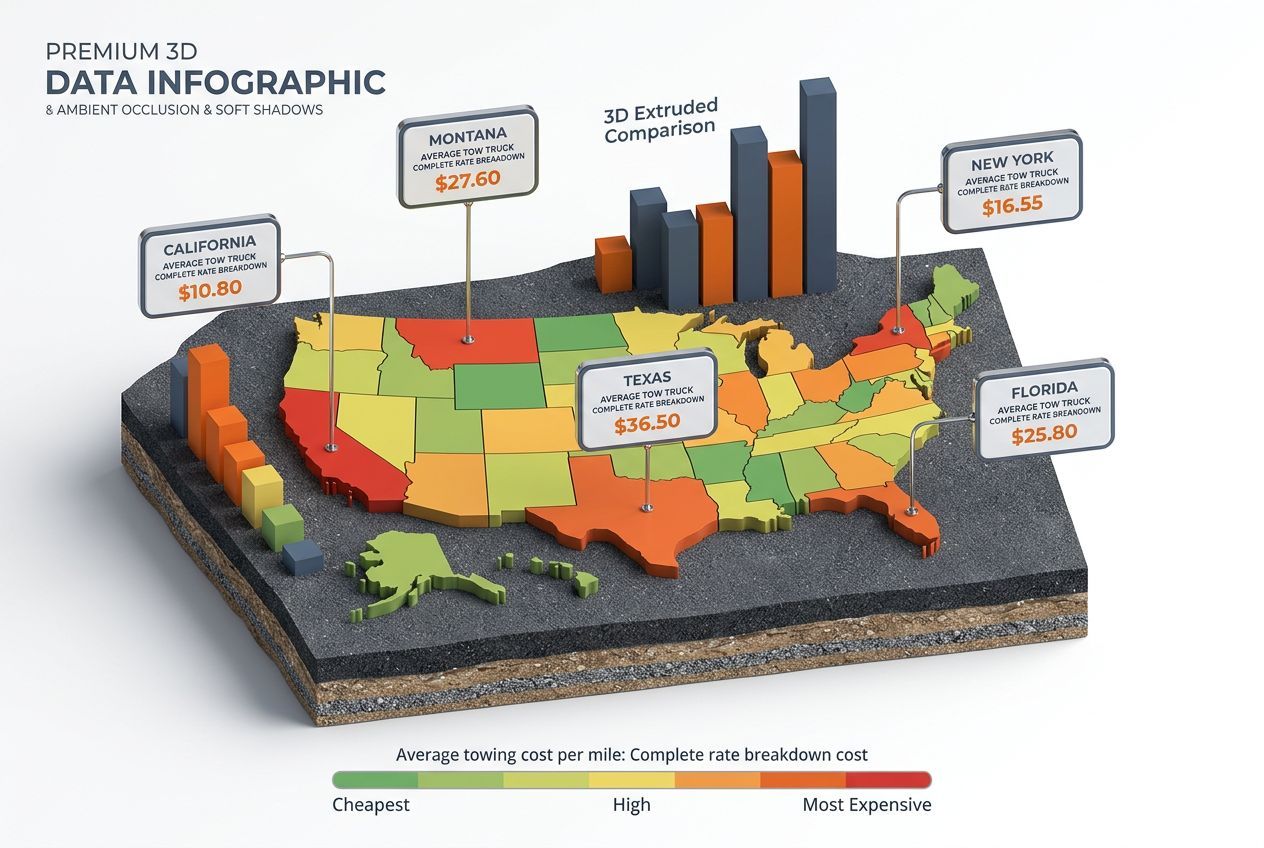

3D isometric US map showing average tow truck per mile: complete rate breakdown costs by state
⚙️
TOWING COSTS

How Much Does AAA Towing Cost Per Mile?

AAA membership offers substantial benefits when it comes to towing costs. AAA members pay nothing per mile up to their plan's included distance — 3–7 miles for Classic (depending on the club), 100 miles for Plus, and one 200-mile tow a year for Premier. Beyond those limits, the tow truck cost per mile averages $3.50 to $5.00, billed directly to the member.

The financial benefits of AAA often outweigh the annual cost. Annual membership costs $60–$170 depending on tier and region, according to AAA (aaa.com). Run the math: a single 40-mile tow at $4/mile plus a $100 hook-up fee would cost $260 out of pocket. An AAA Plus membership at $100/year covers that tow completely — and you get roadside assistance, battery service, and lockout help for the same price. If you tow even once a year beyond 10 miles, the membership pays for itself.

📊 Quick Fact: A single 40-mile tow, costing $260 out-of-pocket, would be entirely covered by an AAA Plus membership (approx. $100/year), which also includes roadside assistance and battery service.

One common misconception about AAA plans is that the short (3–7 mile) Classic limit is almost never enough. Most breakdown scenarios — engine failure, flat tire in an unfamiliar area, dead battery far from home — involve distances greater than 5 miles to the nearest qualified shop. Classic members who need a 25-mile tow still pay out of pocket for miles 6 through 25. Upgrading to Plus for $30–$50 more per year is almost always the better deal.

⚠️ Warning: The 3–7 mile Classic plan limit is often insufficient for most breakdown scenarios. Upgrading to AAA Plus for an additional $30–$50 annually is almost always a better value, covering up to 100 miles.

For an honest comparison of AAA against other roadside programs, including your auto insurance's roadside benefit, check our AAA roadside assistance review. That article walks through real scenarios where membership saves money — and a few where it doesn't.


🚛
TOWING COSTS

How Can I Reduce My Tow Truck Cost Per Mile?

Reducing your towing expenses is achievable through a combination of pre-planning, comparison shopping, and smart destination choices. The biggest lever most people ignore: where you tell the driver to take your car.

Most towing companies charge by the mile from your breakdown point to your destination. If you instruct them to tow to a dealership 18 miles away when there's a qualified independent shop 6 miles away, you've tripled your mileage charge. That choice alone can cost you $50–$100 extra on a standard tow.

Effective Strategies to Reduce Towing Costs

Here are the most effective cost-reduction strategies:

  • 1. Call at least three providers before authorizing. Rates in most markets vary by 30–50% between the highest and lowest quotes for the same job. Use our cheap towing near me guide to find vetted low-cost providers in your area.
  • 2. Avoid rotation tow lists. When police dispatch a tow truck after an accident, they pull from a rotation list of approved vendors. Those vendors often charge significantly more than the market rate because they know you can't shop around. You have the legal right in most states to request your own towing company — even at an accident scene. NHTSA (nhtsa.gov) recommends drivers be informed of this right before a rotation tow is dispatched.
  • 3. Use your auto insurance roadside benefit. Many comprehensive auto policies include roadside assistance with towing coverage of $50–$150 per incident. That's not a lot, but it offsets the hook-up fee almost entirely. Check your declarations page — most people have this benefit and never use it.
  • 4. Ask about flat-rate pricing for longer hauls. For trips over 50 miles, many carriers will negotiate a flat rate that beats the per-mile calculation. This works especially well for long-distance towing scenarios where you have time to make a few calls.
  • 5. Time it right. A daytime weekday tow saves 20–50% over an after-hours call. If your car is safely off the road and you can wait until morning, do it.

For a full view of what drives towing costs from every angle, our complete towing cost guide is the best place to start your research.
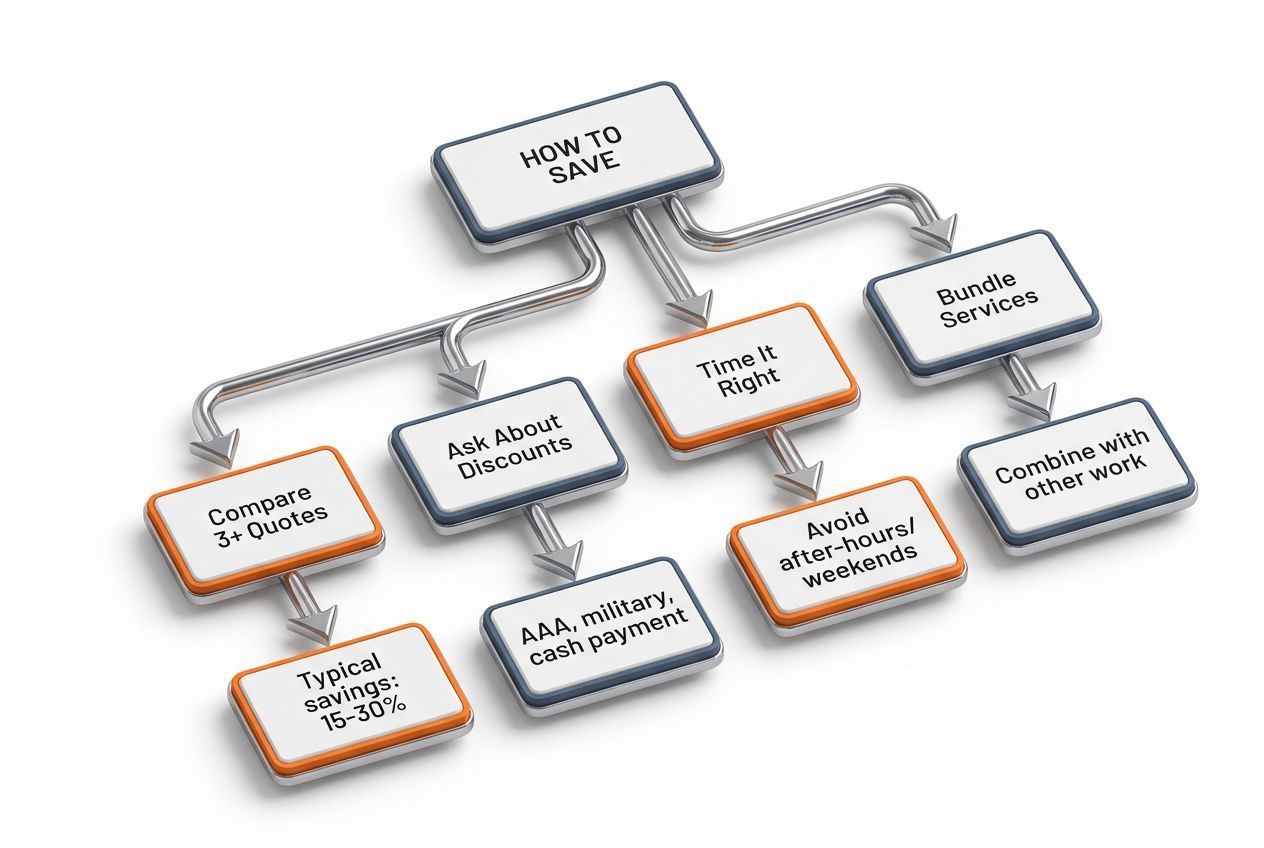
3D flowchart showing ways to reduce tow truck per mile: complete rate breakdown costs

Sources & Methodology

Rate ranges in this article were compiled from the following sources. Per-mile figures reflect data current as of early 2026.

  1. 1.
    AAA (aaa.com) — Membership tier pricing, included tow distances, and out-of-pocket per-mile rates for AAA-dispatched services.
  2. 2.
    National Highway Traffic Safety Administration — nhtsa.gov — Consumer rights guidance related to rotation tow lists and post-accident towing authorization.
  3. 3.
    Federal Motor Carrier Safety Administration — fmcsa.dot.gov — Commercial vehicle towing regulations, weight class definitions, and cargo securement standards used to define heavy-duty towing categories.
  4. 4.
    State DOT rate schedules (Florida, California, Texas) — Used to identify states with statutory caps on police-initiated towing rates. Accessed via individual state transportation department websites.

Methodology: Regional per-mile rates were cross-referenced across industry surveys, consumer-reported pricing data, and publicly available carrier rate sheets. Ranges reflect the 10th to 90th percentile of reported rates and should be used as estimates — actual quotes will vary by provider, market, and vehicle condition.

TowingServiceHub is reader-supported: we may earn money from ads and from some links on this page. See our editorial policy.

Mark — Founder & Editor

Mark

Founder & Editor

Mark is the founder and editor of TowingServiceHub, which he launched in 2026 after struggling to find clearly sourced towing costs and truck specs. He works in enterprise technology and tows his own boats, trailers, and equipment, so he knows the questions drivers actually ask.

Read full bio →

Need a tow truck right now?

Browse vetted local providers in your area. Real Google ratings, verified business info, free to use.

Or browse all 50 states from our directory

Frequently Asked Questions

The average tow truck cost per mile is $2.50 to $7.00 for standard passenger vehicles, plus a hook-up fee of $50 to $125. Total cost for a typical 10-mile tow runs $100 to $200 depending on your region and the type of truck dispatched.

Most towing companies charge a flat hook-up fee plus a per-mile rate. Some carriers offer flat-rate pricing for long-distance hauls over 50–100 miles. Always ask for both numbers upfront — the per-mile rate alone doesn't tell you your true total cost.

A 20-mile tow for a standard sedan usually costs $150 to $250. At $4/mile plus a $100 hook-up fee, you're at $180. Rural or after-hours tows at the same distance can push to $250 or more depending on surcharges and regional rates.

Most comprehensive auto insurance policies include roadside assistance with towing coverage of $50 to $150 per incident. That typically covers the hook-up fee but only partially offsets mileage charges on longer tows. Check your declarations page for your specific per-incident limit.

Yes — flatbed towing costs roughly $1.00 to $2.00 more per mile than wheel-lift towing because the equipment is larger and more expensive to operate. However, flatbeds are required for AWD and 4WD vehicles to prevent driveline damage, making the extra cost necessary in those cases.

Related Articles

Explore More Towing Guides

Browse all 157 expert guides and 10 free tools.