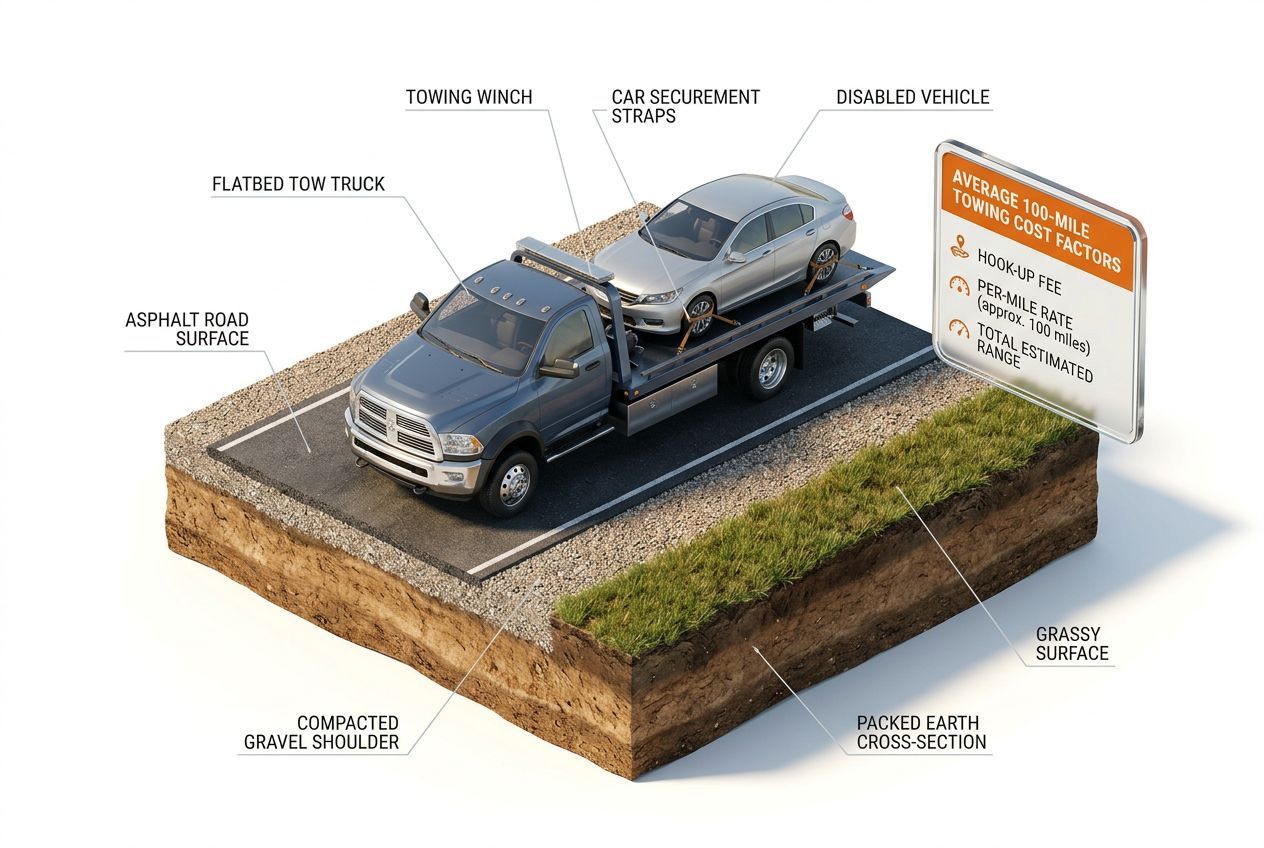
Rural vs. Urban Rates: Regional cost benchmarks matter most if you're deciding whether to call a local tow truck or shop around. In rural areas, "shopping around" is often limited to one or two providers — which is why rural rates often run higher than urban rates.
If you're in a high-cost state, our cheap towing near me guide covers exactly how to find competitive rates without sacrificing reliability.
🛡️
TOWING COSTS
Does AAA Cover a 100-Mile Tow?
AAA Membership Tiers and Coverage: AAA covers a 100-mile tow only on its Plus membership tier — the Basic/Classic plan covers just 3–7 miles per tow, depending on the club. AAA Plus runs approximately $100–$125 per year and covers up to 100 miles per towing incident. The Premier tier (roughly $150–$175/year) extends that to 200 miles. If you exceed your covered distance, you pay the per-mile overage at the tow company's standard rate.
💡 Key Takeaway: If you have AAA Plus and your car breaks down exactly 100 miles from home, you pay $0 out of pocket for the tow — a potential savings of $250–$600 on a single incident. The membership pays for itself the first time you use it for a long haul.
Important AAA Exclusions: But there's a catch: AAA's network dispatches contracted towers, and response times in rural areas can run 90 minutes or longer. If you're on a busy interstate, that wait matters.
⚠️ Warning: AAA won't cover commercial vehicles, vehicles over certain weight thresholds (typically 10,000 lbs GVWR), or tows that are part of an at-fault accident claim. Always read the exclusions before assuming full coverage. According to AAA, members must also be present with the vehicle for service — you can't call on behalf of someone else's car.
For a full breakdown of whether AAA's annual fee makes financial sense for your situation, see our AAA roadside assistance review.
📋
TOWING COSTS
What Factors Affect the Cost of a 100-Mile Tow?
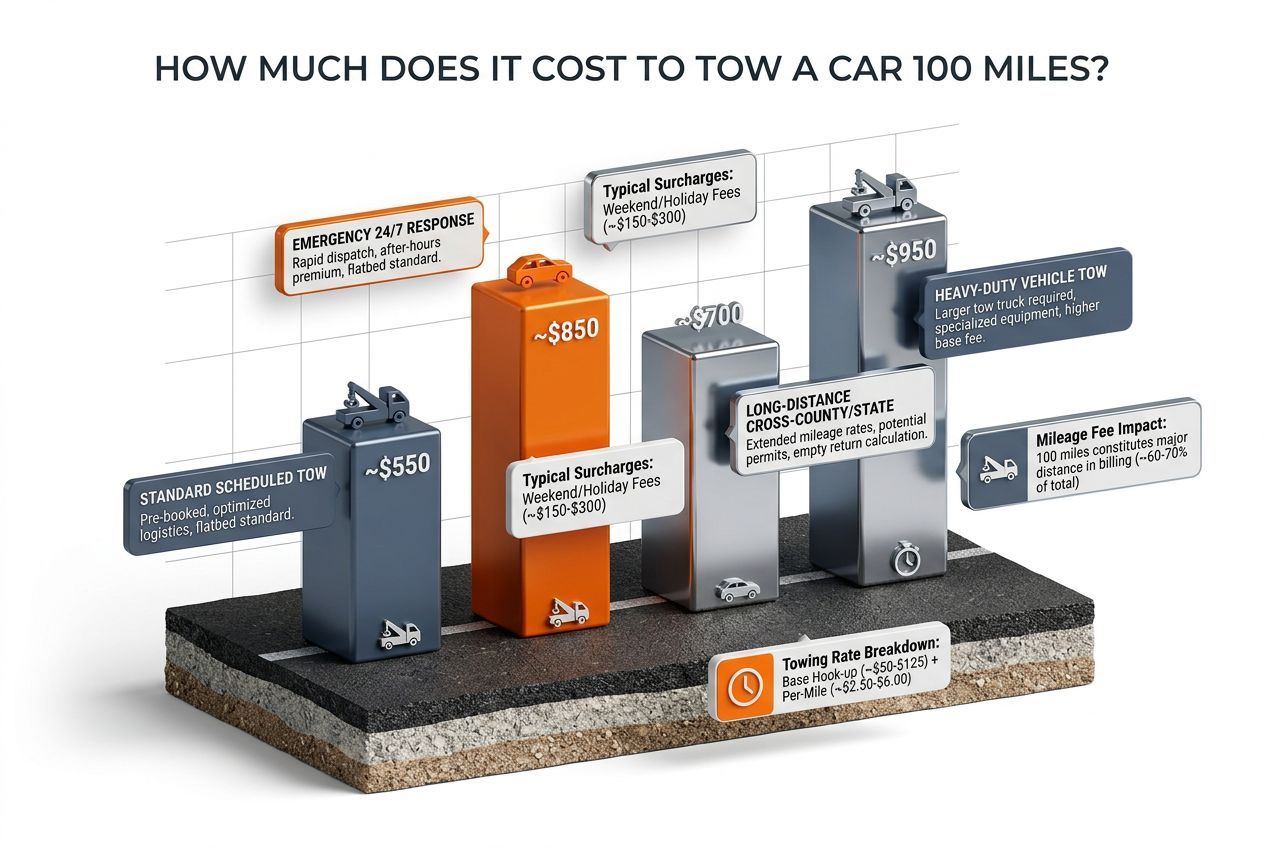
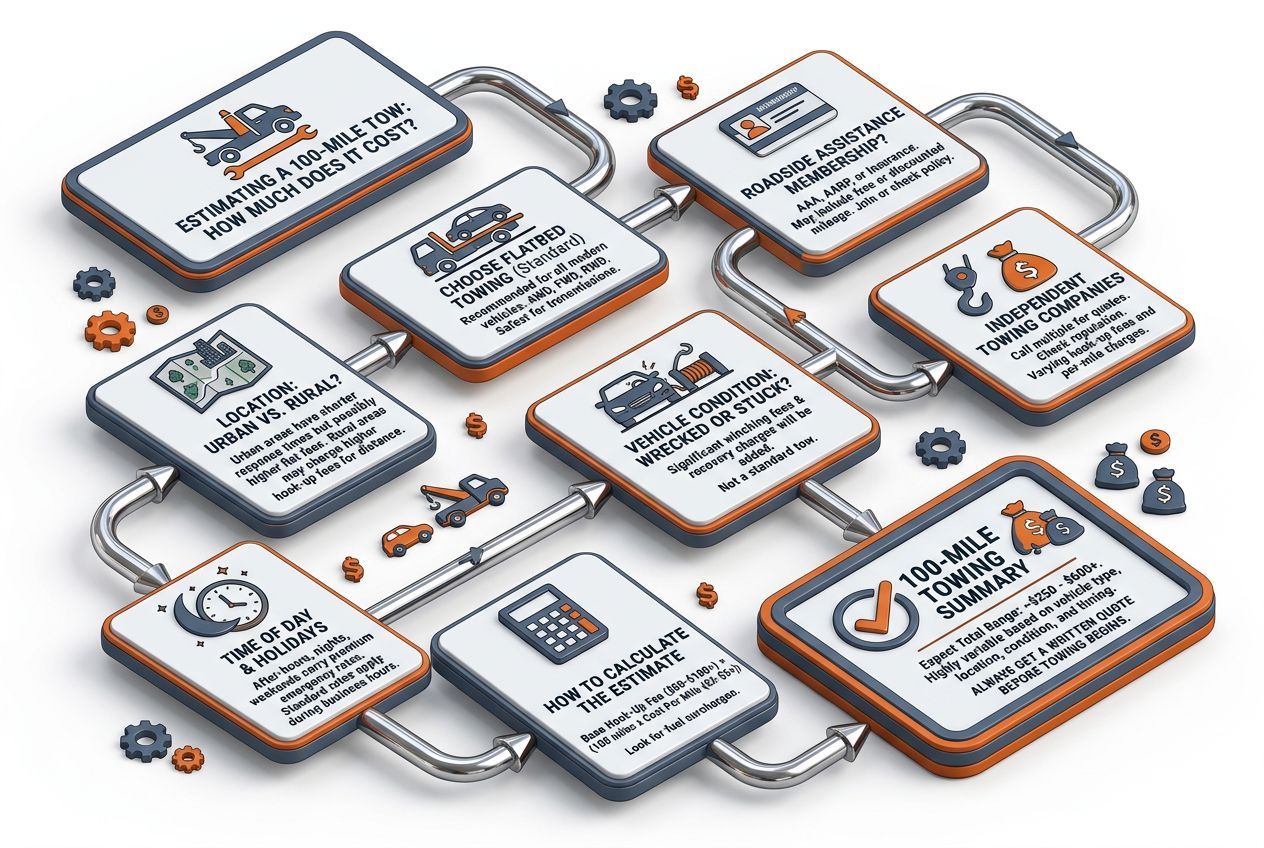
Key Cost Drivers Beyond the Base Rate: Several variables drive the final tow truck 100 miles price beyond the base rate. Vehicle weight and type matter most — towing a loaded F-250 costs 30–40% more than a Honda Civic because heavier vehicles require a Class 7 or Class 8 rollback with a higher operating cost. Time of day is the second-biggest variable: after-hours and weekend surcharges of $50–$150 are standard across most markets.
Here's a breakdown of the main cost drivers:
1. Tow method
Flatbed towing costs 15–25% more than wheel-lift.
- For AWD vehicles, rear-wheel-drive sports cars, or anything with less than 4 inches of ground clearance, a flatbed isn't optional — it's required to avoid drivetrain damage.
⚠️ Warning: Don't let a dispatcher talk you into a wheel-lift to save $40 if your car genuinely needs a flatbed. Our flatbed towing cost guide explains the rate difference in detail.
2. Terrain and road conditions
Mountain routes in Colorado, Montana, and Utah add real cost.
- Operators account for slower speeds, higher fuel burn, and increased brake wear on descents.
📊 Quick Fact: According to NHTSA vehicle operation data available at nhtsa.gov, steep grades increase fuel consumption by 20–30% for heavy vehicles. That cost passes to you in the per-mile rate.
3. Seasonal surcharges
- Winter towing in northern states runs 15–25% higher from November through March. Ice and snow increase both recovery complexity and risk.
- Holiday weekends — Memorial Day, Fourth of July, Labor Day — see surcharges of up to 50% above standard rates because demand spikes and staffing is limited.
4. Vehicle accessibility
- If your car went off-road, into a ditch, or is stuck on a flooded street, you're not getting a standard tow rate.
- Recovery operations — winching, extraction, rigging — are billed separately and can add $150–$500 on top of the tow itself.
Our towing fees breakdown guide covers every line item you might see on a tow invoice.
⚙️
TOWING COSTS
Is It Cheaper to Tow or Transport a Car Long Distance?
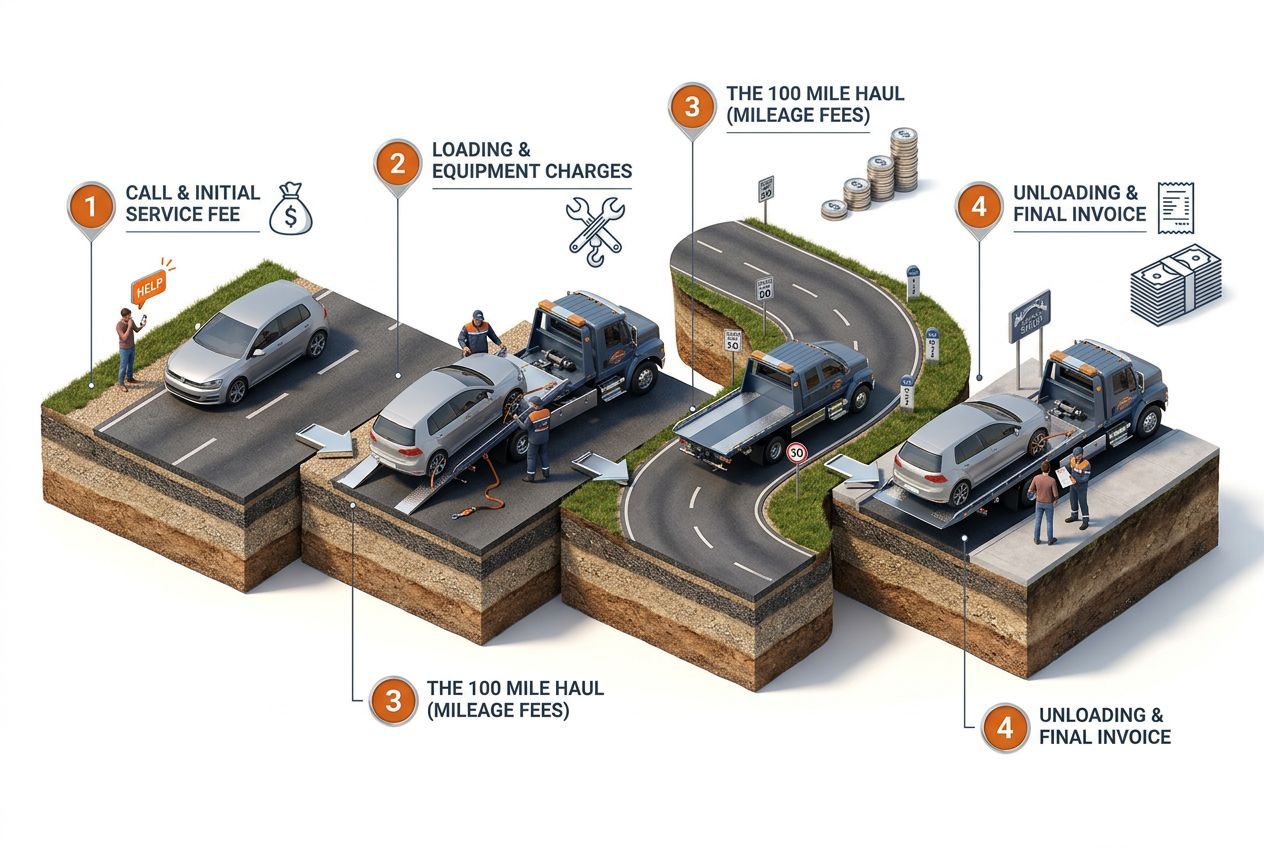
Towing vs. Auto Transport for 100 Miles: For 100 miles specifically, a local tow truck is almost always cheaper than booking an auto transport carrier. Open car transport carriers typically set a minimum haul distance of 200–250 miles, and short-distance quotes often run $400–$800 because they can't back-haul efficiently on a short route. A tow truck at $250–$600 for 100 miles beats that in most scenarios.
The Crossover Point: The math flips somewhere between 200 and 400 miles. At 300+ miles, open transport carriers can move your car for $0.40–$0.70/mile loaded on a multi-car hauler, while a dedicated tow truck at $3–$5/mile becomes prohibitively expensive. At 300 miles, a tow truck might run $900–$1,500. A transport carrier does the same job for $600–$900.
⚠️ Warning: Most national carriers won't prioritize a 100-mile pickup — your vehicle may sit on a lot for 3–7 days waiting for a carrier headed in your direction. If you need your car moved today or tomorrow, a tow truck is the only realistic option.
For longer hauls, our long-distance towing cost guide breaks down the crossover point where transport beats towing on cost.
🚛
TOWING COSTS
How Can You Reduce the Cost of a 100-Mile Tow?
Strategies for Lowering Your Towing Bill: You can meaningfully cut the cost to tow a car 100 miles by timing your call, getting multiple quotes, and using membership or insurance coverage you may already have. The single most effective move is asking for a flat-rate quote on any tow over 50 miles — most reputable companies will give you one, and it protects you from billing surprises.
Five concrete steps to lower your bill:
-
Call during business hours (Mon–Fri, 7 a.m.–5 p.m.)
- Avoid the $50–$150 after-hours surcharge.
- If your car is safely parked and not a safety hazard, wait until morning to call.
-
Get three quotes before committing
- Price variation between tow companies in the same market can run $75–$150 for the same job.
- The towing cost calculator can help you benchmark a fair rate before you call.
-
Check your credit card benefits
- Several premium cards (Chase Sapphire Reserve, certain Amex products) include roadside assistance with towing reimbursement up to $50–$100 per incident.
- It won't cover everything, but it's free money you already have.
-
Verify your auto insurance policy
- Adding roadside assistance to a standard auto policy costs $2–$5/month and can cover $100–$200 of towing costs.
- Per transportation.gov, consumers have the right to choose their own tow provider — don't let an insurer force you to a preferred tower that charges more.
-
Consider AAA Plus before your next road trip
- At $100–$125/year with 100-mile tow coverage, one long-distance breakdown pays for multiple years of membership.
- If a 100-mile tow is in your future, join before you leave.
Our full how much does towing cost guide covers every savings angle in one place.
📝
TOWING COSTS
Does Insurance Cover Long-Distance Towing?
Limitations of Standard Auto Insurance for Long Tows: Standard auto insurance roadside assistance add-ons cover towing, but the limits are low. Most policies cap reimbursement at $50–$100 per incident or restrict coverage to 15–25 miles — nowhere near enough for a full 100-mile tow. Even enhanced roadside riders that cost $2–$5/month typically max out at $150–$200 per tow, leaving you responsible for $100–$400 of a mid-range 100-mile tow bill.
💡 Key Takeaway: Many drivers assume their insurance will handle a roadside emergency end-to-end. It won't — not for long distances. The $75 towing reimbursement buried in your policy was written when "towing" meant three miles to the nearest shop, not 100 miles to a dealership in the next city.
⚠️ Warning: Your best combined strategy is to layer coverage: AAA Plus or Premier for the tow distance itself, plus your insurance reimbursement as a secondary offset. Together, they can cover the majority of a 100-mile tow bill at a combined annual cost of roughly $125–$175.
For context on how heavy-duty towing interacts with insurance, coverage gaps are even more pronounced — most personal auto policies exclude vehicles over 10,000 lbs GVWR entirely.