💡 Key Takeaway: Standard flatbed towing costs $3.50–$7.00 per mile plus a $75–$150 base hookup fee in 2026. 💡 Key Takeaway: AWD, EV, and luxury vehicles require flatbed service and pay 20–50% above standard flatbed towing rates. 💡 Key Takeaway: A 100-mile flatbed tow typically runs $400–$750 depending on region, vehicle type, and time of day. 💡 Key Takeaway: After-hours and holiday surcharges add $50–$100, pushing emergency flatbed tow cost up 25–50%. 💡 Key Takeaway: Most insurance policies reimburse only $100–$200 per incident — often less than the actual flatbed tow truck price.
Understanding flatbed towing costs in 2026 reveals an average of $3.50–$7.00 per mile, applied after an initial hookup fee typically ranging from $75–$150. This structure means a standard local tow often falls between $109–$195 for the first five miles. Be aware that luxury, All-Wheel Drive (AWD), and Electric Vehicles (EVs) usually incur a 20–50% premium. Additionally, after-hours and weekend calls will add another $50–$100 to your total cost.
In This Article
💰
TOWING COSTS
How Much Does Flatbed Towing Cost per Mile?
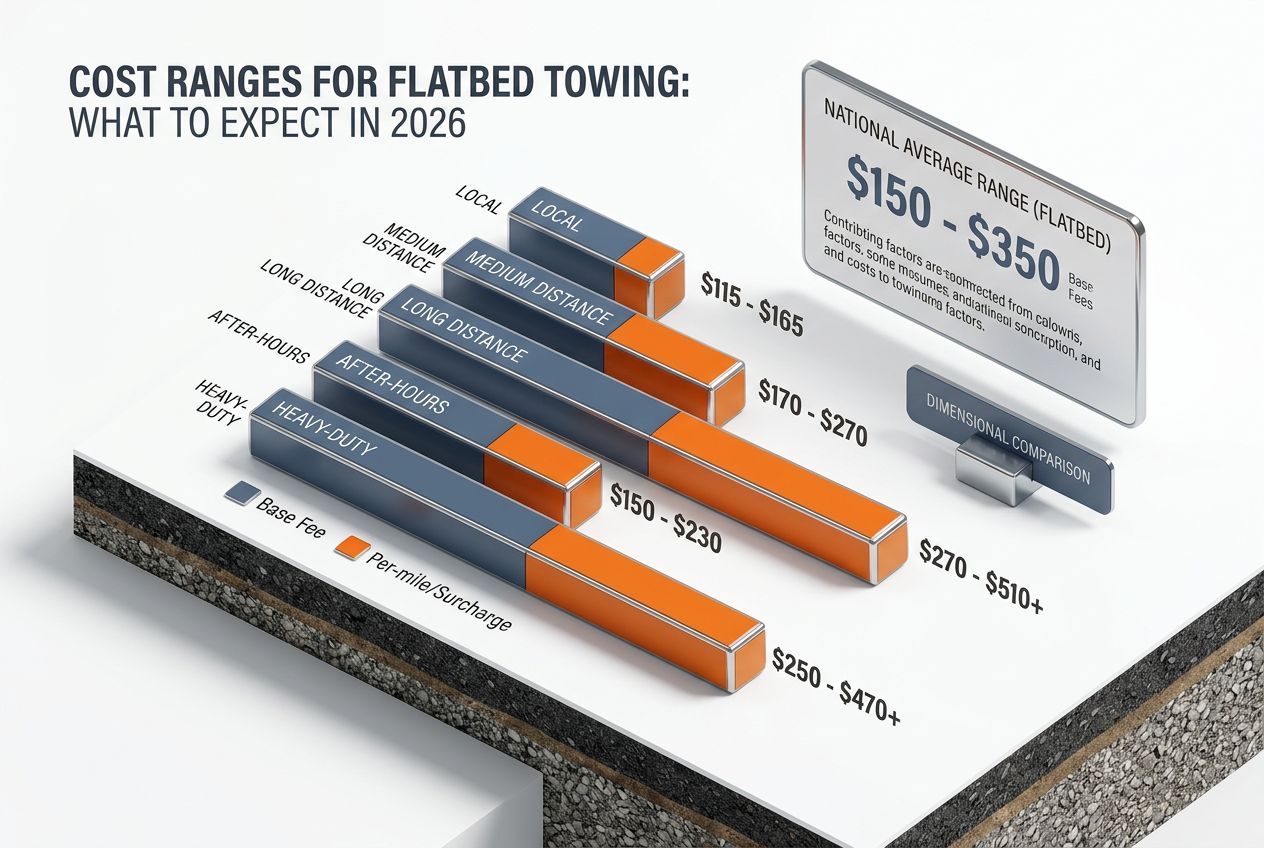
Flatbed towing rates in 2026 typically average $3.50–$7.00 per mile, following an initial hookup fee of $75–$150. Most towing services employ a pricing model that includes a flat base rate for the first 5–10 miles, with subsequent per-mile charges. You'll find urban areas generally have rates at the lower end of this spectrum, while rural or highway recoveries often incur higher flatbed towing rates due to factors like limited competition and longer travel distances for the tow operator.
Let's calculate a common scenario: Imagine your vehicle breaks down 18 miles from the nearest service center. With a typical $100 hookup fee and a $5.50 per-mile rate, your flatbed tow cost would be $100 + (18 miles × $5.50/mile) = $199. If you're in a remote rural area, that per-mile rate could increase to $7.00 or more, pushing the same 18-mile tow to $226 before any additional surcharges.
For a full breakdown of how per-mile rates compare across all tow truck types, see our tow truck cost per mile guide.
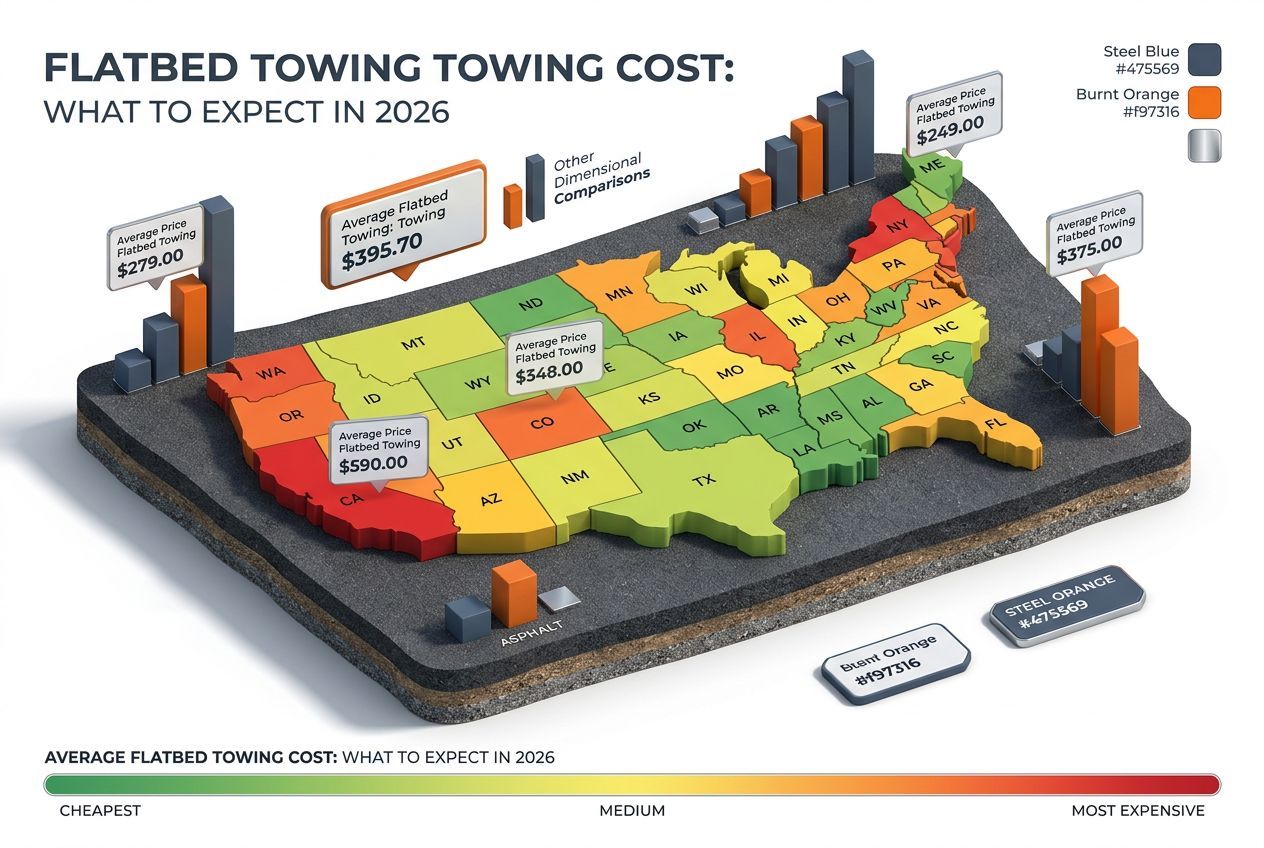
Regional differences significantly impact pricing. States like California experience some of the nation's highest flatbed towing rates, with base fees in major metro areas reaching $125–$175, driven by strict labor regulations and high fuel costs. Conversely, Southeast markets such as Georgia or Tennessee often see lower base fees, typically in the $75–$100 range.
| Distance | Low Estimate | High Estimate | Assumptions |
|---|---|---|---|
| 5 miles (local) | $109 | $195 | $100 base + $3.50–$7/mi after mile 5 |
| 25 miles | $175 | $350 | $100 base + per-mile after mile 5 |
| 50 miles | $275 | $500 | Some companies offer flat-rate quotes at this range |
| 100 miles | $400 | $750 | Long-distance rates; per-mile may decrease |
| 200 miles | $700 | $1,400 | Often quoted as flat rate; negotiate directly |
TowingServiceHub editorial estimates; actual rates vary by market. See Sources & Methodology.
📊
TOWING COSTS
Why Is Flatbed Towing More Expensive Than Regular Towing?
Flatbed towing typically costs 20–40% more than traditional wheel-lift towing. This premium is justified by several factors, including:
- Specialized Equipment: Flatbed tow trucks utilize a hydraulic tilt-bed platform that lifts the entire vehicle, ensuring all four wheels are completely off the ground. This sophisticated equipment is significantly more expensive to purchase, maintain, and operate than a standard wheel-lift.
- Increased Fuel Demand: The larger size and heavier mechanisms of a flatbed truck inherently consume more fuel.
- Higher Driver Skill: Operating a flatbed, especially for complex loading scenarios or recovering damaged vehicles, requires a higher level of training and expertise from the driver.
The capital investment for flatbeds is substantial. A new standard wheel-lift truck might cost $60,000–$80,000, whereas a medium-duty flatbed, equipped with a hydraulic bed and winch system, can range from $120,000–$180,000. These higher capital costs directly contribute to the elevated prices for flatbed towing services.
Safety is a critical factor justifying the higher cost. Wheel-lift towing, which leaves two wheels on the ground, can transfer road vibrations and stress directly through the vehicle's drivetrain. While this might be manageable for a front-wheel-drive car with a minor issue, it can be catastrophically damaging for an All-Wheel Drive (AWD) vehicle, potentially destroying the center differential or transfer case in a very short distance. Flatbed towing completely mitigates this risk by ensuring all four wheels are suspended and off the ground.
Want to understand how different tow truck types affect your cost and vehicle safety? Our types of tow trucks guide breaks down the full equipment comparison.
🔧
TOWING COSTS
What Does Flatbed Towing Cost by Distance?
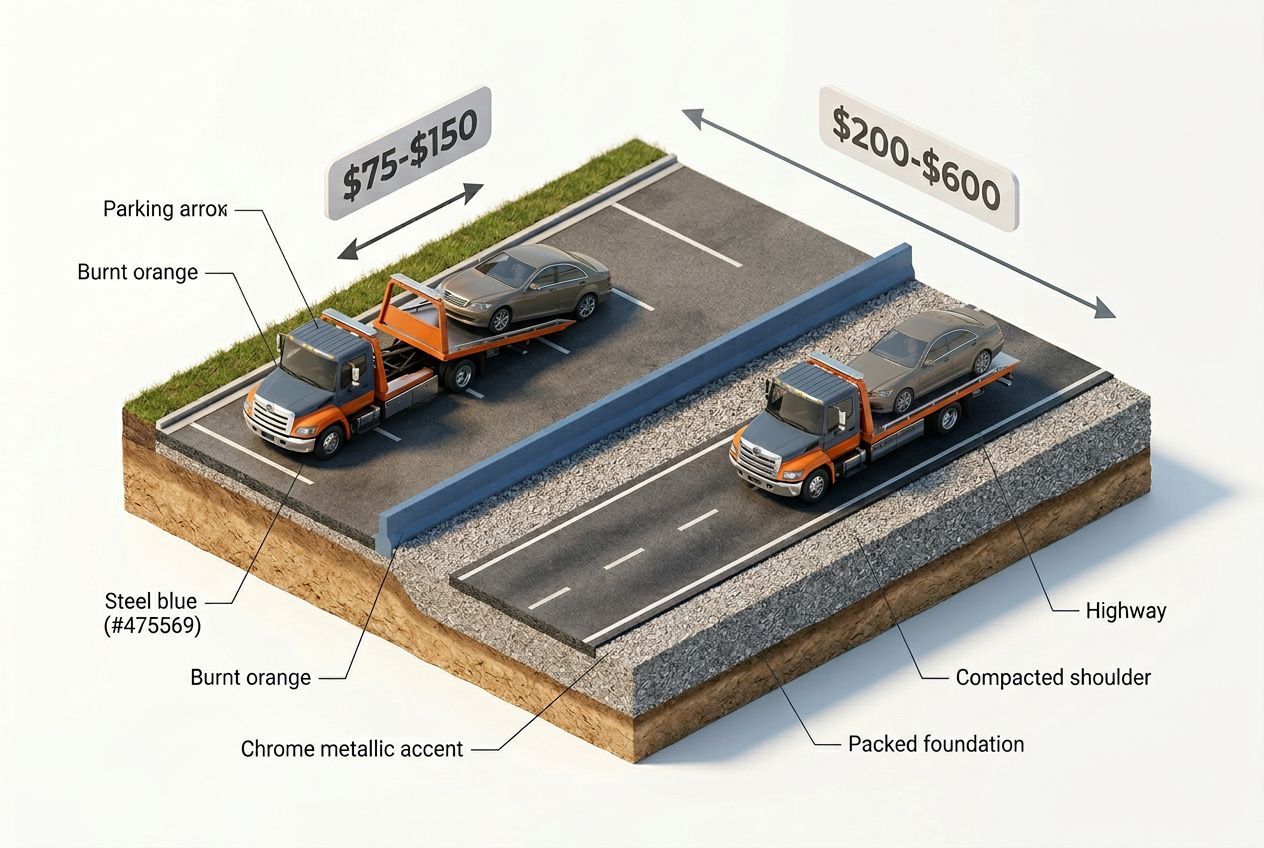
For longer distances, expect varied pricing structures. A 100-mile flatbed tow for a standard vehicle typically costs between $400–$750 in 2026, a range that incorporates both the hookup fee and per-mile charges. For distances exceeding 50 miles, some operators offer flat-rate pricing for long hauls. Negotiating a flat rate upfront can often be more advantageous than simply accepting the default per-mile structure.
Use the calculator below to get a real-time estimate based on your zip code, vehicle type, and distance.
Enter your details to get a ballpark estimate before you call a tow company — it'll help you spot quotes that are way off from market rates.
Try Our Free Towing Cost Calculator
Understanding distance-based pricing is key.
- Up to 25 Miles: Most tows in this range fall under standard per-mile rates, typically without any volume discounts.
- Around 50 Miles: This distance often represents a "gray zone" where some companies may begin to offer flat rates. It's crucial to explicitly ask for this option.
- 100 Miles and Beyond: For these longer distances, you'll generally benefit from obtaining quotes from two or three different operators. This includes long-distance towing specialists who frequently have distinct pricing models compared to local tow companies.
✅ Pro Tip: When arranging a long-distance flatbed tow, clarify the operator's mileage policy. Some quote "loaded miles only," charging solely for the distance your car is on the truck. Others use a "portal-to-portal" method, including the distance traveled to reach your location. Always ask which method they use before accepting a quote.
🛡️
TOWING COSTS
Does Insurance Cover Flatbed Towing Costs?
Insurance coverage for towing is often limited. Most comprehensive auto insurance policies provide reimbursement of $100–$200 per towing incident. While this might cover a short local flatbed tow, it's typically insufficient for trips exceeding 20–30 miles. This per-incident cap is clearly outlined in your policy declarations page and generally doesn't differentiate between standard and flatbed towing services. For carrier-by-carrier insurance towing coverage cost — including which providers extend to 100-mile premium tiers — see our add-on pricing guide.
💡 Key Takeaway: Always review your auto insurance policy's declarations page to understand your specific towing reimbursement limits, as most policies have a cap that may not fully cover longer flatbed tows.
Roadside assistance plans can offer significant benefits. For instance, AAA's entry-level membership covers towing up to 3–7 miles, depending on the club. Their AAA Plus tier expands this to 100 miles, and AAA Premier includes one tow a year of up to 200 miles — both of which include flatbed service when necessary. If you own an AWD vehicle, a Tesla, or a lowered car that consistently requires flatbed service, considering an AAA membership proactively can be a wise financial decision. For a full breakdown of AAA towing cost by tier — including the per-mile overage fee math beyond your tier's mileage cap — see our AAA pricing guide.
⚠️ Warning: Be aware of the limitations of even premium roadside assistance plans. These often include coverage caps per incident and annual maximums for the number of service calls. Towing multiple times within a single year could lead you to exceed your annual limit, leaving you responsible for subsequent costs. Always read the fine print regarding "number of service calls per membership year."
✅ Pro Tip: For insurance claims, meticulous documentation is crucial. Always obtain an itemized receipt from the tow operator that clearly separates the hookup fee, mileage, and any surcharges. Insurers frequently reject flatbed claims that only provide a lump-sum total, as it prevents them from verifying the type and cost of services rendered.
Check out our towing fees breakdown to see exactly what should appear on a legitimate tow receipt.
📋
TOWING COSTS
When Should You Use a Flatbed Tow Truck Instead of a Dolly?
⚠️ Warning: Flatbed towing is not merely a recommendation but a strict requirement for specific vehicle types and conditions. Failing to use a flatbed in these cases can lead to severe and costly damage, potentially $2,000–$5,000 in transmission or drivetrain repairs, according to NHTSA data. You MUST use a flatbed tow truck for:
- AWD and 4WD Vehicles: To prevent damage to the drivetrain, center differential, or transfer case.
- Lowered Cars: To avoid scraping the undercarriage or damaging aerodynamic components.
- Electric Vehicles (EVs): To protect sensitive battery management systems and electric drivetrains.
- Vehicles with Severe Mechanical or Collision Damage: When components are compromised, ensuring no stress is placed on specific axles or parts.
The core principle is drivetrain protection. A simple rule of thumb: if any part of your vehicle's drivetrain would rotate while the wheels spin during towing, a flatbed is essential. This applies to virtually all AWD cars currently available, including popular models like Subaru, Audi Quattro, Tesla dual-motor, BMW xDrive, and Ford EcoBoost AWD variants. For example, towing a 2025 Subaru Outback with a wheel-lift, even if only the front or rear wheels are lifted, will still cause the other set of wheels to spin the differential and center viscous coupler, potentially leading to enough heat to crack critical components within just 15 miles.
Manufacturer guidelines often mandate flatbed use. Major automakers, such as Toyota (toyota.com), explicitly state in their published towing guidelines that AWD models like the RAV4 and Highlander must be transported on a flatbed with all four wheels completely off the ground. Ford's guidelines for EcoSport and Escape AWD models echo this requirement. If a repair shop or insurance company attempts to dispatch a wheel-lift tow truck for your AWD vehicle, you have every right to refuse the service and insist on a flatbed.
For flat-towing questions — like when you can tow a vehicle with all four wheels down behind an RV — see our flat towing guide.
⚙️
TOWING COSTS
How Much Does Flatbed Towing Cost for Luxury or AWD Vehicles?
Luxury and AWD vehicles incur higher flatbed towing costs, typically running $150–$300 for the base fee, plus $5–$10 per mile. This represents a premium of roughly 30–50% above standard flatbed towing rates. For a 20-mile tow, a realistic total cost could range from $250–$500, depending on the service provider.
📊 Quick Fact: Towing luxury, exotic, or AWD vehicles on a flatbed can cost 30-50% more than standard flatbed rates, with a 20-mile tow potentially reaching $250-$500.
This cost premium is driven by three primary factors:
- Specialized Equipment: This includes soft tie-down straps designed for low-clearance vehicles, foam-lined wheel chocks for wide performance tires, and the option for enclosed transport for ultra-high-value automobiles.
- Additional Insurance Coverage: Operators transporting high-value vehicles typically carry enhanced liability insurance, and the cost of this coverage is integrated into the flatbed tow truck price.
- Certified Driver Handling: Many luxury auto dealers and exclusive marque clubs (e.g., BMW CCA, Porsche Club of America) partner with operators who have undergone manufacturer-specific training and adhere to precise loading and transport protocols.
Consider a real-world example: If your 2024 Tesla Model S Plaid experiences a charging issue mid-highway, Tesla's roadside assistance (if within the 4-year coverage) will dispatch a flatbed. This is because Tesla explicitly mandates flatbed-only transport for the Model S to safeguard its intricate battery management system. Outside of this warranty coverage, you'll be responsible for the cost. A 35-mile flatbed tow for a Model S in the Los Angeles area cost approximately $380–$450 in 2025, with 2026 rates projected to increase by 4–6% due to rising fuel surcharges.
For vehicles in the heavy-duty or commercial category, costs scale considerably higher — see our heavy-duty towing cost guide for specifics.
🚛
TOWING COSTS
Are Flatbed Towing Rates Higher at Night or on Weekends?
Yes, flatbed towing rates are significantly higher during off-peak hours. After-hours calls typically incur a $50–$100 surcharge, increasing the total flatbed tow cost by 25–50% compared to standard weekday business hours. The highest rates are reserved for emergency flatbed towing between 10 PM and 6 AM. Weekend and holiday calls also carry a premium, usually 20–35% above standard pricing. For the full after-hours towing cost breakdown by time window — daytime vs evening vs late-night vs weekend/holiday — see our surcharge pricing guide.
💡 Key Takeaway: Expect a $50-$100 surcharge for after-hours flatbed towing, increasing total costs by 25-50% compared to weekday rates.
This tiered pricing directly reflects higher operational costs. Overnight dispatching necessitates on-call drivers who are paid a shift premium. Additionally, reduced visibility at night increases the risks associated with recoveries, especially on highway shoulders. Furthermore, holiday surcharges on major dates like Thanksgiving, Christmas Eve, and New Year's Eve can escalate, sometimes adding $75–$150 above the standard rates.
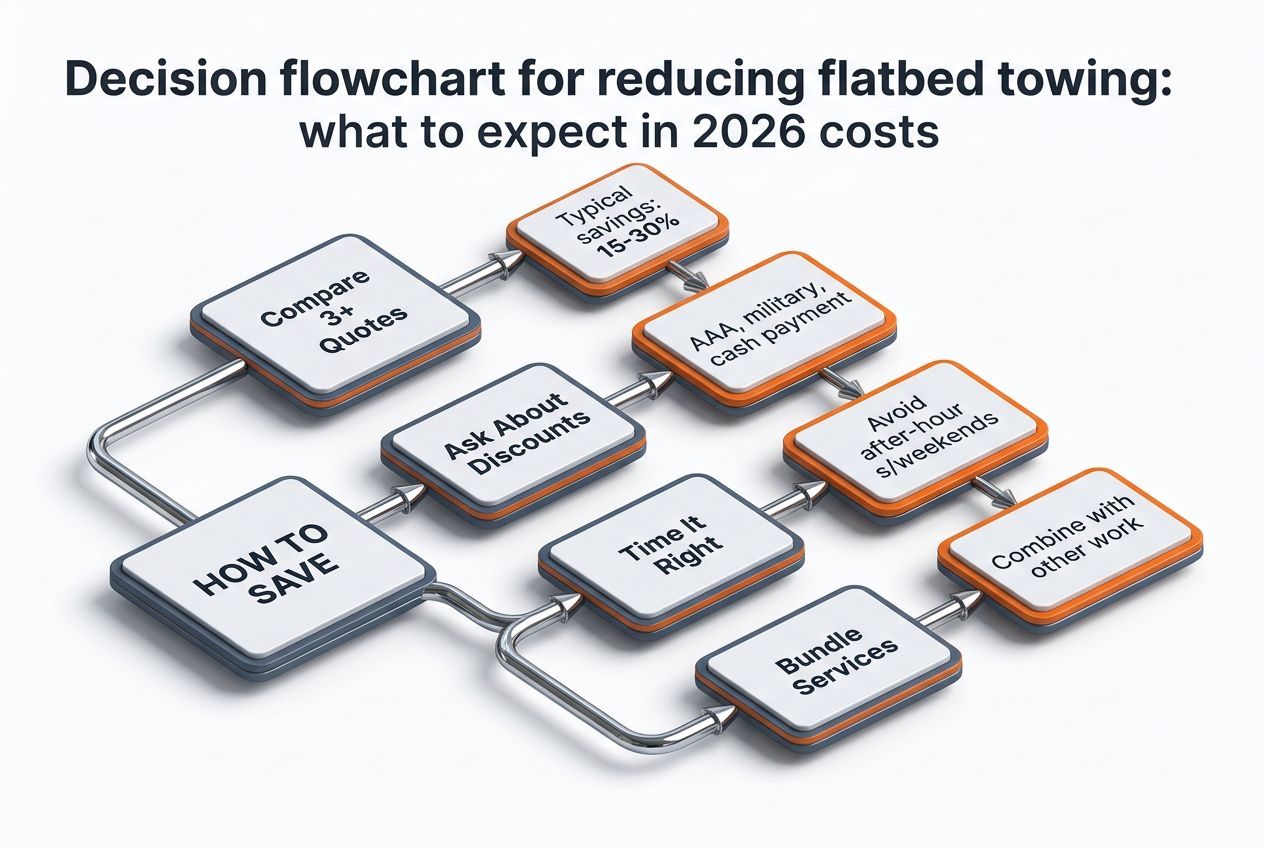
✅ Pro Tip: If your vehicle is in a safe, secure location and you're not facing an immediate emergency, consider waiting until weekday business hours (e.g., 7 or 8 AM) to arrange a tow. This simple strategy can often save you $75–$150 by avoiding after-hours surcharges, with no significant downside.
Seasonal factors, particularly winter, can also influence rates. In snow-belt states like Minnesota, Ohio, and New York, demand for towing services surges from November through February. This spike not only extends response times but can also push rates 15–30% higher than the summer baseline. For instance, a major ice storm in Cleveland during January might lead to three-hour wait times and flatbed towing rates at the peak of regional averages. If you're planning a non-urgent vehicle move during winter, it's advisable to book two or three days in advance, rather than on the day of service.
Our towing cost by state tool shows current regional rate ranges updated for 2026.
For the cheapest available options near you, including how to find operators who honor standard rates, see our guide to cheap towing near me.
For complete context on all towing pricing factors across every tow type, the towing cost pillar guide covers the full picture.
Sources & Methodology
Pricing estimates in this article reflect 2026 market rates compiled from the following sources:
- 1.AAA — Roadside assistance coverage tiers (Classic, Plus, Premier), towing mileage limits, and flatbed service inclusion policies. aaa.com
- 2.NHTSA (National Highway Traffic Safety Administration) — Vehicle safety data, drivetrain damage risk documentation for improper towing methods, and manufacturer towing specification references. nhtsa.gov
- 3.Toyota, Ford manufacturer towing guidelines — Published owner's manuals and towing supplements specifying flatbed-only transport requirements for AWD/4WD models. toyota.com \| ford.com
- 4.FMCSA (Federal Motor Carrier Safety Administration) — Cargo securement standards and commercial towing regulations that govern how tow operators must load and secure vehicles. fmcsa.dot.gov
Per-mile rates and base fees reflect weighted averages from urban, suburban, and rural operators across all four U.S. census regions. Individual quotes will vary. Fuel surcharge inflation of 3–5% is baked into 2026 estimates based on 2024–2025 trend data.
TowingServiceHub is reader-supported: we may earn money from ads and from some links on this page. See our editorial policy.

Mark
Founder & Editor
Mark is the founder and editor of TowingServiceHub, which he launched in 2026 after struggling to find clearly sourced towing costs and truck specs. He works in enterprise technology and tows his own boats, trailers, and equipment, so he knows the questions drivers actually ask.
Read full bio →Need a tow truck right now?
Browse vetted local providers in your area. Real Google ratings, verified business info, free to use.
Or browse all 50 states from our directory
Frequently Asked Questions
For a typical local tow covering 5–10 miles, the average flatbed towing cost in 2026 ranges from $109–$195. This figure includes a base hookup fee of $75–$150, combined with per-mile charges. Costs in urban markets generally fall towards the lower end, while rural areas and after-hours services push prices toward the higher end of this range.
Absolutely, for specific vehicles, flatbed towing is undeniably worth the additional expense. For AWD vehicles, EVs, lowered cars, and luxury models, the risk of $2,000–$5,000 in drivetrain damage from improper wheel-lift towing far outweighs the extra cost. While a wheel-lift might suffice for standard front-wheel-drive sedans in non-collision scenarios, a flatbed eliminates all potential risks to your vehicle.
Several strategies can help reduce your flatbed towing expenses:
Schedule strategically: Book non-emergency tows during weekday business hours to avoid $50–$100 after-hours surcharges. * Compare quotes: Always obtain at least two to three quotes before committing to a service. * Leverage roadside assistance: An AAA Plus or Premier membership can cover 100–200 miles of flatbed towing annually, offering substantial savings compared to out-of-pocket costs for long-distance hauls.
Yes, vehicle weight significantly impacts flatbed towing rates. Heavier vehicles, such as full-size trucks, dually pickups, and commercial vehicles, necessitate specialized medium-duty or heavy-duty flatbeds. These services typically cost 40–60% more than standard flatbed rates. Most standard flatbeds can accommodate vehicles up to approximately 10,000 lbs GVWR; anything heavier requires more robust (and more expensive) specialized equipment.
For planned, non-emergency vehicle relocations, it's advisable to book at least 24–48 hours in advance. During holiday periods or severe winter weather in northern states, expect wait times to extend to 4–8 hours, even with advance booking. Pre-booking also gives you leverage to negotiate for a flat-rate quote, which can be more favorable than accepting the default per-mile structure.
