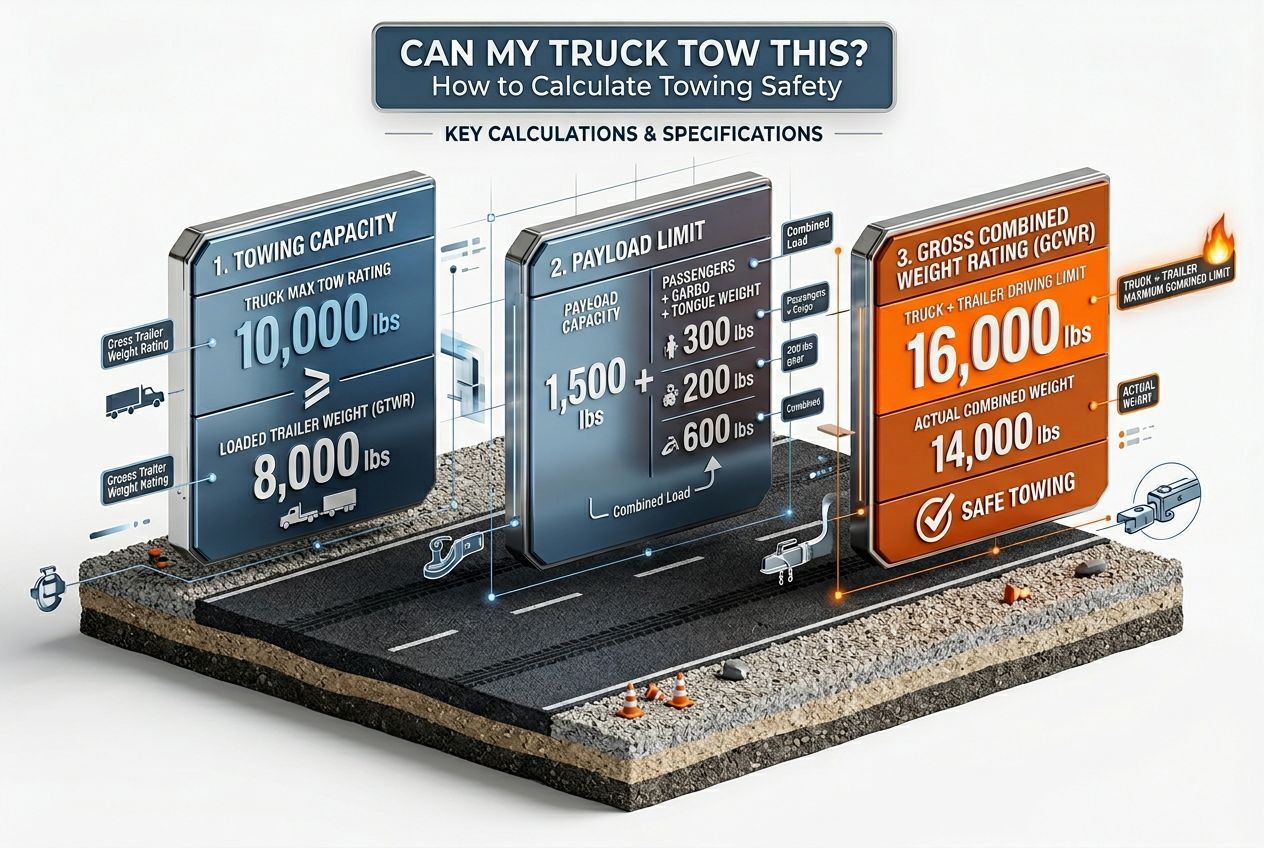
💡 Key Takeaway: Your truck's tow rating varies by engine, axle ratio, cab size, and whether a factory tow package is installed — the same model year can differ by thousands of pounds.
💡 Key Takeaway: Payload and towing capacity are linked: tongue weight, passengers, and bed cargo all count against your payload rating simultaneously.
💡 Key Takeaway: GCWR (truck + trailer combined) is the ceiling you must never exceed — even if the trailer weight alone looks legal.
💡 Key Takeaway: A truck without a factory tow package may be rated thousands of pounds lower than the advertised max for that model.
⚠️ Warning: Exceeding tow capacity can void insurance coverage and draw fines at DOT weigh stations — it's not just a mechanical risk.
How Do You Find Out How Much Your Truck Can Tow?
Locating your truck's exact tow rating is the first step. Your truck's max tow rating lives in two primary places: the driver-side door jamb sticker and the Trailer Towing Supplement. This supplement is a separate document from the owner's manual that Ford, GM, Ram, and Toyota all publish annually.
- Door Jamb Sticker: This sticker lists critical information like GVWR (Gross Vehicle Weight Rating) and GAWR (Gross Axle Weight Ratings).
- Trailer Towing Supplement: This document provides the actual max trailer weight specific to your vehicle's configuration.
The catch with advertised numbers: The "max tow capacity" you see on a manufacturer's website is often the best-case figure, applicable only to the most capable configuration of that model. Your specific truck may not match that configuration. For example, two 2024 F-150s can have tow ratings that differ by 4,000 lbs based on:
- Engine type
- Rear axle ratio
- Presence of a MaxTrailer Tow Package (e.g., Ford F-150 option code 53C)
✅ Pro Tip: The most accurate method is a VIN lookup. Ford, GM, Ram, and Toyota all allow you to enter your VIN on their websites to retrieve the exact towing specifications for your specific build. For a deeper walkthrough, check our guide on how to find towing capacity.

What Happens If You Tow More Than Your Truck's Capacity?
Exceeding your truck's towing capacity creates compounding stress across all major systems simultaneously. This significantly increases the risk of mechanical failure and accidents.
- Engine: Runs hotter, leading to accelerated wear.
- Transmission: Fluid degrades faster, potentially causing costly damage.
- Frame: Flexes beyond its tested range, compromising structural integrity.
- Brakes: Already working harder on grades, they take significantly longer to stop the vehicle and trailer, increasing fade.
📊 Quick Fact: According to NHTSA crash data estimates, roughly 25% of RV-related accidents involve some form of vehicle overloading. A 20% over-capacity load can increase stopping distance by 25–30%, a critical difference in emergency situations.
Temperature is a critical limiting factor. Most OEM service manuals consider anything above 265°F transmission fluid temperature a danger zone for fluid breakdown. While towing at max capacity on flat ground in mild conditions might be manageable, exceeding capacity up a steep grade in hot weather can spike fluid temps into this danger zone within minutes.
The financial repercussions are severe. If you're involved in an accident while over towing capacity, your insurer can deny the claim. This is a real risk, as operating a vehicle outside manufacturer specifications is often grounds for denial in commercial and personal auto policies.