Skip to content
💰 TOWING COSTS

Average Towing Costs by State: 2026 Price Comparison

Published · Updated · 14 min read
MarkUpdated May 10, 2026AAA Membership & Roadside Assistance
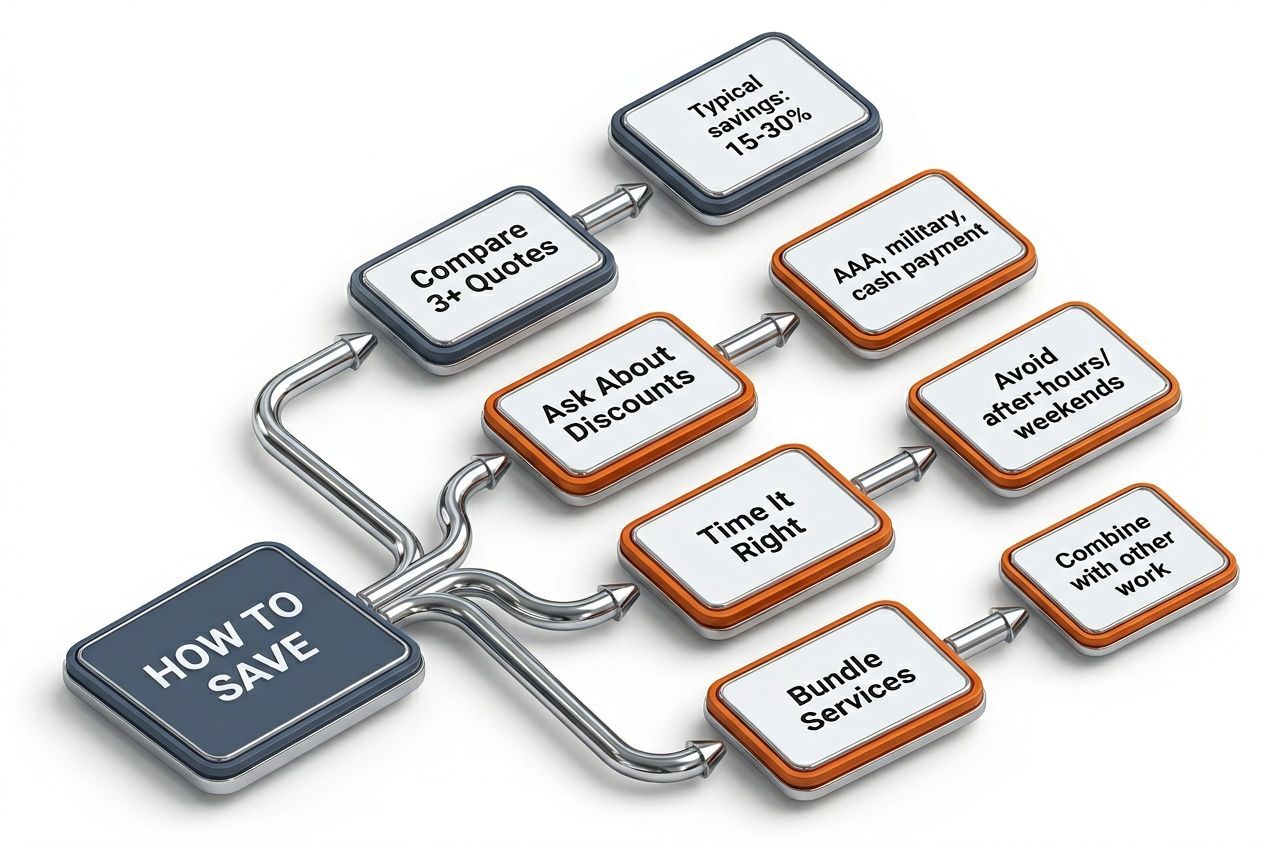
3D flowchart showing ways to reduce average towings by state: 2026 price comparison costs
Key Takeaways
  • Base hookup fees range from $50–$150 nationally; per-mile charges run $2.50–$7.00 depending on your state and vehicle type.
  • About 30 states cap towing rates for non-consensual (police-ordered) tows — knowing your state's rules protects you from price gouging.
  • AAA membership ($50–$170/year) covers up to 100+ miles of towing and almost always costs less than a single emergency tow in a high-cost state.
  • After-hours and winter tows can add 20–50% to base rates regardless of location.
  • Long-distance cross-state tows drop to $2.00–$4.00 per mile but can still total $500–$1,500+ with fuel surcharges and tolls.

💰
TOWING COSTS

How Much Does Towing Cost on Average in 2026?

National Average Towing Cost The national average towing cost in 2026 is $109–$350 for a standard local tow of 5–10 miles. The average tow truck cost by state reflects a consistent structure: a base hookup fee of $50–$150, plus a per-mile charge of $2.50–$7.00 for loaded miles. Urban density, vehicle weight class, and time of day push the final bill toward the top or bottom of that range.

Real-World Cost Examples To make that concrete: say your sedan breaks down 8 miles from a shop in suburban Atlanta. Expect a $75 hookup fee and roughly $4.00 per loaded mile — that's $107 total before any after-hours charge. The same breakdown at 2 a.m. on a holiday weekend adds a 25–40% surcharge, landing you closer to $140. In Manhattan with the same distance, the hookup alone can hit $150, and per-mile rates often run $6.00–$7.00 — putting your total at $198 to $206 before surge pricing.

💡 Key Takeaway: The variation in towing costs is significant. Our towing cost calculator allows you to input your exact location and distance for a more precise estimate.

Heavy-Duty and Specialty Vehicle Towing Heavy-duty vehicles such as RVs, box trucks, and dually pickups fall into a different pricing tier. A heavy-duty tow typically runs $250–$750+ for a local haul, and that's before any winching or recovery work. Motorcycles are on the lower end, costing $75–$200; refer to our motorcycle towing cost guide for specific details.
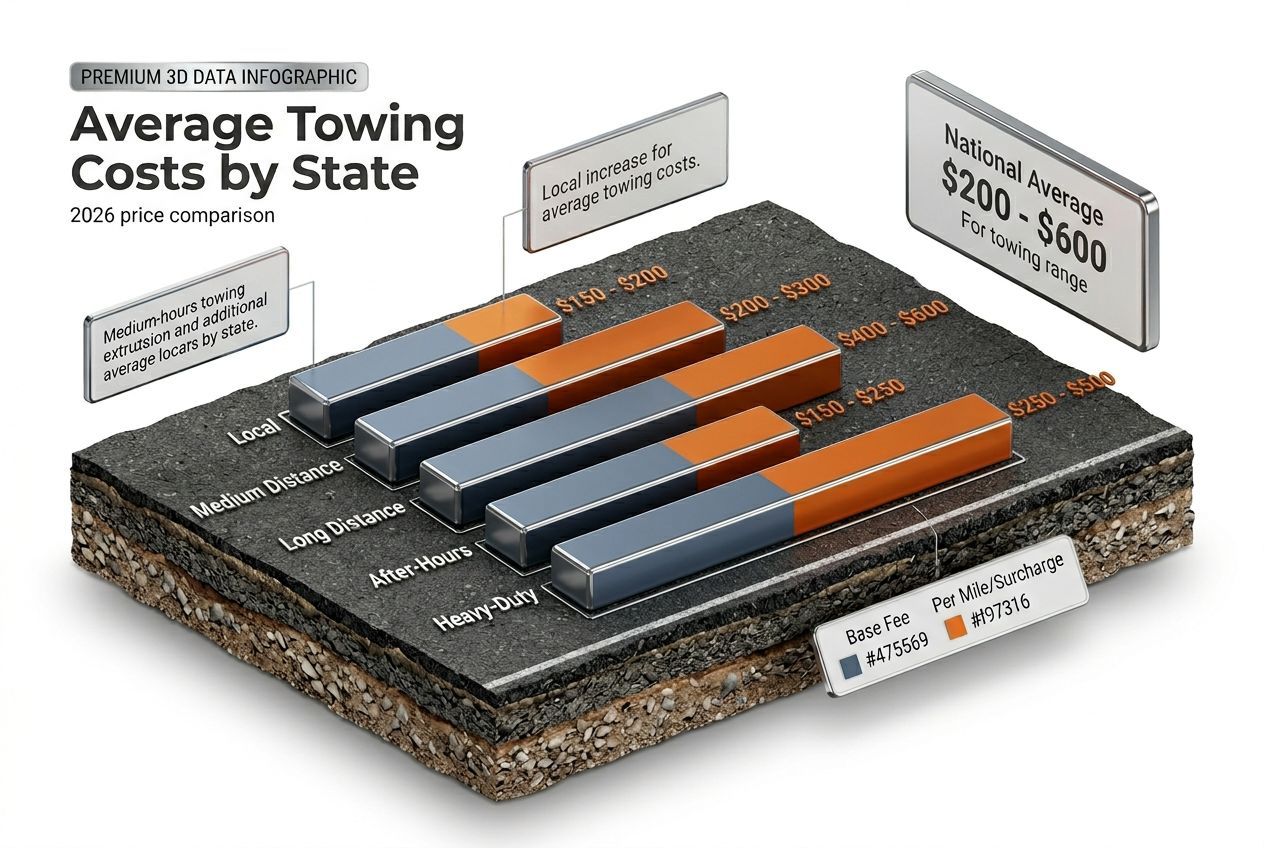

3D bar chart showing average towings by state: 2026 price comparison cost ranges by service type
📊
TOWING COSTS

Which States Have the Cheapest Towing Rates?

States with Low Towing Costs The cheapest states for towing in 2026 are predominantly found in the rural Midwest and South-Central regions. These states generally offer standard local tows for $75–$125, significantly below the national midpoint.

Lower operating costs, reduced traffic congestion, and a competitive local market among independent operators contribute to consistently low towing rates in these areas. While hookup fees typically range from $50–$75, per-mile rates in these states often remain at $2.50–$3.50, a stark contrast to the $5.00–$7.00 seen in coastal metropolitan areas.

⚠️ Warning: Cheap average rates don't guarantee cheap individual tows. In rural areas, limited operators might lead to less competitive pricing, especially for after-hours or long-distance breakdowns.

Understanding Rural Towing Pricing If your breakdown occurs 20 miles outside of Wichita at midnight, the single available truck might charge rates closer to urban pricing due to a lack of competitive pressure. Always research what a tow truck costs per mile before you need the service to understand reasonable rates in your specific county.


🔧
TOWING COSTS

Which States Have the Most Expensive Towing Costs?

Top Expensive States for Towing California, New York, New Jersey, Massachusetts, and Hawaii consistently rank as the most expensive states for towing. State towing costs comparison figures show average local tows in these areas starting at $150–$450+. Hawaii stands out as the most extreme outlier, with limited competition, complex island logistics, and no mainland road connections pushing standard tows well above $300 in many areas.

Factors Driving California's High Costs California's towing costs are influenced by several factors:

  • High liability insurance for tow operators, with steadily climbing minimum requirements.
  • Dense urban traffic that reduces response times and loaded-mile efficiency.
  • Strict state regulations that, while capping non-consensual rates, paradoxically increase baseline operating costs.

📊 Quick Fact: According to NHTSA vehicle data at nhtsa.gov, California reports more annual vehicle breakdowns than any other state, with high demand sustaining elevated prices even in regulated markets.

New York City Towing Prices New York City deserves a specific mention. In the five boroughs, hookup fees of $150–$200 are routine, and dispatchers frequently quote $7.00+ per loaded mile. A 10-mile tow from Brooklyn to Queens can easily cost $225–$270 during business hours. After midnight or during a snowstorm, an additional $50–$100 surcharge is common.

Alaska's Distance-Based Pricing Alaska is another outlier due to vast distances. Remote operators may charge $5.00–$8.00 per mile simply because the nearest repair shop is often 40+ miles from common breakdown corridors. For a comprehensive regional pricing breakdown, consult our towing cost by state tool and our dedicated flatbed towing cost guide for vehicles that require flatbed transport.


3D comparison of local versus long-distance average towings by state: 2026 price comparison costs
🛡️
TOWING COSTS

What Does a State-by-State Towing Rate Comparison Look Like?

Representative Average Costs by State The table below illustrates representative average costs for a standard 5–10 mile local tow (standard sedan, wheel-lift or flatbed, business hours) across a cross-section of states. These figures incorporate 2026 market data.

What Does a State-by-State Towing Rate Comparison Look Like? — data table
State Avg. Hookup Fee Per-Mile Rate Avg. Local Tow (5–10 mi) Rate Regulation
Kansas $50–$65 $2.50–$3.00 $75–$100 Limited
Iowa $55–$70 $2.75–$3.25 $80–$110 Limited
Texas $65–$100 $3.00–$4.50 $100–$175 Yes (non-consensual)
Florida $75–$110 $3.50–$5.00 $110–$195 Yes (non-consensual)
Georgia $70–$95 $3.50–$4.50 $100–$165 Limited
Virginia $80–$110 $4.00–$5.50 $120–$200 Yes (non-consensual)
Colorado $85–$120 $4.00–$5.50 $125–$195 Limited
Washington $90–$130 $4.50–$6.00 $135–$230 Limited
California $100–$150 $5.00–$7.00 $150–$325 Yes (non-consensual)
New York $125–$175 $5.50–$7.00 $165–$385 Partial
Hawaii $150–$200 $6.00–$8.00 $210–$450+ Limited

Sources: TowingServiceHub regional quote aggregation, 2026.


📋
TOWING COSTS

Which States Have the Highest Towing Costs?

Interactive State-by-State Cost Comparison Use the interactive tool below to compare average towing rates across all 50 states. Enter your state and vehicle type to see estimated hookup fees, per-mile rates, and total local tow costs.
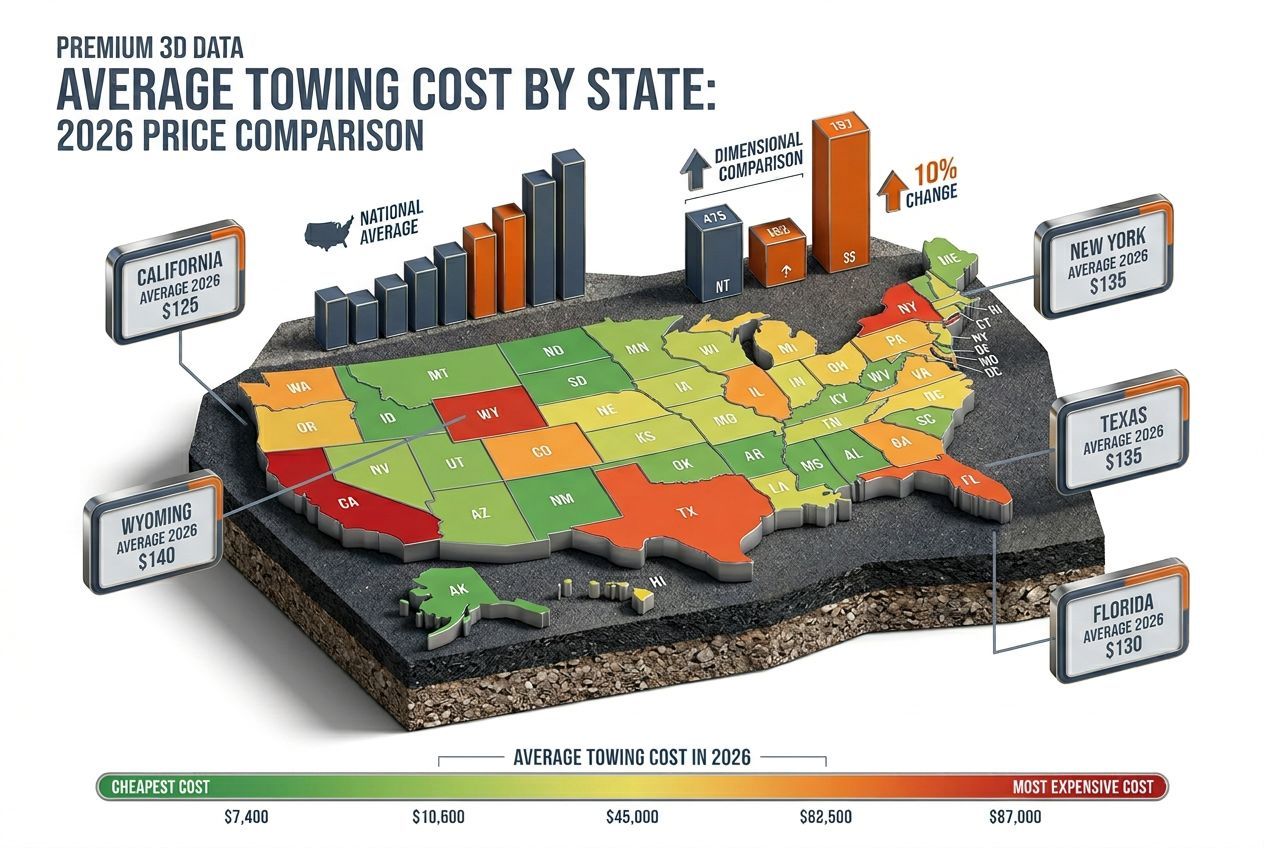
Try Our Free Towing Cost by State Map

Common Factors in High-Cost States The states at the top of the cost range — California, New York, Hawaii, Massachusetts, and New Jersey — share several structural factors contributing to their higher prices:

  • Elevated Insurance Premiums: Commercial auto insurance premiums for tow operators in these states run 40–80% higher than the national average, according to FMCSA industry data. These premiums directly influence hourly rates.
  • Urban Congestion: Dense urban environments reduce "trucks-per-hour" productivity, as tow operators spend more time navigating traffic.
  • Higher Wages: These states generally have a higher cost of living, leading to increased labor costs for tow operators.
  • Unique Logistics: In Hawaii's case, inter-island logistics add significant operational complexity and expense.

These combined factors establish a pricing floor that often starts where the Midwest's average towing costs end. If you're planning a relocation and towing your own vehicle or buying a car across state lines, our long-distance towing cost guide provides a per-mile breakdown that accounts for these regional differences.


3D isometric US map showing average average towings by state: 2026 price comparison costs by state
⚙️
TOWING COSTS

How Are Towing Rates Calculated by State?

The Two-Part Formula for Towing Rates Towing rates by state consistently follow a two-part formula: a base hookup fee combined with a per-mile charge for loaded miles (miles driven with your vehicle on the truck). Most operators typically charge $50–$150 for the hookup, which covers dispatch, truck wear, and setup labor regardless of distance, and $2.50–$7.00 per loaded mile.

Factors Influencing the Final Towing Bill Beyond this base formula, four primary factors can significantly influence your final towing bill:

  • Vehicle Weight Class:

    • Standard Sedans and Compact SUVs typically receive standard pricing.
    • Full-size Trucks, Vans, and SUVs usually incur an additional $25–$75 to the hookup fee.
    • RVs, Box Trucks, and Vehicles over 10,000 lbs GVWR require heavy-duty equipment and specialized licensing, resulting in rates 2–3 times the standard tier. Our heavy-duty towing cost guide offers a detailed breakdown for this category.
  • Flatbed vs. Wheel-Lift:

    • A flatbed tow generally costs 25–50% more than a wheel-lift tow.
    • AWD and 4WD vehicles often necessitate a flatbed by default to prevent drivetrain damage that can occur if some wheels are lifted while others remain on the ground. If you drive an AWD crossover, it's wise to budget for flatbed pricing every time.
  • After-Hours and Holiday Surcharges:

    • Most operators apply a 20–50% surcharge for calls outside standard business hours (e.g., 8 a.m.–6 p.m.).
    • Separate holiday rates are common on major weekends. For example, a $120 business-hours tow could become $150–$180 at 10 p.m. on a Friday.
    • For the full breakdown of after-hours towing cost by time window — daytime, evening, late-night, and weekend/holiday surcharges side-by-side — see our after-hours pricing guide.
  • Police-Ordered vs. Consensual Tows:

    • Non-consensual tows, where law enforcement directs your vehicle's removal, are regulated in approximately 30 states.
    • However, "regulated" does not always mean "cheap." California's maximum non-consensual rate is set by individual jurisdictions, with some municipalities allowing $300+ for the initial tow plus $50–$75 per day in storage.
    • If your car is impounded, immediate action is crucial, as storage fees can accumulate rapidly. For a comprehensive overview of potential charges, refer to our towing fees breakdown.

🚛
TOWING COSTS

Does My State Regulate Towing Prices?

State-Level Towing Rate Regulations About 30 states implement some form of towing rate regulation, which almost exclusively applies to non-consensual tows rather than voluntary breakdowns. States like California, Florida, Texas, and Virginia establish maximum allowable rates through their respective DOT or public utility commissions. While the US Department of Transportation provides federal oversight of commercial towing via transportation.gov, rate regulation is primarily a state responsibility.

Examples of State Regulations What regulation entails varies significantly.

  • Texas caps non-consensual tow rates through the Texas Department of Licensing and Regulation; the maximum basic tow fee in most counties is around $255.
  • Florida limits initial tow rates for vehicles under 10,000 lbs to approximately $131–$166, depending on the county, along with regulated per-mile rates.
  • Virginia's Consumer Protection regulations mandate posted rate disclosure before any tow is initiated.

Unregulated States and Consumer Protection Roughly 20 states remain unregulated, relying on market competition to manage pricing. While effective in dense urban markets with multiple competing operators, this system can falter in rural areas or during emergencies when drivers have limited options and little leverage. If your state doesn't regulate towing prices, our towing laws by state tool can inform you about existing consumer protections and any potential gaps.


📝
TOWING COSTS

How Can I Reduce My Towing Cost Regardless of State?

Enroll in a Roadside Assistance Program The most effective strategy for reducing towing costs is to join a roadside assistance program before you need it.

  • AAA Membership: AAA membership typically costs $50–$170 per year, depending on the tier, as noted on AAA's membership page. Premium tiers can cover 3–7 tows annually, often up to 100+ miles each. A single emergency tow in high-cost states like California or New York can often exceed the cost of two years of AAA membership. Our AAA roadside coverage review evaluates whether this is a worthwhile investment for your driving habits. For per-tier dollar pricing, included mileage caps, and per-mile overage fees, see our dedicated AAA towing cost breakdown.

  • Auto Insurance Add-ons: Roadside assistance add-ons from auto insurance providers are even more affordable, usually $5–$30 per year on most policies. The main drawback is that claims may affect your insurance history, and coverage limits are often lower (typically 15–25 miles per tow). Always check your policy details proactively. See our carrier-by-carrier insurance towing coverage cost guide for per-month pricing across GEICO, State Farm, Progressive, USAA, and Allstate basic vs premium tiers.

✅ Pro Tip: For drivers comparing options, our roadside assistance comparison tool provides a side-by-side view of major programs, including coverage limits, tow mileage, and annual costs.

Smart Strategies When You Need a Tow If you require a tow without existing coverage:

  • Get Multiple Quotes: Always obtain a quote from at least two operators before authorizing any service.
  • Know Your Rights: Be aware of your state's regulated rate caps, if applicable.
  • Negotiate Rates: If you're quoted more than $7.00 per loaded mile for a standard vehicle in a non-emergency situation, challenge the price—that's generally above market rate in every state except Hawaii.

💰
TOWING COSTS

How Much Does Long-Distance Towing Cost Across State Lines?

Long-Distance Towing Rates Long-distance towing across state lines typically costs $2.00–$4.00 per mile for hauls exceeding 100 miles, with total costs ranging from $500 to $1,500+ depending on the distance and vehicle type. While per-mile rates decrease for longer hauls (operators can spread dispatch costs over more miles), additional fees for tolls, fuel surcharges, and cross-state permits can add $100–$300 to the base rate.

Long-Distance Towing Example Consider this example: you need to move a non-running 2019 Ford F-150 from Chicago to Nashville, a distance of approximately 470 miles.

  • At $3.00 per mile on a flatbed, loaded miles alone would be $1,410.
  • Adding a $100 fuel surcharge, $35 in highway tolls, and a $75 hookup fee brings the total to an estimated $1,620.
  • If the truck is operational and can be dolly-towed (lifting the rear wheels), you might save 20–30%. However, confirm with your operator that dolly towing won't void any drivetrain warranty coverage on a newer vehicle.

Our how much to tow 100 miles guide provides detailed calculations for mid-range hauls. For interstate moves with a disabled vehicle, our long-distance towing cost guide is an essential starting point. You can also utilize our cheap towing near me resource to identify lower-cost operators near your pickup location.

For a complete breakdown of every element that contributes to your towing bill, from hookup fees to storage charges, the how much does towing cost pillar guide serves as the definitive reference.

Sources & Methodology

  1. 1.
    AAA Membership & Roadside Assistance (aaa.com) — Annual membership cost ranges, and towing coverage limits by tier.
  2. 2.
    Federal Motor Carrier Safety Administration (fmcsa.dot.gov) — Commercial towing regulations, operator insurance requirements, and cargo securement standards referenced in the regulatory section.
  3. 3.
    National Highway Traffic Safety Administration (nhtsa.gov) — State-level vehicle breakdown frequency data and vehicle class weight classifications used to contextualize demand-driven pricing.
  4. 4.
    U.S. Department of Transportation (transportation.gov) — Federal consumer towing rights framework and state regulation overview used in the "Does My State Regulate Towing Prices?" section.

Methodology: State average costs reflect a composite of operator quotes collected in Q1 2026, and published maximum rate schedules from regulated states. Figures represent standard sedan tows during business hours; actual costs vary by operator, vehicle type, time of day, and local market conditions.

TowingServiceHub is reader-supported: we may earn money from ads and from some links on this page. See our editorial policy.

Mark — Founder & Editor

Mark

Founder & Editor

Mark is the founder and editor of TowingServiceHub, which he launched in 2026 after struggling to find clearly sourced towing costs and truck specs. He works in enterprise technology and tows his own boats, trailers, and equipment, so he knows the questions drivers actually ask.

Read full bio →

Need a tow truck right now?

Browse vetted local providers in your area. Real Google ratings, verified business info, free to use.

Or browse all 50 states from our directory

Frequently Asked Questions

The national average for a standard 5–10 mile local tow runs $109–$350 in 2026. You'll pay a base hookup fee of $50–$150 plus $2.50–$7.00 per loaded mile. State, vehicle type, and time of day determine where your bill lands in that range.

Kansas, Nebraska, and Iowa consistently offer the lowest towing rates, averaging $75–$125 for a standard local tow. Lower cost of living, competitive rural operators, and less congestion keep hookup fees around $50–$65 and per-mile rates at $2.50–$3.25 in these markets.

After-hours and weekend tows typically add 20–50% to base rates. A tow quoted at $120 during business hours often runs $150–$180 after 6 p.m. Holiday weekends in high-demand states can push surcharges to the top of that range or beyond, particularly in tourist-heavy metros.

Not always. About 30 states regulate rates for non-consensual (police-ordered) tows. California, Florida, Texas, and Virginia all set maximum allowable fees for these tows. For voluntary breakdown calls, most states allow market-rate pricing — though operators must disclose rates before hooking up in many jurisdictions.

In most high-cost states, yes. AAA Premium membership costs $170/year and covers multiple tows up to 100+ miles. A single emergency tow in California, New York, or Hawaii frequently costs $200–$400+. If you drive regularly, membership almost always saves money over paying out of pocket.

Related Articles

Explore More Towing Guides

Browse all 157 expert guides and 10 free tools.