- Most half-ton trucks require a WDH when towing trailers over 5,000 lbs — check your owner's manual, not just the tow rating sticker
- Tongue weight should stay at 10–15% of gross trailer weight; anything beyond that causes rear sag, loose steering, and longer stopping distances
- Many WDH systems now include integrated sway control — a standalone sway bar isn't always needed if your hitch already has it built in
- Skipping a WDH your manufacturer requires doesn't just risk a crash — it can void your warranty and shift accident liability to you
- Sizing matters: buy a WDH rated to match or exceed your actual loaded trailer weight, not your trailer's dry weight
What Does a Weight Distribution Hitch Do?
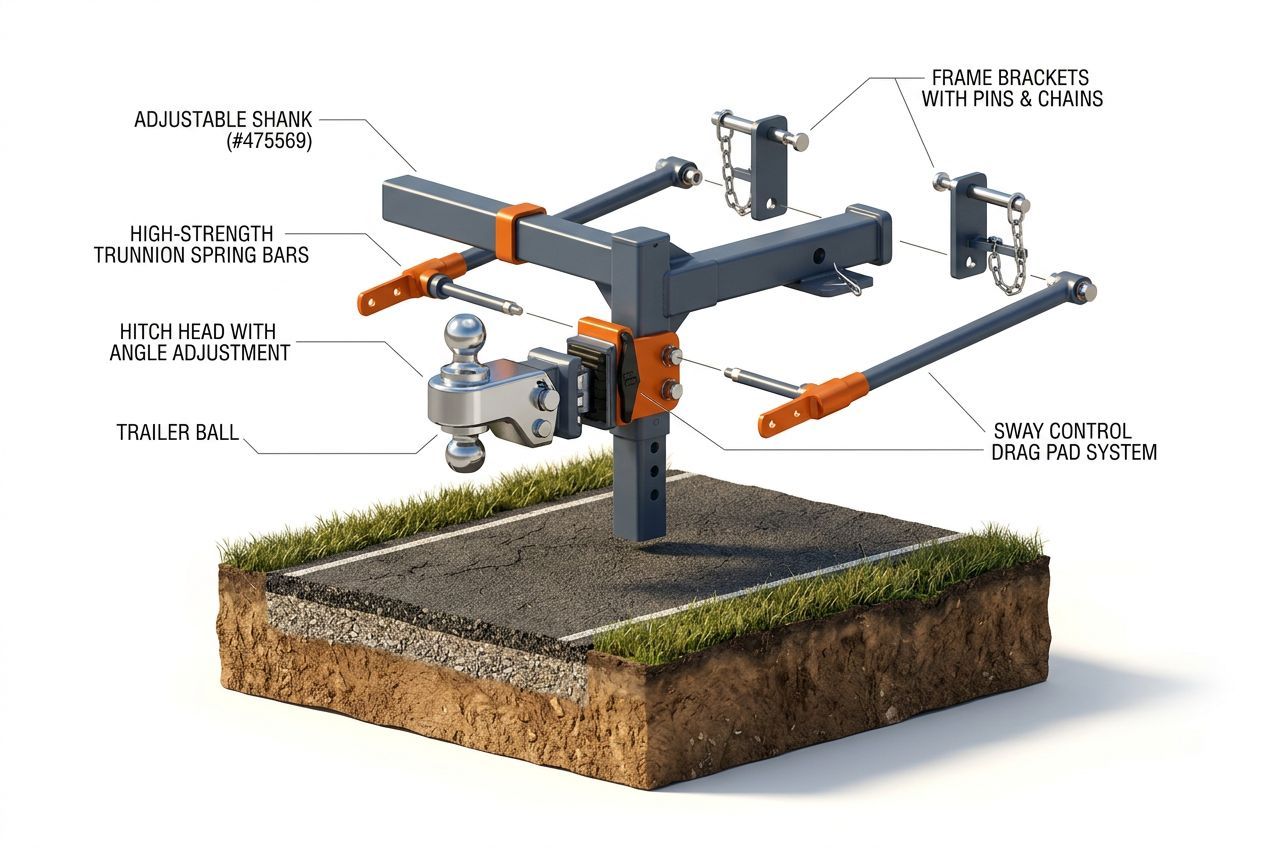
Function of a WDH: A weight distribution hitch uses tensioned spring bars to transfer tongue weight off the tow vehicle's rear axle and redistribute it across all four wheels of the truck and the trailer axles. Without one, the trailer coupler pushes straight down on the ball mount, overloading the rear suspension, lifting the front tires, and killing your steering authority.
The Mechanical Process
Here's the mechanical picture:
- The spring bars hook into head brackets on the shank assembly.
- They are levered upward under tension.
- That tension creates a lifting force on the trailer tongue.
- It also applies an equal downward force on the tow vehicle's front axle.
- The net result is a level rig — headlights pointed at the road, front tires fully loaded, and brakes working as designed.
💡 Key Takeaway: Weight distribution hitches don't increase your vehicle's tow rating or let you haul a trailer that's too heavy for the powertrain. They make a legal, within-spec tow setup actually handle safely. That's a critical distinction — see our payload capacity guide to make sure your numbers are right before you even think about hitch setup.
Do I Need a Weight Distribution Hitch for My Trailer?
Determining Your Need: You need a weight distribution hitch when your trailer's tongue weight exceeds your receiver hitch's unassisted tongue weight rating, when your trailer tops 50% of your tow vehicle's curb weight, or when your owner's manual specifies one — whichever threshold comes first.
Manufacturer Requirements
For most half-ton truck and SUV owners, that trigger lands around 5,000 lbs of gross trailer weight. Specific examples include:
- Ford F-150: Ford's Trailer Towing Supplement requires a WDH for any trailer over 5,000 lbs on most configurations.
- Ram and GM: These manufacturers publish similar thresholds for their half-ton trucks.
- Toyota Tundra: Toyota's documentation also calls for one above 5,000 lbs (check toyota.com for your specific model year's supplement).
The 50% rule is a useful gut check. For instance, a 2024 Ram 1500 with a curb weight around 4,800 lbs means any trailer over 2,400 lbs starts shifting weight dynamics. However, the WDH threshold is typically higher for full-size trucks because their suspensions are tuned to handle more rear-axle load before sag becomes dangerous.
Worked Example: Imagine you own a 2023 Silverado 1500 (curb weight: ~4,900 lbs) and you're towing a 6,800-lb travel trailer.
- Tongue weight at 13% is 884 lbs.
- Your standard Class IV receiver has a max tongue weight of 1,000 lbs unassisted — but your rear suspension is already sagging half an inch.
- You're also carrying two adults (370 lbs combined), a dog, and 120 lbs of camping gear. Your payload is shrinking fast.
- A WDH at 10,000-lb GTW / 1,000-lb TW rating straightens the truck out and keeps front-axle traction where it belongs. Without it, you're a crosswind gust away from a sway event. Learn more about how tongue weight interacts with your setup in our tongue weight guide.
⚠️ Warning: A WDH doesn't fix an overloaded truck. If your loaded trailer exceeds your vehicle's published tow rating, no hitch system makes that legal or safe. A WDH also won't help if your trailer axles are already overloaded — that's a trailer weight problem, not a hitch problem.
How Do I Know If My Tongue Weight Is Too Heavy?
Signs of Excessive Tongue Weight: Tongue weight is too heavy when it exceeds 15% of your gross trailer weight, surpasses your hitch's tongue weight rating, or pushes you past your truck's payload limit — whichever cap you hit first.
The physical symptoms are obvious if you know what to look for:
- Rear squat of more than an inch after hookup
- Headlights angling skyward
- A vague or floaty feeling at the steering wheel
- Braking that feels delayed
📊 Quick Fact: NHTSA (nhtsa.gov) has documented how front-axle load reduction directly correlates with increased stopping distances — some real-world estimates put it at 20–30% longer stops when the front end is unloaded.
Measuring Tongue Weight Precisely
Measuring it precisely takes specialized equipment:
- Tongue Weight Scale: A simple ball-mount scale is available at most hitch shops for around $50–$100.
- Truck Scale: Alternatively, a commercial truck scale can be used to get precise readings.
- Process: Place the trailer coupler on the scale, ensure the trailer is level, and read the number.
✅ Pro Tip: The ideal tongue weight range is 10–15% of your gross trailer weight. Below 10% and you risk trailer sway from a light tongue; above 15% and you're overloading the rear axle.
Use our payload calculator to check whether your tongue weight, passengers, and cargo are still inside your truck's payload envelope.

Do You Need a Weight Distribution Hitch Based on Your Setup?
Use this quick-reference table to size your WDH or determine whether you need one at all.
Enter your numbers in the estimator below to get a personalized answer — it factors in trailer weight, tongue weight, and your vehicle's payload rating.