A Worked Example with Real Numbers
Let's consider a practical scenario. Imagine you're driving a 2023 Ram 1500 with the 5.7L HEMI engine and the optional factory Class IV Trailer Tow Package (option code TG). This package is crucial, as it includes essential upgrades like a transmission oil cooler, an upgraded radiator, a heavy-duty flasher relay, and a 7-pin wiring harness. Without this package, Ram's published 12,750-lb max towing rating may not apply to your specific truck. The payload capacity for a typical crew cab 4x4 version of this truck is approximately 1,680 lbs.
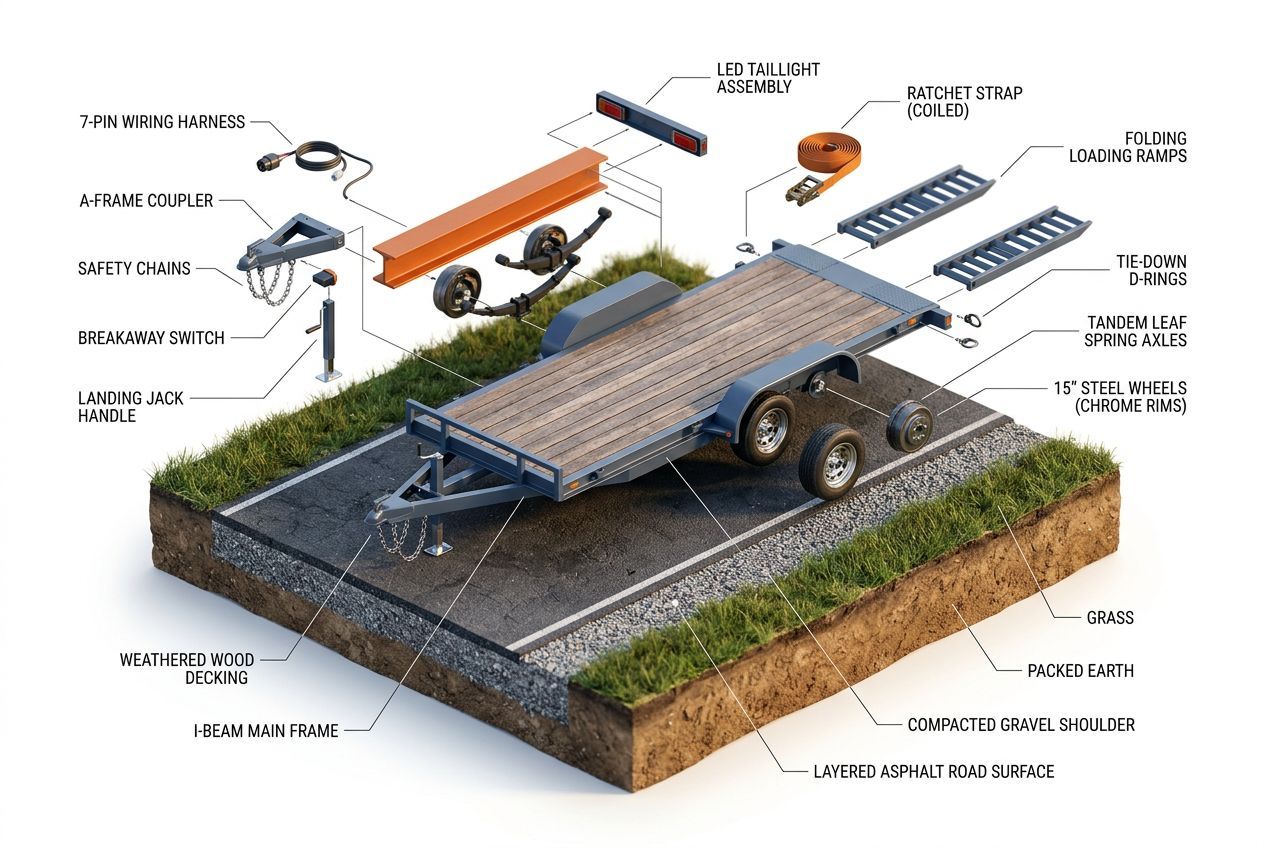
Now, let's factor in the load. You plan to haul a 2019 Honda Accord sedan, which weighs about 3,300 lbs, on a 16-foot open hauler that has a curb weight of 1,800 lbs.
- Total trailer weight: 3,300 lbs (car) + 1,800 lbs (trailer) = 5,100 lbs.
- Target tongue weight (12% of trailer weight): 0.12 * 5,100 lbs = 612 lbs.
Add in your personal weight and gear:
- You: 190 lbs
- A passenger: 160 lbs
- Additional gear: 60 lbs
- Total in-cab/bed weight: 190 + 160 + 60 = 410 lbs.
Total payload consumed: 612 lbs (tongue weight) + 410 lbs (passengers/gear) = 1,022 lbs.
Payload capacity remaining: 1,680 lbs (truck's payload) - 1,022 lbs (consumed) = 658 lbs.
In this example, you're operating at approximately 61% of your truck's payload capacity, leaving ample room for a safe and stable tow. However, if you were to swap that 3,300-lb sedan for a heavier 4,500-lb muscle car, the math would become much tighter, potentially pushing or exceeding your truck's limits.
For a more in-depth understanding of how payload interacts with towing capacity, our towing capacity guide thoroughly explains every number you need to know.
🛡️
DIY TOWING & FLAT TOWING
Is a Tow Dolly or Car Trailer Better for DIY Hauling?
A full car trailer is generally superior to a tow dolly for most DIY car hauling scenarios, offering greater safety and versatility.
- Tow Dolly: Lifts only the front two wheels of the vehicle. It's cheaper to rent, typically $50–$80/day, and works adequately for short-distance moves involving front-wheel-drive (FWD) vehicles.
- Full Car Trailer: Supports all four wheels of the vehicle on its deck. Rental costs for an open unit usually range from $100–$180/day. It is the only safe choice for all-wheel-drive (AWD), four-wheel-drive (4WD), lowered, or non-running vehicles.
⚠️ Warning: The most significant limitation of a tow dolly is its incompatibility with rear-wheel-drive (RWD) and AWD vehicles. Towing these types of vehicles on a dolly without proper preparation (like removing the driveshaft) will cause the rear wheels to spin the driveshaft at road speed without adequate lubrication. This almost inevitably leads to severe transmission or drivetrain damage.
Before deciding on a method, review our tow bar vs. tow dolly comparison for detailed scenarios and our guide on towing with an automatic transmission, as drivetrain type is a more critical factor than many people realize.
📋
DIY TOWING & FLAT TOWING
How Do You Safely Load a Car onto a Trailer?
Safely loading a car onto a trailer is a critical step that dictates the stability and security of your entire haul. It involves precise positioning, securing of ramps, and careful driving.
Key principles for safe loading:
- Position the trailer on flat, level ground.
- Ensure ramps are securely attached and rated for the vehicle's weight.
- Drive straight and slow up the center of the deck.
- Aim to place approximately 60% of the car's weight forward of the trailer axle. This precise weight distribution is essential for maintaining the recommended 10–15% tongue weight range, which effectively prevents dangerous trailer sway during transit.
Here's the step-by-step process for loading your vehicle:
- Level Ground Only: Always position your trailer on flat, level ground. Even a slight 2-degree slope can significantly alter the ramp angle, potentially causing a lowered car to bottom out or shifting the load unpredictably on a heavier vehicle.
- Check Ramp Rating: Before driving, verify that your ramps are explicitly rated for the car's total weight. This rating should apply to the combined weight, not just split per wheel. Most reputable ramps will have their capacity stamped near the base.
- Drive Straight and Slow: Carefully drive the car straight up the center of the trailer ramps. Angling the car can cause lateral weight shifts, which may bend or damage ramps.
✅ Pro Tip: Always use a spotter when loading, and ensure they stand to the side of the vehicle, never directly behind it, to avoid any risk of injury should the car roll unexpectedly.
- Stop Before Wheel Chocks: Avoid relying on momentum to position the car. Instead, creep the final few feet, stopping just before the tires meet the wheel chocks or front stops.
- Set the Parking Brake: Once the car is in its final position, set the parking brake firmly before you exit the vehicle. The car will inevitably shift slightly as you apply tie-down straps, and keeping the brake engaged prevents any unintended rolling while you work.
For situations where the vehicle cannot be driven, our DIY car trailer tips article also covers detailed procedures for winching and flatbed loading.
⚙️
DIY TOWING & FLAT TOWING
How Do You Properly Strap Down a Car on a Trailer?
Properly securing your vehicle involves using four ratchet straps or wheel nets. Each of these must be rated for a minimum breaking strength of 3,300 lbs. This is the minimum standard required per FMCSA cargo securement regulations for vehicles in this weight class.
Attaching the straps:
- Factory Tie-Down Points: Connect straps to the vehicle's designated factory tie-down points, which are typically visible hooks or loops located behind the front and rear bumper fascia.
- Over-the-Wheel Basket Nets: Alternatively, use over-the-wheel basket nets that wrap securely around each tire.
Strap Angle and Tension:
- Angle: Pull each strap downward at an angle of approximately 45 degrees to the trailer's D-rings. If the angle is too steep (near vertical), you lose critical horizontal restraint. If it's too shallow, the vertical hold diminishes.
- Tightness: Tighten each ratchet until there is absolutely no slack in the strap and the vehicle's suspension compresses slightly. The car should not shift or move when you attempt to push it sideways by hand.
⚠️ Warning: Recheck strap tension every 100 miles. Straps can loosen as rubber components compress and metal settles during transit. The FMCSA's Commercial Vehicle Safety Alliance recommends the first check within 50 miles of departure, and then every 150 miles thereafter. For recreational DIY hauling, rechecking every 100 miles is a practical and safe standard.
You'll also benefit from reviewing our tow strap guide to understand the crucial distinction between working load limits and breaking strength — they are not interchangeable numbers.
🚛
DIY TOWING & FLAT TOWING
How Fast Can You Drive While Towing a Car on a Trailer?
The safe maximum speed for towing a car on a trailer is generally 55 mph, as recommended by NHTSA guidance and most trailer manufacturer specifications. However, it is paramount to be aware that several states impose their own specific speed limits for vehicles towing trailers, which you are legally obligated to follow.
- California Example: According to the California Vehicle Code (§22406), any vehicle towing a trailer is strictly limited to 55 mph, regardless of higher posted freeway speeds.
- Texas Example: Texas, in contrast, typically imposes no such blanket restriction, generally allowing you to tow at the posted speed limit on most roads.
✅ Pro Tip: Before embarking on your trip, always check our towing laws by state tool to verify all state-specific requirements for every state on your route. Ignorance of these laws can lead to significant fines.
Speed directly impacts stopping distance. NHTSA data indicates that a loaded trailer can increase your stopping distance by 20–40% compared to an unloaded vehicle.
📊 Quick Fact: At 65 mph on dry pavement, an increased stopping distance of 20-40% translates to roughly 40–70 extra feet needed to stop. This additional distance can be critical, especially when approaching a highway off-ramp or encountering unexpected traffic.
Trailer sway is a significant concern, becoming self-reinforcing at speeds above 55 mph. NHTSA data links approximately 34% of towing accidents to improper loading or excessive speed, which are common triggers for trailer sway.
Altitude also plays a role. At altitudes above 5,000 feet, naturally aspirated engines lose approximately 3% of their power for every 1,000 feet of elevation gain. This means your Ram 1500, rated for 12,750 lbs at sea level, would effectively be working with about 15% less power at 7,000 feet in the Colorado Rockies. Consequently, it's crucial to maintain lower speeds on grades and allow yourself considerably more braking room when descending downhill.
📝
DIY TOWING & FLAT TOWING
Do You Need a Special License to Haul a Car on a Trailer?
For most DIY car hauling in the U.S., a standard Class C or Class D driver's license is sufficient. This applies as long as the combined gross vehicle weight rating (GCVWR) of your tow vehicle and loaded trailer remains below 26,001 lbs. This 26,001-lb threshold is the federal benchmark for requiring a Commercial Driver's License (CDL), as mandated by FMCSA regulations.
💡 Key Takeaway: A typical half-ton pickup (with a 7,000-lb GVWR) paired with a loaded 10,000-lb GVWR car trailer results in a combined GCVWR of 17,000 lbs. This is well under the 26,001-lb CDL ceiling, meaning most recreational haulers will not require a special license.
However, some states impose additional requirements.
- California: Requires trailer registration that matches the loaded weight, and certain counties may mandate a brake controller for trailers exceeding 1,500 lbs.
- Pennsylvania: Requires a safety inspection sticker for trailers over 3,000 lbs that are registered in-state.
✅ Pro Tip: Before beginning your journey, always verify the specific licensing, registration, and equipment requirements for every state you plan to travel through. Fines for non-compliance can be substantial, and registration issues could lead to delays or impoundment at weigh stations.
If your project evolves into regular vehicle transport—such as flipping cars, moving equipment for a business, or hauling for hire—the licensing landscape changes dramatically. Commercial for-hire towing triggers specific Department of Transportation (DOT) number requirements and potentially a CDL, depending on the weight of the rig and whether you are receiving compensation. Our how much does towing cost guide provides further insights into when professional transport might be a more financially sensible option than DIY.