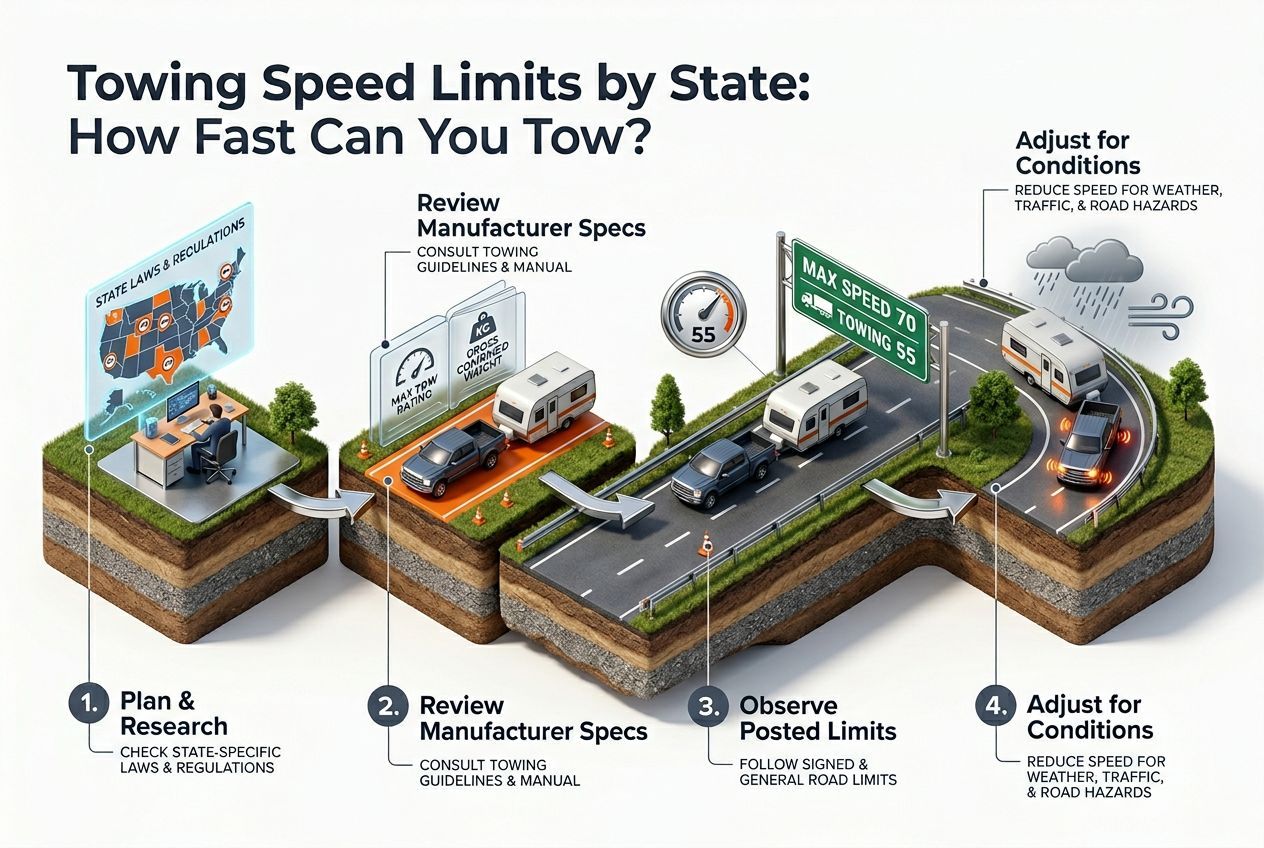
💡 Key Takeaway: At least 12 states enforce a towing speed limit lower than the standard posted limit — always know your route before you go.
What Is the Speed Limit When Towing a Trailer?
Most states do not impose a separate towing speed limit; the posted limit applies to your truck and trailer just like any other vehicle. On the majority of U.S. interstates, this typically means 65–70 mph. The primary exceptions are roughly a dozen states with laws that specifically reduce the speed limit while towing, usually by 5–15 mph below the standard limit. Your most prudent action before any multi-state haul is to thoroughly check the towing laws by state for each state on your route.
For trips through states like Texas, Florida, Ohio, or much of the Midwest, you can generally tow at whatever the posted sign indicates. However, as you head west through states such as California or Oregon, these rules can shift immediately and significantly.
Which States Have Reduced Speed Limits for Towing?
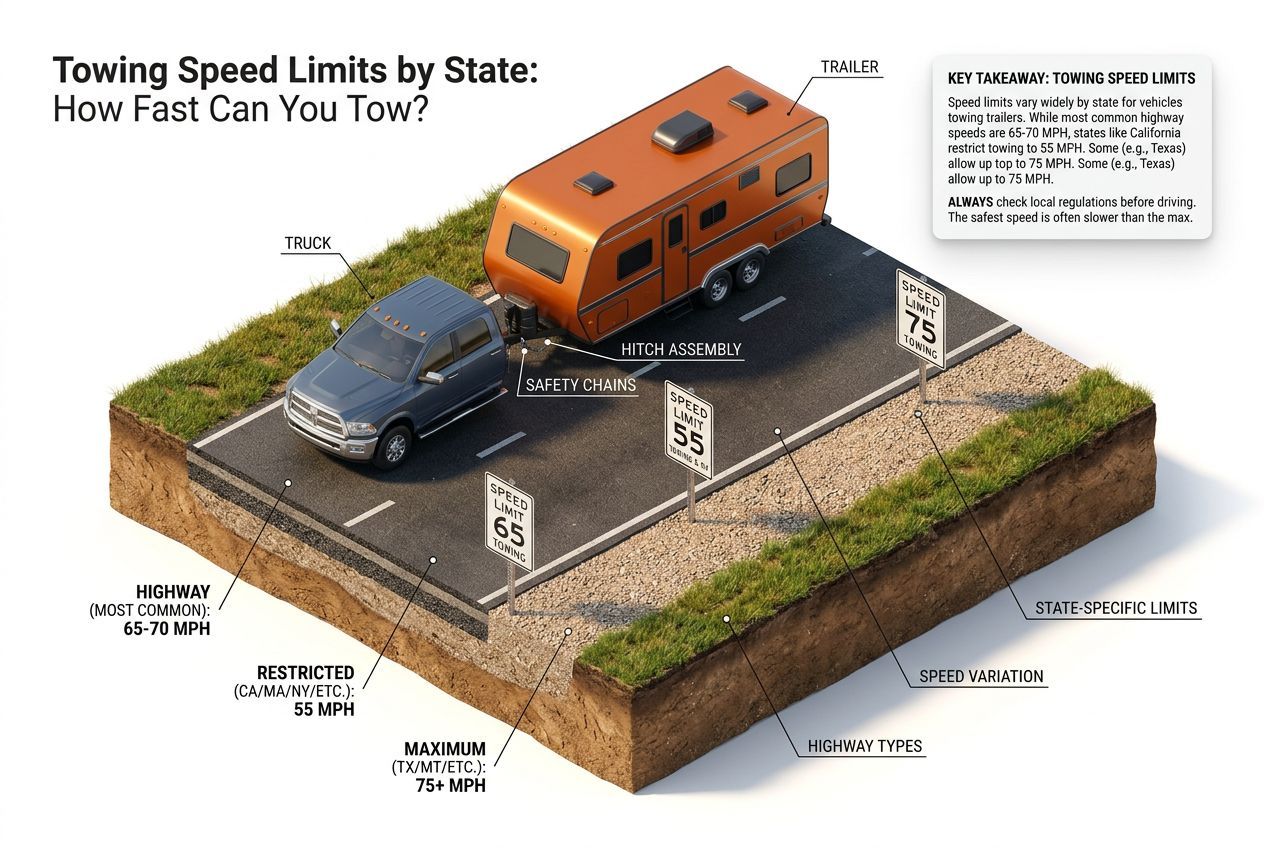
Approximately 12 states enforce a lower speed limit for vehicles towing trailers, with many of these located in the western U.S.
- California limits towing to 55 mph statewide on all highways.
- Oregon applies a 55 mph limit to trailer combinations exceeding certain weights on specific road types.
- Michigan posts 55 mph on some non-interstate routes for vehicles with trailers.
- Indiana generally restricts trailer combinations to 65 mph, even where passenger cars can legally travel at 70 mph.
- Washington, Idaho, and Illinois implement situational reductions that depend on factors such as road classification and trailer weight.
💡 Key Takeaway: States with reduced towing speed limits are mostly concentrated in the Western U U.S., with California's 55 mph rule being the most well-known.
Here's a consolidated state-by-state breakdown of some of the most relevant towing speed laws:
| State | Towing Speed Limit | Notes | Source |
|---|---|---|---|
| California | 55 mph | All vehicles towing a trailer, all highways — CVC §22406 | California Vehicle Code |
| Oregon | 55 mph | Combinations over 10,000 lbs GCW on two-lane roads | Oregon Revised Statutes §811.105 |
| Michigan | 55 mph | Certain non-freeway routes; check road classification | Michigan Vehicle Code |
| Indiana | 65 mph | Trailer combinations on most interstates | Indiana Code §9-21-5 |
| Washington | 60 mph | Vehicles towing trailers on certain highways | RCW 46.61.400 |
| Texas | Posted limit | No separate towing reduction — follow posted signs | Texas Transportation Code |
| Florida | Posted limit | No dedicated trailer speed reduction | Florida Statutes §316.183 |
| New York | Posted limit | Turnpike restrictions may apply — verify locally | NY Vehicle & Traffic Law |
Data current as of March 2026. Laws change — confirm with your state DOT before departure.
⚠️ Warning: Always cross-reference with your specific state's Department of Transportation (DOT) website for the most up-to-date and accurate towing regulations, especially before multi-state trips.
For a full, searchable breakdown, use the towing speed limits guide or cross-reference with your state's DOT website.
What Is the Towing Speed Limit in California?
California enforces one of the strictest trailer speed limits in the country: a blanket 55 mph on every highway and interstate. Under California Vehicle Code §22406, any motor vehicle towing a trailer is prohibited from exceeding 55 mph, regardless of the posted speed limit for other vehicles. This means that even if you're on major arteries like I-5 or I-10 where cars legally travel at 70 mph, your truck and travel trailer must adhere to the 55 mph limit.
📊 Quick Fact: California's 55 mph towing limit applies universally, even where passenger vehicles can legally travel at 70 mph.
Violations of this law carry a base fine of approximately $238, plus court fees that can push the total past $500. Additionally, you'll receive one point on your California driving record. This point can lead to an increase in your insurance premiums, particularly if you accumulate other points within a 12-month period.
This specific law often catches out-of-state drivers by surprise. If you're hauling a fifth-wheel from Arizona into California, the moment you cross that border, 55 mph becomes your absolute maximum speed — even if you were legally doing 65 mph on the Arizona side. For a broader look at how California compares to other states on trailer regulations, see our overview of DOT towing regulations.
What Is the Speed Limit When Towing in Your State?
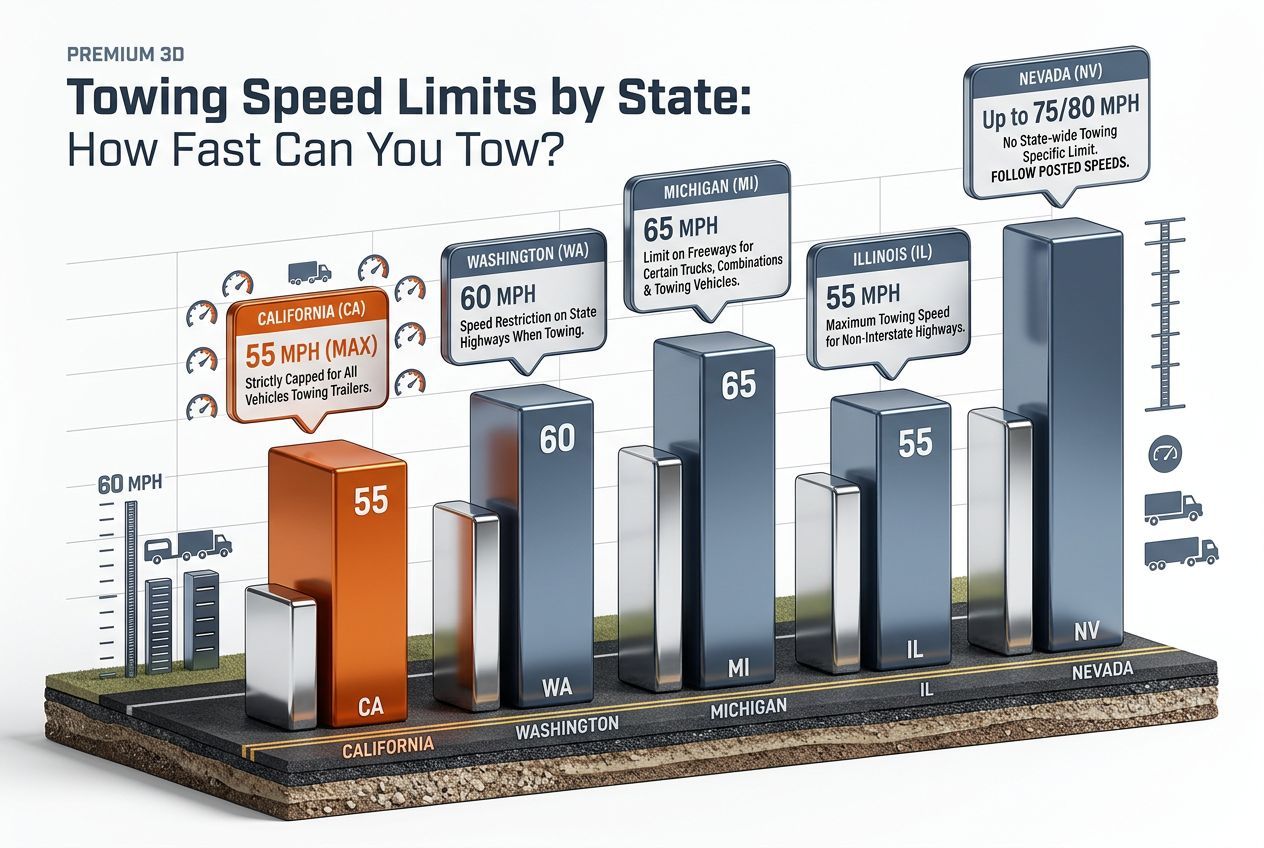
State towing laws are often complex and don't always fit neatly into a single table. Speed limits can vary significantly based on factors like road class (interstate vs. two-lane highway), the specific weight of the trailer, the number of axles, and whether the combination is classified as a commercial motor vehicle under FMCSA rules. The interactive tool below provides a streamlined way to select your state and trailer type to determine the applicable limit.
Use this lookup to check your state's regulations before you hitch up — this is especially critical if you're crossing multiple state lines on a long journey.