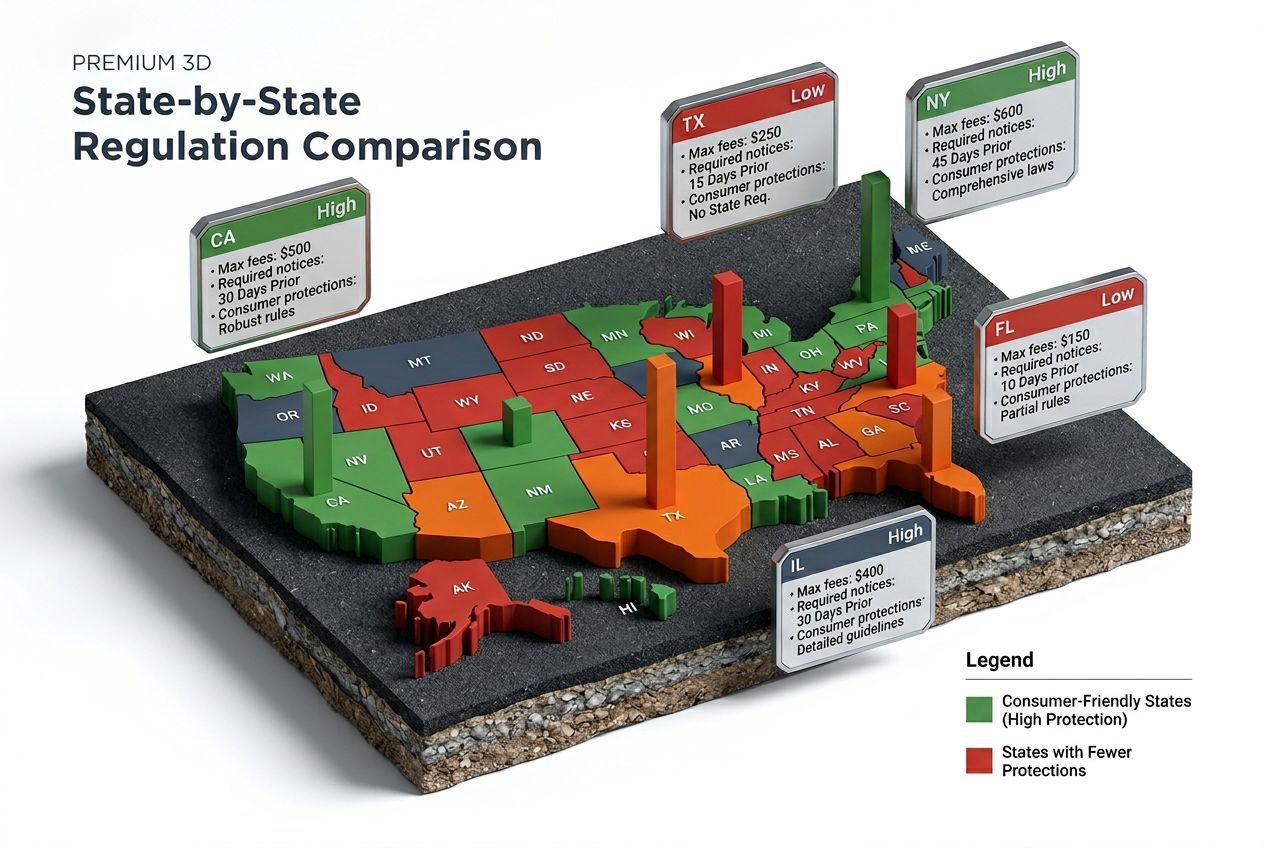
Specific state examples highlight the diversity of these regulations:
- Florida (Florida Statute §715.07): Requires the towing company to notify local police within 30 minutes of a private property tow and to release the vehicle within 1 hour after it is requested.
- Virginia (Code §46.2-1233.1): Caps the hookup and initial towing fee for a non-consensual passenger car tow at $210 (unless a locality sets different limits) and bars any storage charge for the first 24 hours.
✅ Pro Tip: Before traveling or operating a towing business, familiarize yourself with the specific state towing laws for your current location and any states you plan to visit or operate in.
For a deeper breakdown of how private lot towing rules work in your state, see our private property towing rules guide.
🛡️
TOWING LAWS & REGULATIONS
What Are Private Property Towing Laws by State?
Private property towing laws regulate when a vehicle can be removed from a private lot without the owner's consent. In most states, a property owner or manager must post a sign at each entrance with the tow company's name, phone number, and maximum fee before any vehicle can be legally removed. The sign must typically be clearly visible from every parking space.
💡 Key Takeaway: Proper signage is a universal requirement for legal private property towing. Without it, a tow can often be challenged as unlawful.
Minimum dwell-time rules and notification requirements vary by state:
- California: Requires a tow company to give the vehicle owner a reasonable opportunity to leave before towing begins.
- Illinois: Mandates photographic evidence of the violation and notification to local law enforcement within 30 minutes of the tow. Missing either step exposes the tow company to civil liability under state towing laws.
State rules on nonconsensual towing rights have tightened considerably since 2020. If your car was towed from a private lot and you believe the tow was unauthorized, check our guide on how to file an illegal towing complaint — the process differs by state, but the documentation steps are consistent.
It's important to understand the scope of these laws. What private property towing laws can't do is override a property owner's fundamental right to remove vehicles entirely if parked illegally. If your car is parked illegally on private property, a compliant tow is legal even if inconvenient. These laws primarily regulate how towing happens, not whether it can happen.
📋
TOWING LAWS & REGULATIONS
What Licensing Do Tow Truck Operators Need by State?
Tow truck licensing requirements vary more than almost any other category of state towing laws. This disparity creates significant compliance challenges for operators working across state lines.
- California: Requires tow operators to hold a Motor Carrier Permit, carry a minimum $750,000 in liability insurance, and pass a background check through the California Highway Patrol.
- Illinois: Mandates a separate Towing Recovery Immobilization Specialist (TRIS) certification for operators performing non-consensual tows.
📊 Quick Fact: On the other end of the spectrum, Montana requires no state-specific tow truck license — operators need only a standard CDL for rigs over 26,001 lbs GVWR, plus applicable FMCSA registration for commercial work.
Insurance minimums also swing dramatically from state to state. Some states accept $300,000 in general liability, while others — particularly those with active predatory towing enforcement — require $1,000,000 or more. Additionally, many states require a separate Vehicle Storage Facility (VSF) license to legally hold towed vehicles, which comes with its own bonding and inspection requirements.
Our full tow truck license requirements guide covers all 50 states. If you're a tow operator expanding into a new state, that's your first stop before you pull a single vehicle.
⚙️
TOWING LAWS & REGULATIONS
What Equipment and Lighting Laws Apply to Towing by State?
Every state requires functioning tail lights, brake lights, and turn signals on any towed vehicle or trailer — that's the FMVSS 108 federal floor. However, state-specific rules add significant requirements on top.
💡 Key Takeaway: Even seemingly minor details like safety chain specifications differ by state. California requires chains rated to the gross trailer weight, crossed under the tongue, while some southeastern states only require chains rated to the trailer's tongue weight.
Trailer brake requirements are where you'll find the biggest state-to-state variation:
- 1,000 lbs GVWR: Required in some states (check carefully before towing even a light utility trailer).
- 1,500 lbs GVWR: The threshold in states including Oregon and New Mexico.
- 3,000 lbs GVWR: A common threshold in Texas, Florida, and several Midwest states.
- No threshold / brakes always required: A few states mandate trailer brakes on any combination capable of exceeding a set speed.
Breakaway switches are another critical piece of equipment. These spring-loaded brake activators engage if the trailer separates from the tow vehicle. They are required in California for trailers over 1,500 lbs and in most western states for anything over 3,000 lbs. Mirror requirements also vary: if your trailer is wider than your tow vehicle, most states mandate extended side mirrors that provide a clear view 200 feet to the rear.
Before you hook up anything, use the towing capacity lookup tool to confirm your vehicle's ratings, then cross-check equipment requirements with your state's DOT. Our towing regulations by state hub links directly to official state sources.
🚛
TOWING LAWS & REGULATIONS
How Do Predatory Towing Laws Protect Consumers?
Predatory towing laws are designed to protect vehicle owners from excessive fees, surprise charges, and unauthorized vehicle removal. As of 2026, at least 42 states cap non-consensual towing fees or require tow companies to file rate schedules with a regulatory body — typically the state public utilities commission or department of transportation.
📊 Quick Fact: Since 2020, there has been a significant expansion in consumer protections against predatory towing practices across the United States.
Key consumer protections frequently found in state towing laws include:
- Credit card acceptance: Required at the storage facility in some states — California's Vehicle Code §22658 requires storage facilities to accept a valid bank credit card or cash.
- Pre-tow photography: Mandatory in Illinois and several other states, requiring the tow company to document the violation before hooking up.
- Law enforcement notification: Most states require notification within 30–60 minutes of completing a non-consensual tow.
- Fee caps: Daily storage caps range from $20 to $75 per day depending on the state.
The predatory towing laws guide on TowingServiceHub covers which states have the strongest protections — and which still leave consumers largely unprotected. If an HOA or property manager initiated the tow, see also can an HOA tow my car for the specific rules governing HOA-directed removals.
To understand your rights under towing lien laws — the process tow companies use to claim abandoned vehicles — see our towing lien laws guide.
📝
TOWING LAWS & REGULATIONS
What Are the Tow Dolly and Flat Towing Laws by State?
Tow dolly and flat towing laws specifically govern supplemental braking, lighting, registration, and license plate visibility for vehicles towed behind motorhomes or trucks. Most states require auxiliary braking when the towed vehicle exceeds 1,500–3,000 lbs. Pennsylvania and Indiana, for example, require tow dollies to be separately registered and display a license plate — a requirement many RV owners miss entirely.
⚠️ Warning: Always check your specific tow dolly's registration requirements and ensure proper licensing for the dolly and visibility of the towed vehicle's license plate.
Flat towing rules also vary on license plate visibility. Some states require the towed vehicle's rear plate to be visible; others accept a temporary placard. Our flat towing guide includes a state-by-state compliance checklist specifically for RV and motorhome operators.
It's critical to consider manufacturer recommendations, not just state laws. What flat towing laws can't solve is mechanical damage caused by towing a vehicle in an unsupported configuration. Not every vehicle is approved for flat towing (all four wheels down) by its manufacturer. A vehicle towed flat without manufacturer approval can destroy its transmission or transfer case in as few as 30 miles. The flat tow checker tool lets you verify your specific year/make/model before you attach a tow bar.
💰
TOWING LAWS & REGULATIONS
How Do Towing Notification and Storage Fee Rules Work?
Towing notification requirements generally mandate that tow companies inform vehicle owners within 24–72 hours of a non-consensual tow, depending on the state. Most states route this process through local law enforcement — the tow company reports the tow to police, who then log it in a searchable database. If you can't find your car, calling the local non-emergency police line and providing your plate number is usually your fastest path to locating it.
✅ Pro Tip: If your vehicle has been towed, contacting local law enforcement is often the quickest way to determine its location and ensure proper notification protocols were followed.
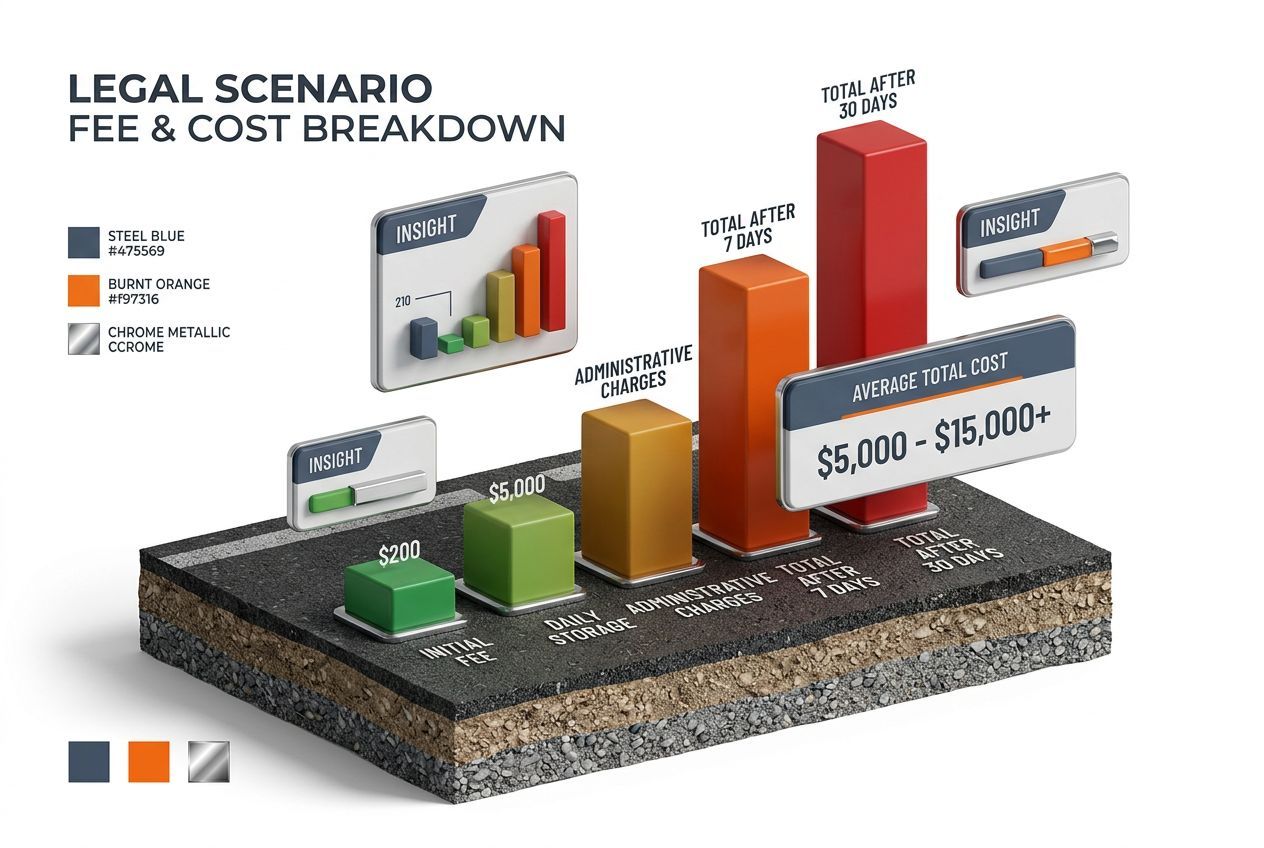
Storage fees are another area with state-specific regulations. Texas, for example, caps storage at $22.85 per day for a vehicle 25 feet or less (TDLR), and Virginia prohibits any storage charge for the first 24 hours after a non-consensual tow. Most states with capped fees also require an itemized receipt before releasing the vehicle.
If you're disputing unlawful storage charges, it's crucial to document everything: photograph the receipt, note the exact time of tow and retrieval, and cross-check your state's official fee schedule against what you were charged. The process for challenging those charges is covered in our illegal towing complaints guide. For estimated towing and recovery costs in your area, the towing cost calculator provides current market benchmarks. General towing cost context is also in our how much does towing cost guide.
📊
TOWING LAWS & REGULATIONS
How Do You Stay Compliant When Towing Across State Lines?
Staying compliant when towing across state lines means adhering to the most restrictive towing rule of every state on your route — not just your home state's rules. For example, if you're towing from Texas to California, California's 55 mph speed cap and specific trailer brake threshold apply the moment you cross the state line, regardless of what Texas regulations allow.
⚠️ Warning: Always research the most stringent requirements for every state you will be traveling through. A violation could lead to fines, citations, or even impoundment of your vehicle and trailer.
To help you navigate the complexities of multi-state towing regulations, we've developed a comprehensive checklist. This tool will guide you through the essential considerations for each state on your route, ensuring you meet all legal obligations.


