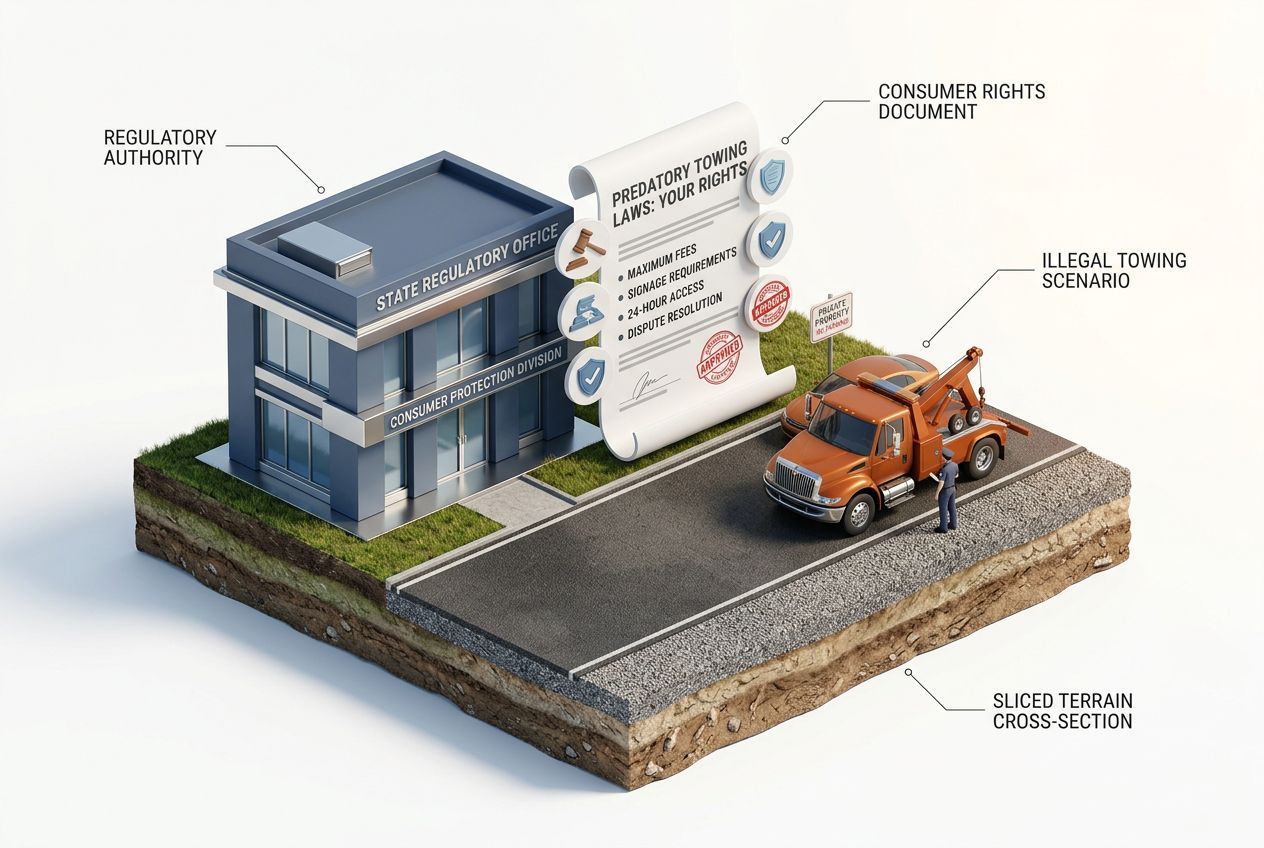
State-by-State Comparison of Key Metrics: Here's how key states compare on the most important anti-predatory towing metrics:
Which States Have Predatory Towing Protections? — data table
| State |
Max Non-Consensual Tow Fee (Light-Duty) |
Storage Fee Cap |
Drop Fee Rule |
Criminal Penalties? |
| California |
Local law enforcement agreement or CHP-approved rate |
Set by the same rate limits |
Half the regular towing charge |
Yes — misdemeanor for knowingly charging excessive rates (fine up to $2,500 and/or up to 3 months in jail) |
| Texas |
$272 (up to 10,000 lbs) |
$22.85/day (vehicles 25 ft or less) |
$135 (up to 10,000 lbs) |
Yes — misdemeanor, $500–$1,500 fine; Class B if knowing or intentional |
| Florida |
Set by county or municipality |
Set by county or municipality |
Half the posted rate |
Yes — first-degree misdemeanor or third-degree felony, depending on the provision |
| Virginia |
$210 hookup and initial tow (passenger car), unless a locality sets its own limits |
No charge for the first 24 hours; then per local ordinance |
Not set by statute |
Civil penalty of 10× the charges in Planning District 8 (Northern Virginia) |
Sources: California Vehicle Code §22658; Texas Occupations Code ch. 2308 and TDLR towing and storage fees; Florida Statutes §715.07; Code of Virginia §46.2-1233.1 and §46.2-1233.3.
For more on how these regulations intersect with private lots specifically, read our private property towing rules breakdown.
🛡️
TOWING LAWS & REGULATIONS
How Much Can a Tow Company Legally Charge?
Regulated Towing Charges: Maximum towing charges are set at the state or municipal level — and they vary enough that what's legal in one city might be highway robbery in another.
- California does not set one statewide dollar cap. Under Vehicle Code §22658, charges may not exceed the rates in the local law enforcement agency's towing agreement or the rate the CHP approved for that operator.
- Texas caps a nonconsent tow of a light-duty vehicle (up to 10,000 lbs) at $272, according to TDLR.
- Virginia caps the hookup and initial towing fee for a passenger car at $210, plus up to $30 for night, weekend, or holiday tows, unless a locality sets different limits (§46.2-1233.1).
Storage Fee Regulations: Storage fees are regulated separately. In Texas, a vehicle storage facility may charge up to $22.85 per day for a vehicle 25 feet or less (TDLR). Where storage fees are not capped, a week in an impound lot can add up to more than an older car is worth.
📊 Quick Fact: A vehicle impounded for a week can accumulate storage fees that dwarf the car's value in unregulated lots.
Worked Example: Houston Tow Scenario
Imagine you park near a concert venue in Houston. Your car gets spotted and towed.
- Under Texas rules, the operator can charge up to $272 for the tow, and the storage facility up to $22.85 per day for storage.
- If you retrieve it the next morning, the tow and one day of storage come to about $295, before any impoundment or notification fees the storage facility is allowed to add.
- If the operator bills you $450 for the tow plus a $75 "administrative fee," that exceeds the cap. You can request a hearing in justice court (Texas requires the request within 14 days, excluding weekends and holidays, of the car being placed in storage), and a knowing, intentional, or reckless violation makes the company liable for $1,000 plus three times the fees under §2308.404.
Important Limitations: Fee caps typically apply to non-consensual private property tows of light-duty passenger vehicles. Commercial vehicles, oversized trucks, and RVs often fall under different rate structures. Also, if your vehicle required special equipment (a flatbed versus a wheel-lift), operators may legally charge more. Always check your state's specific statutes, or use our towing cost calculator to benchmark what you should have paid.
For a broader look at what towing typically runs, see how much does towing cost.
📋
TOWING LAWS & REGULATIONS
Can a Tow Truck Take Your Car If You're in It?
The "Right to Drop": Generally, no. In many states, a tow truck operator must release a vehicle if the owner or driver arrives before it leaves the property. This right is commonly called the "right to drop" — and it's one of the clearest towing consumer rights on the books.
When the Right Applies: If you arrive before your vehicle leaves the property, the operator must release it in states such as California and Florida. They can charge a drop fee, but it is capped: half the regular towing charge in California, half the posted rate in Florida, and $135 for a light-duty vehicle in Texas. Once the vehicle has left the property, the full tow fee applies.
⚠️ Warning: Towing an occupied vehicle is a serious violation. Virginia, for example, prohibits anyone from riding in a vehicle while it is being towed, and depending on state law it can lead to criminal charges.
Practical Advice for Intervention: If you spot the operator hooking up your car, approach calmly, state clearly that you're the owner, and document the interaction. Don't physically block the truck — that creates liability for you. Just invoke your right to drop, get the drop fee in writing, and photograph everything.
For a full breakdown of your rights during and after a non-consensual tow, see our nonconsensual towing rights guide.
⚙️
TOWING LAWS & REGULATIONS
How Do You Fight a Predatory Tow?
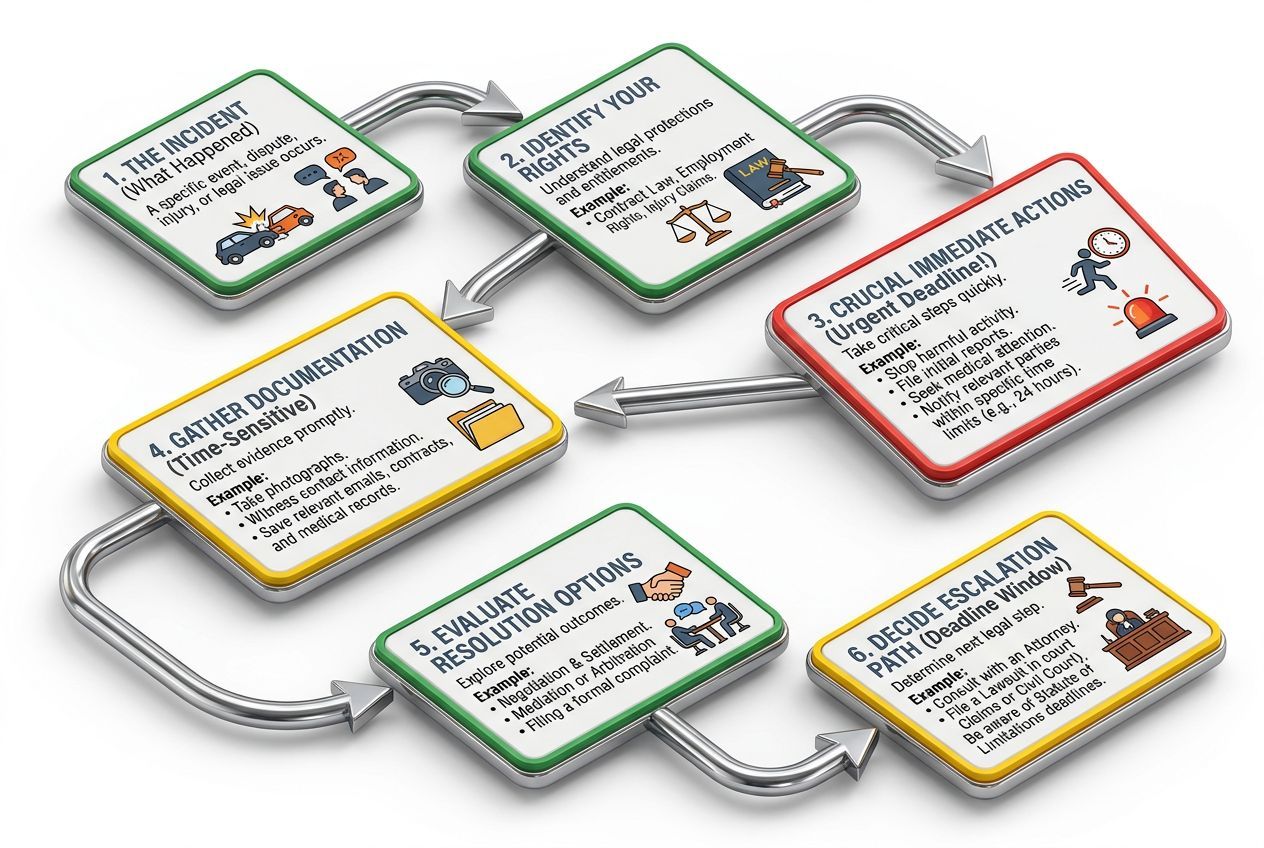
Winning Your Case: Fighting a predatory tow starts with thorough documentation — collected before you pay, while evidence is still fresh. Here's the sequence that holds up in small claims court:
Documenting the Incident
Gathering Evidence: The more information you collect at the scene, the stronger your case will be.
- Photograph the lot: Capture every sign (or the absence of signs), their placement height, and whether they're legible or illuminated at night.
- Record the operator: Get their name, the towing company name, truck number, and license plate. Ask for a receipt itemizing every charge.
- Note the timeline: Record the exact time you parked, exact time you received notice, and exact time you retrieved the vehicle.
Filing Complaints and Legal Action
Pursuing Your Rights: Once you have documented the incident, it's time to take action.
- File complaints in parallel: Submit to your city's consumer protection office, your state attorney general's office, and the towing licensing authority in your state.
- Small claims court: Filing fees run $30–$75 in most states.
- In Texas, a knowing, intentional, or reckless violation makes the company liable for $1,000 plus three times the fees.
- In Northern Virginia (Planning District 8), the Attorney General can collect a civil penalty of 10 times the towing and storage charges and pay it to you.
- In California, an operator who charged excessive rates is liable for four times the amount charged.
💡 Key Takeaway: Thorough documentation wins towing disputes. The most common reason people lose: they paid, discarded the receipt, and photographed nothing.
If the towing company holds a lien against your vehicle, our towing lien laws guide walks you through the timeline and your rights before a lien sale occurs.
For step-by-step complaint filing, see how to file an illegal towing complaint.
🚛
TOWING LAWS & REGULATIONS
What Signage Is Required for Private Property Towing?
The Importance of Signage: Most states mandate specific towing signage before a vehicle can be legally removed from private property — and failure to meet those standards often makes the tow illegal outright. Signage requirements are where a huge number of predatory tows fall apart legally.
Common Mandates for Signage: Across strong-protection states, these are typical requirements:
- Placement: Signs at every entrance to the lot, not just the main entrance.
- Size: California requires signs at least 17" × 22" with lettering at least 1 inch high; Florida requires "tow-away zone" in letters at least 4 inches high.
- Content: A warning that unauthorized vehicles will be removed at the owner's expense, plus the towing company's name and phone number (California also requires the local police phone number).
- Height: Florida requires the sign to be 3–6 feet above ground level.
Impact of Non-Compliance: If even one of these requirements is missing — a phone number that's disconnected, a sign blocked by a bush, or no sign at the secondary entrance — the tow is likely illegal in those states. That gives you grounds for full reimbursement without even reaching the fee dispute.
✅ Pro Tip: Before parking on private property in an unfamiliar area, it's worth photographing entrance signs. If you end up towed, that photo proves the sign was either missing or non-compliant.
More on what HOAs and private landowners can and can't do: can an HOA tow my car and private property towing rules.
📝
TOWING LAWS & REGULATIONS
Can You Sue a Towing Company for Illegal Towing?
Yes, You Can Sue: In states with strong predatory towing laws, suing is often the most effective financial remedy available to you. Small claims court in every state accepts towing disputes, and enhanced damages provisions in many states make even a single bad tow worth litigating.
State-Specific Recovery Options:
- Virginia: In Planning District 8 (Northern Virginia), an improper tow is subject to a civil penalty of 10 times the total towing and storage charges, collected by the Attorney General and paid to the victim (§46.2-1233.3). Statewide, you can file a complaint with the Attorney General's Division of Consumer Counsel.
- Texas: Under Occupations Code §2308.404, a company that intentionally, knowingly, or recklessly violates the chapter is liable for $1,000 plus three times the towing, storage, or booting fees.
- California: Under Vehicle Code §22658, an operator who charges excessive rates is liable to the vehicle owner for four times the amount charged.
- Florida: Under §715.07, a person who improperly causes a vehicle to be removed is liable for the removal and storage costs, damages, attorney's fees, and court costs.
Public Record and Oversight: Filing a suit also creates a public record, and a complaint to your state's towing regulator (such as TDLR in Texas) goes on file against the company.
Important Limitations: If you signed anything at the impound lot — including a payment receipt with fine print — that document may complicate your case. Always read everything before signing. If you're dealing with a commercial vehicle dispute or a tow initiated by law enforcement, different rules apply under DOT towing regulations.
If you're comparing roadside assistance options to avoid the predatory towing risk entirely, our AAA roadside assistance review covers what membership actually gets you.