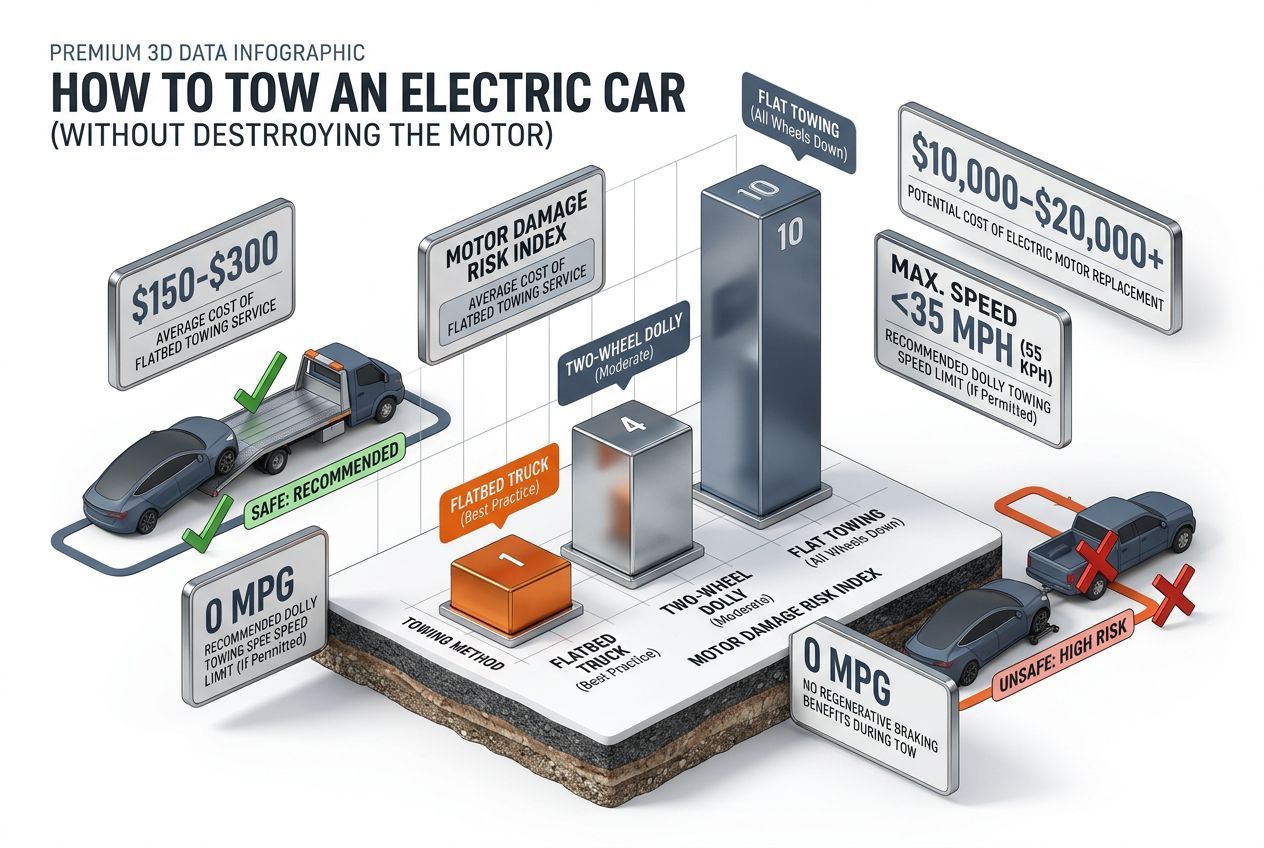
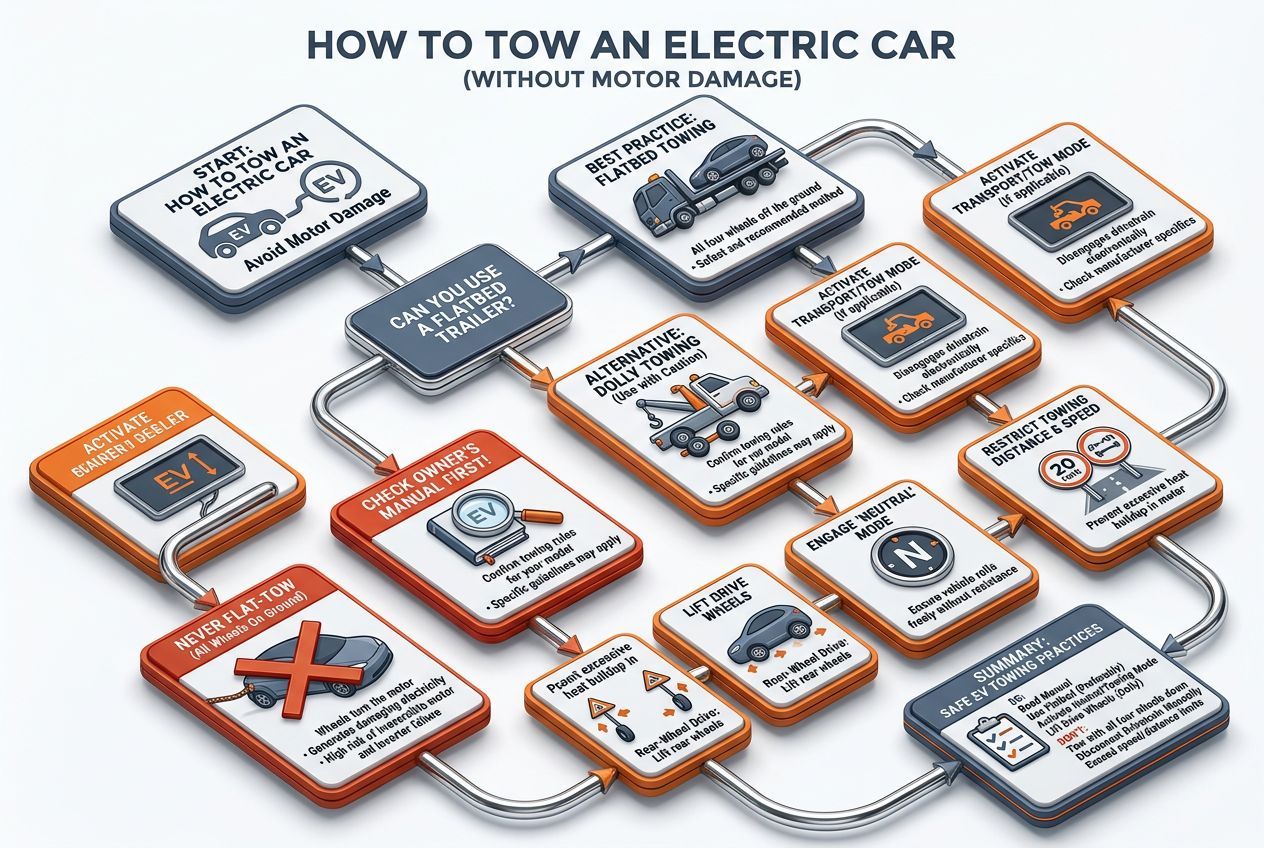
💡 Key Takeaway: Always use a flatbed tow truck for electric cars — wheel-lift and dolly towing can cause permanent drivetrain damage within a fraction of a mile. 💡 Key Takeaway: EV "tow mode" or "transport mode" only helps with loading onto a flatbed — it does NOT make flat towing behind an RV safe. 📊 Quick Fact: Improper EV towing repairs typically run $3,000–$15,000 and are rarely covered under warranty. ✅ Pro Tip: AAA Plus and Premium memberships cover 100–200 miles of flatbed towing, making them genuinely worth it for EV owners. 💡 Key Takeaway: Always tell the dispatcher you have an electric vehicle — not every tow operator carries the right equipment.
Why Can't You Tow an Electric Car Normally?
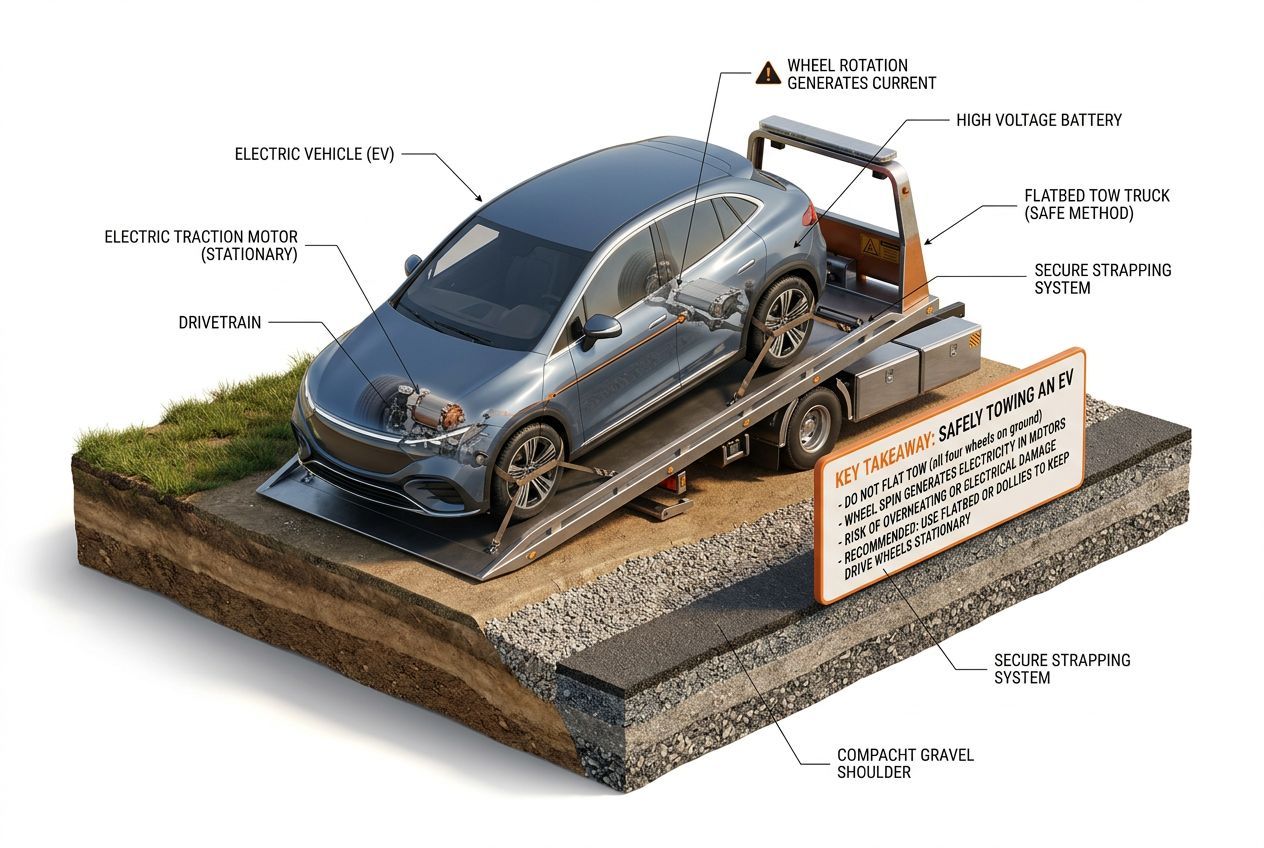
EV motors are permanently connected to the drive wheels, meaning most electric cars cannot be towed with their wheels on the ground. Unlike a traditional transmission, there's no neutral gear that physically disconnects the drivetrain.
Understanding the EV Drivetrain
When those wheels spin during a tow, the motor spins too. This immediately starts generating electricity through regenerative braking. However, that current has nowhere safe to go, so it back-feeds into the battery pack and power electronics.
⚠️ Warning: According to Tesla's service documentation, damage can begin in as little as 0.3 miles of wheels-down towing.
Think of your EV's motor as both an engine and a generator, depending on the direction of energy flow. Tow it incorrectly, and you've turned a simple breakdown into a potentially $10,000 repair.
This mechanism is fundamentally different from towing a rear-wheel-drive gas car with the front wheels up. In that scenario, the drivetrain isn't rotating at all. In an EV, there's no clean way to "disconnect" unless the manufacturer specifically built that feature in.
Can You Flat Tow an Electric Car Behind an RV?
Flat towing an electric car — with all four wheels on the ground, connected by a tow bar to an RV — is explicitly prohibited by nearly every major manufacturer. Tesla, Rivian, Hyundai, Kia, Ford, and GM all state in their owner's manuals that flat towing is not permitted for their EVs.
The danger arises from continuous regenerative braking. At highway speed behind an RV, the driven wheels turning on pavement constantly engage regenerative braking. This means sustained back-EMF current floods the inverter and battery management system with unregulated voltage. The result is almost always:
- Motor winding failure
- Inverter board destruction
- Severe battery degradation
Neither of these outcomes is cheap to fix.
A small number of plug-in hybrids with front-wheel-drive-only configurations technically allow dolly towing of the front wheels while the rear axle (which carries the electric motor) stays off the ground. However, you must verify this with your specific manufacturer before attempting anything. Never assume.
If you're an RV owner shopping for a dinghy car, this information is crucial. Check out our comprehensive flat towing guide before making a purchase decision — not after.
How Should You Tow an Electric Car?
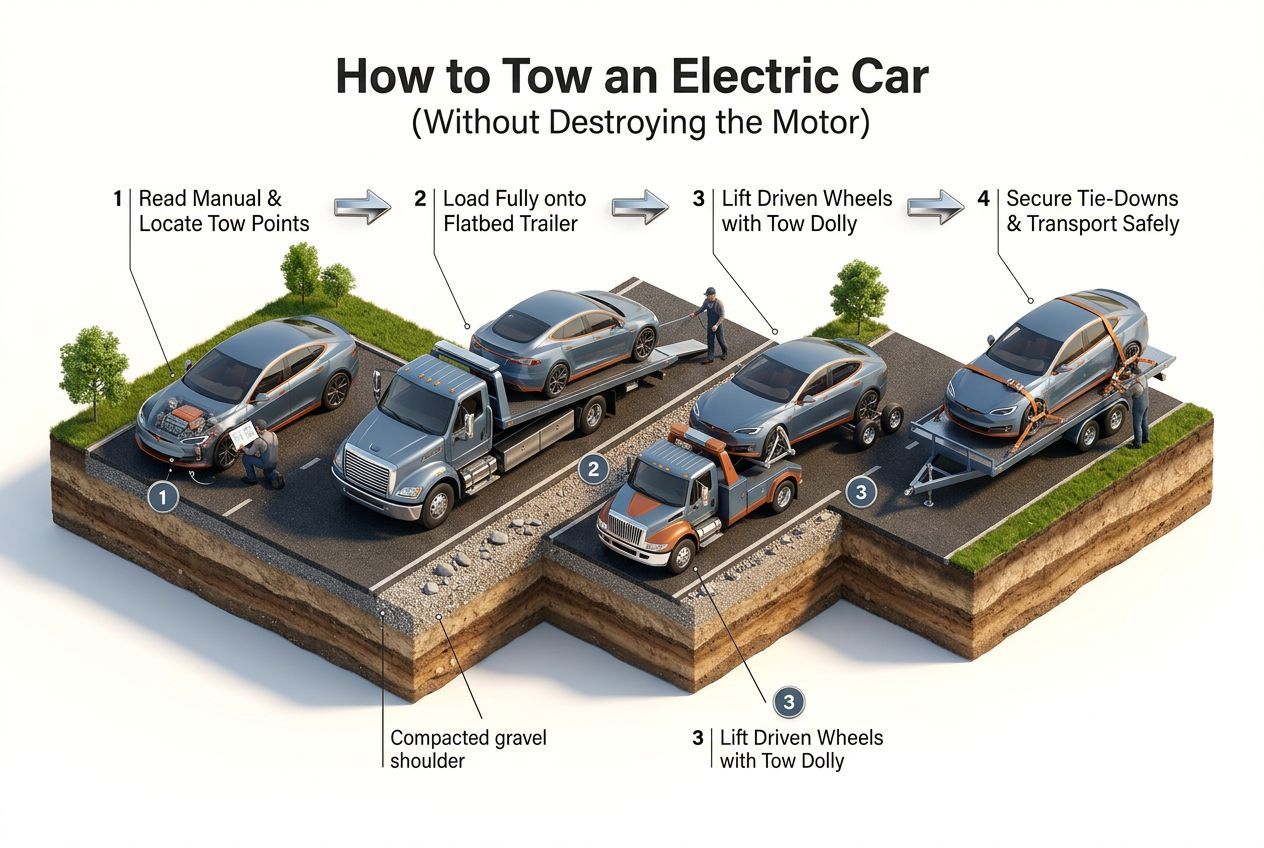
A flatbed tow truck, with all four wheels completely off the ground, is the only universally approved towing method for electric cars. Every major EV manufacturer — including Tesla, Rivian, Ford, Hyundai, BMW, and GM — specifies flatbed-only recovery in their towing guidelines. AAA echoes this position in their EV roadside assistance guidance.
Here's exactly what that process should look like:
Before the Flatbed Arrives
- Activate Transport Mode or Tow Mode: If your vehicle has this feature, activate it (more on that below).
- Manual Parking Brake Release: If the 12V auxiliary battery is dead, consult your manual for the manual parking brake release procedure. This is usually accessed via a small panel in the trunk or under a seat.
- Tesla Specifics: For Tesla Model 3 and Model Y, the manual release is a red strap located behind the rear seat bottom cushion.
- Ensure Visibility: Keep hazard lights on. If you're on a highway, stay behind the barrier if one is present for your safety.
When the Operator Arrives
- Confirm Flatbed: Confirm they have a flatbed — not a wheel-lift or a dolly setup.
- Identify Lift Points: Point out the vehicle's lift points. Most EVs have reinforced jacking pads that prevent damage to the battery enclosure. The Ford F-150 Lightning, for example, has specific jack pad locations stamped in the rocker panel.
- Verify Full Lift: Make sure all four wheels are fully on the deck before any straps are applied.
Use our flat tow checker tool to quickly verify whether your specific EV model is approved for any ground-contact towing. Enter your EV's make, model, and year to get instant manufacturer towing guidance.