What Is the Subaru Outback Towing Capacity by Year? — data table
| Generation |
Years |
Engine |
Max Tow Rating |
GCWR |
| 6th Gen |
2020–2025 |
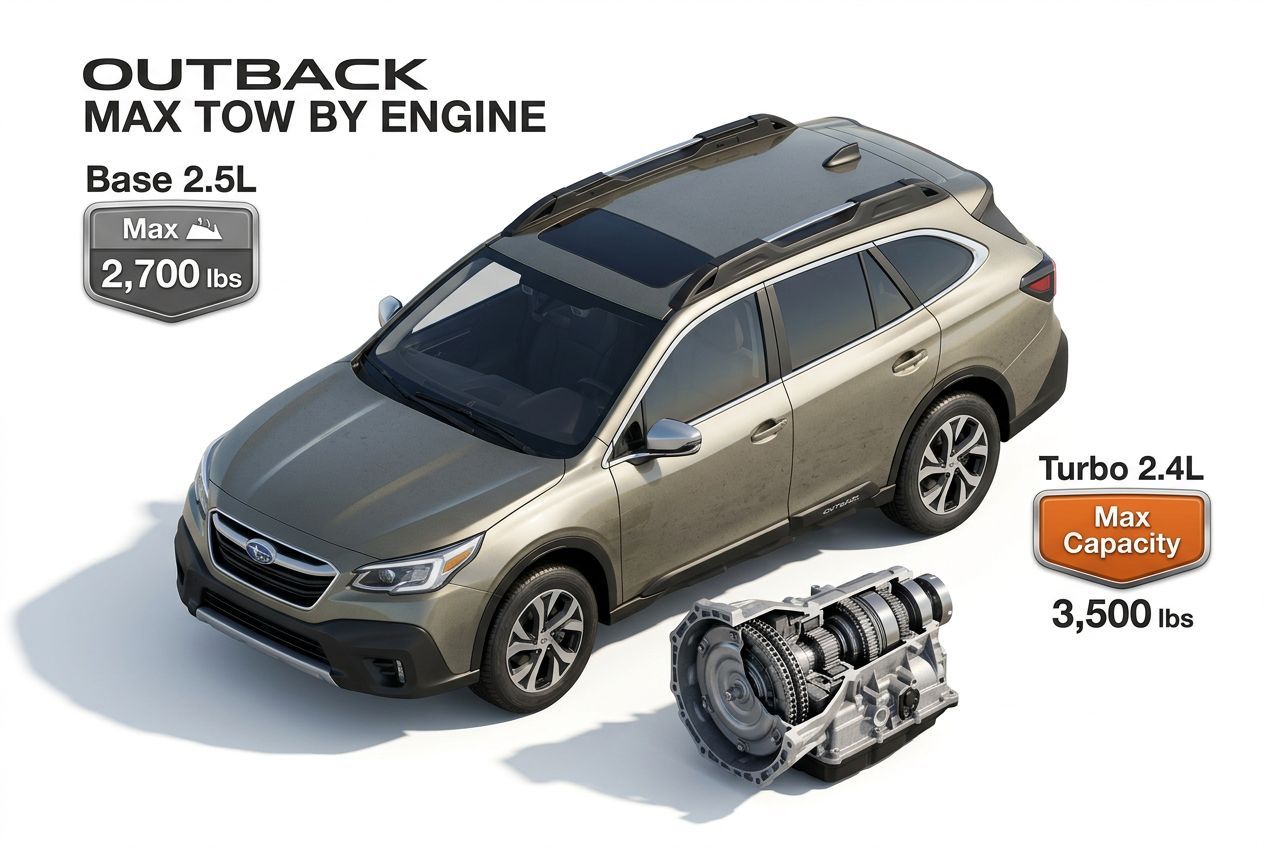
2.4L Turbo (XT/Wilderness) |
3,500 lbs |
~8,700 lbs |
| 6th Gen |
2020–2025 |
2.5L NA Flat-4 |
2,700 lbs |
~7,700 lbs |
| 5th Gen |
2015–2019 |
3.6L Flat-6 (3.6R) |
2,700 lbs |
~8,200 lbs |
| 5th Gen |
2015–2019 |
2.5L Flat-4 |
2,700 lbs |
~7,700 lbs |
| 4th Gen |
2010–2014 |
3.6L Flat-6 |
3,000 lbs |
~8,400 lbs |
| 4th Gen |
2010–2014 |
2.5L Flat-4 |
2,700 lbs |
~7,700 lbs |
| 3rd Gen |
2005–2009 |
2.5L Turbo (XT) |
3,000 lbs |
~8,000 lbs |
| 3rd Gen |
2005–2009 |
2.5L NA Flat-4 |
2,700 lbs |
~7,500 lbs |
| 2nd Gen |
2000–2004 |
3.0L Flat-6 (H6) |
3,000 lbs |
~8,000 lbs |
| 2nd Gen |
2000–2004 |
2.5L Flat-4 |
2,700 lbs |
~7,500 lbs |
| 1st Gen |
1995–1999 |
2.5L Flat-4 |
2,000 lbs |
~6,500 lbs |
Source: Subaru of America Specifications (subaru.com); Edmunds vehicle specifications (edmunds.com)
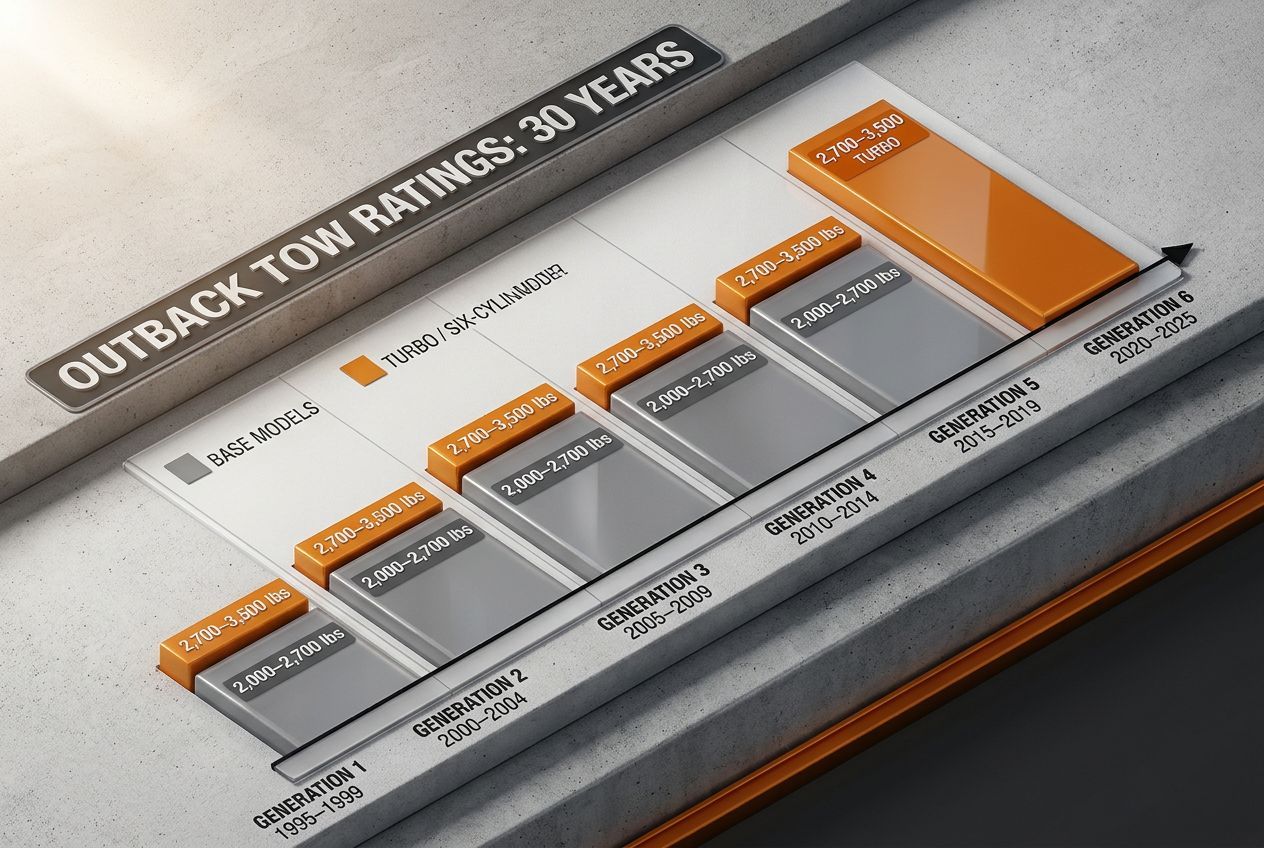
The 3.6R anomaly is worth noting. The 2015–2019 Outback 3.6R used a 256 hp flat-six engine — significantly more powerful than the 175 hp base 2.5L. Yet Subaru rated both at 2,700 lbs. The reason: the same CVT transmission was used in both configurations, and Subaru's engineers determined the CVT's heat tolerance — not engine power — was the bottleneck. The 4th gen 3.6L models (2010–2014) did get a 3,000 lb rating with a slightly different CVT calibration.
💡 Pro Tip: The current 2.4L turbo Outback is the best Outback ever built for towing. It has more torque than the old 3.6R, 800 more pounds of tow capacity than the base model, and the Wilderness trim adds off-road capability for getting to remote launch points and campgrounds. If you're buying an Outback specifically for towing, the turbo is non-negotiable.
🔧
TRUCK TOWING CAPACITY
Does the Outback Wilderness Tow More Than Other Trims?
No — the Wilderness shares the same 3,500 lb tow rating as every other turbo XT trim. The Onyx Edition XT, Limited XT, Touring XT, and Wilderness all use the identical 2.4L turbo engine and CVT, producing the same 3,500 lb rating.
Where the Wilderness earns its keep for towing is off-pavement capability. It offers 9.5 inches of ground clearance (vs 8.7 standard), Yokohama Geolander all-terrain tires, a lower final-drive ratio (4.44:1 vs 3.70:1), reinforced roof rails rated to 700 lbs dynamic, and water-repellent StarTex upholstery.
The lower final-drive ratio is the towing-relevant difference. That 4.44:1 ratio gives the Wilderness more mechanical advantage at low speeds — beneficial when pulling a trailer up steep boat ramps, through soft gravel, or navigating campground roads with tight turns. The tradeoff is slightly higher engine RPM at highway speeds, which translates to 1–2 MPG lower fuel economy.
💡 Key Insight: The Wilderness is worth the premium over other XT trims if your towing involves unpaved roads — campgrounds, boat ramps, hunting land, ski resorts with gravel lots. If you only tow on paved roads, the Onyx XT or Limited XT gives you the same 3,500 lbs at a lower price with better highway manners.
🛡️
TRUCK TOWING CAPACITY
What Can You Actually Tow with a Subaru Outback?
The Outback handles a defined range of light recreational and utility loads. At 3,500 lbs max (turbo) or 2,700 lbs (base), expectations need to be realistic — this is a crossover wagon, not a truck.
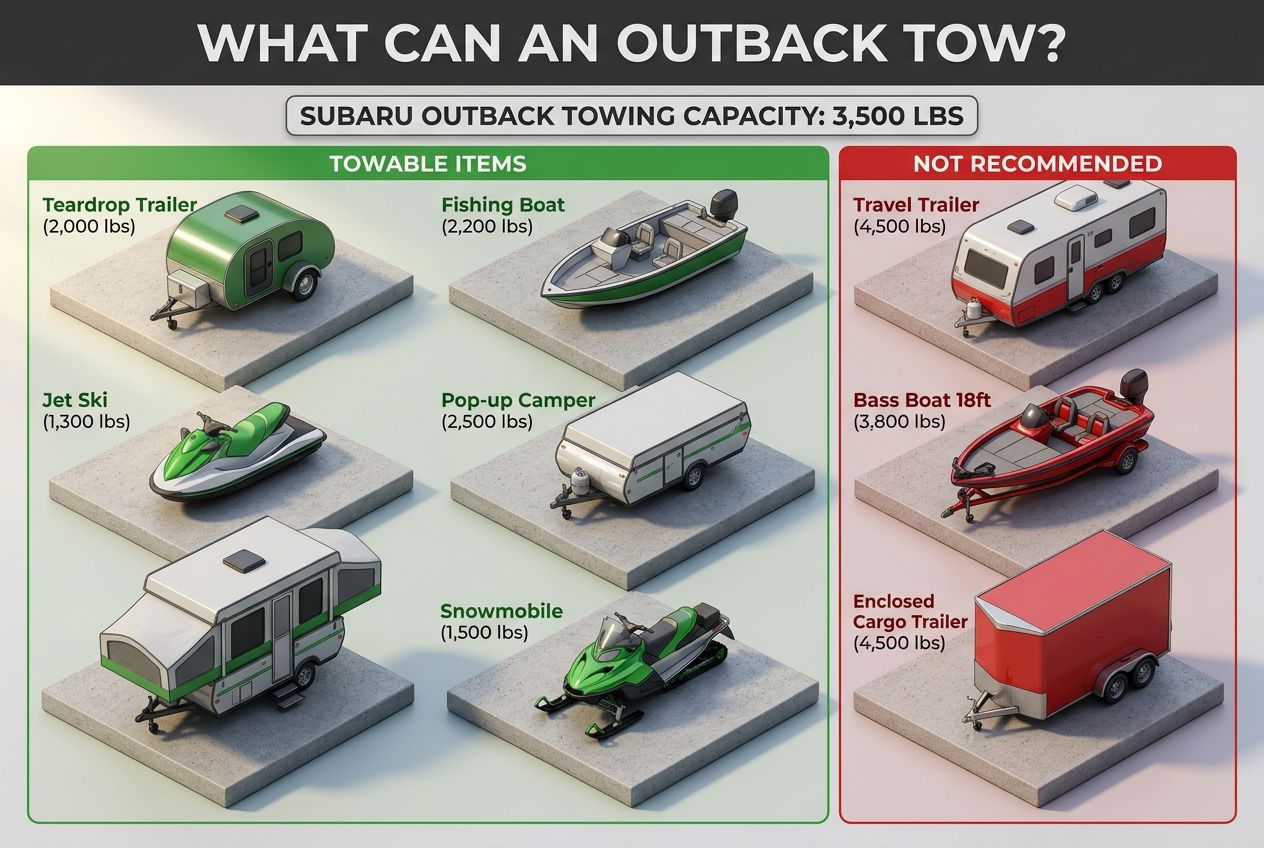
Turbo Outback at 3,500 lbs — Comfortable Loads
- Teardrop trailers: 1,000–2,500 lbs — the Outback's sweet spot
- Pop-up campers: 1,500–2,800 lbs — fits well when loaded carefully
- Small A-frame campers: 1,800–3,000 lbs loaded
- Aluminum fishing boats (14–16 ft): 1,200–2,500 lbs on trailer
- Single jet ski on trailer: 1,000–1,500 lbs
- Small utility trailers: Up to 2,800 lbs loaded
- Snowmobile on trailer: 1,200–1,800 lbs
Base 2.5L Outback at 2,700 lbs — More Limited
- Teardrop trailers under 2,000 lbs loaded
- Small pop-up campers under 2,200 lbs loaded
- Lightweight utility trailer with lawn equipment
- Single jet ski or kayak trailer
What Exceeds the Outback's Capacity
- Travel trailers over 16 feet: Typically 3,000–5,000 lbs loaded
- Bass boats over 17 feet on trailer: 3,000–4,500 lbs
- Enclosed cargo trailers: Most start at 2,500 lbs empty, 4,000+ loaded
- Any dual-axle trailer: Typically over 3,500 lbs loaded
⚠️ Warning: Trailer dry weight listed in the brochure is never your actual tow weight. A pop-up camper listed at 2,200 lbs dry often hits 2,800–3,200 lbs once you add water, propane, bedding, and gear. A turbo Outback has zero margin at 3,500 lbs — plan for 10–15% under the max to maintain safe handling. Our trailer weight guide covers how to calculate loaded trailer weight accurately.
For matching campers to the Outback's rating, our camper towing capacity guide ranks camper types by weight class.
📋
TRUCK TOWING CAPACITY
How Does the Subaru Outback Compare to Other Crossovers for Towing?
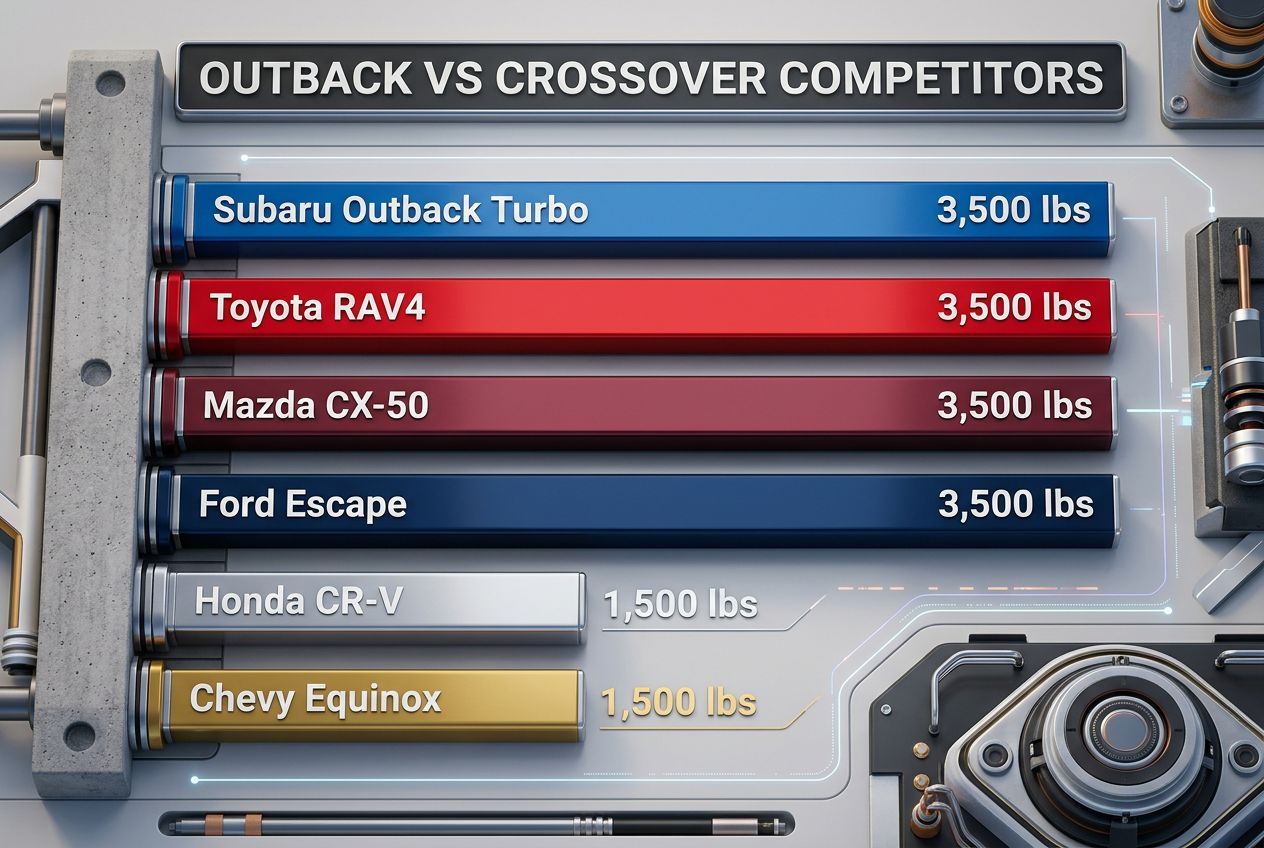
The Outback sits in the lower tier of crossover towing capacity, trading tow rating for standard AWD, ground clearance, and off-road access. Most competitors in its price range tow more, but few match the Outback's all-terrain versatility.
How Does the Subaru Outback Compare to Other Crossovers for Towing? — data table
| Vehicle |
Max Tow Rating |
Engine |
Drive |
Ground Clearance |
| Subaru Outback Turbo |
3,500 lbs |
2.4L Turbo Flat-4 |
AWD |
8.7" (9.5" Wilderness) |
| Subaru Outback Base |
2,700 lbs |
2.5L Flat-4 |
AWD |
8.7" |
| Toyota RAV4 |
3,500 lbs |
2.5L I-4 |
FWD/AWD |
8.4" |
| Honda CR-V |
1,500 lbs |
1.5L Turbo I-4 |
FWD/AWD |
7.8" |
| Ford Escape |
3,500 lbs |
2.0L Turbo I-4 |
FWD/AWD |
7.8" |
| Chevy Equinox |
1,500 lbs |
1.5L Turbo I-4 |
FWD/AWD |
7.9" |
| Hyundai Tucson |
2,000 lbs |
2.5L I-4 |
FWD/AWD |
8.3" |
| Mazda CX-50 Turbo |
3,500 lbs |
2.5L Turbo I-4 |
AWD |
8.6" |
Source: Manufacturer specifications via Edmunds (edmunds.com) and KBB (kbb.com)
The Toyota RAV4 matches the turbo Outback at 3,500 lbs but doesn't offer the Outback's ground clearance or standard AWD (RAV4 AWD is optional on some trims). The RAV4 is a crossover competitor, not a step up.
The Honda CR-V and Chevy Equinox at 1,500 lbs are effectively non-towing vehicles — they can pull a small utility trailer and nothing more. The Outback's 2,700–3,500 lb range nearly doubles their capability.
The Mazda CX-50 Turbo is the Outback's closest competitor in every metric — 3,500 lbs towing, standard AWD available, 8.6" ground clearance, and similar pricing. The CX-50 has a slight handling edge; the Outback has a slightly larger cargo area.
For a full ranking across all SUV classes, see our SUV towing capacity rankings.
⚙️
TRUCK TOWING CAPACITY
What Factors Affect Subaru Outback Towing Capacity?
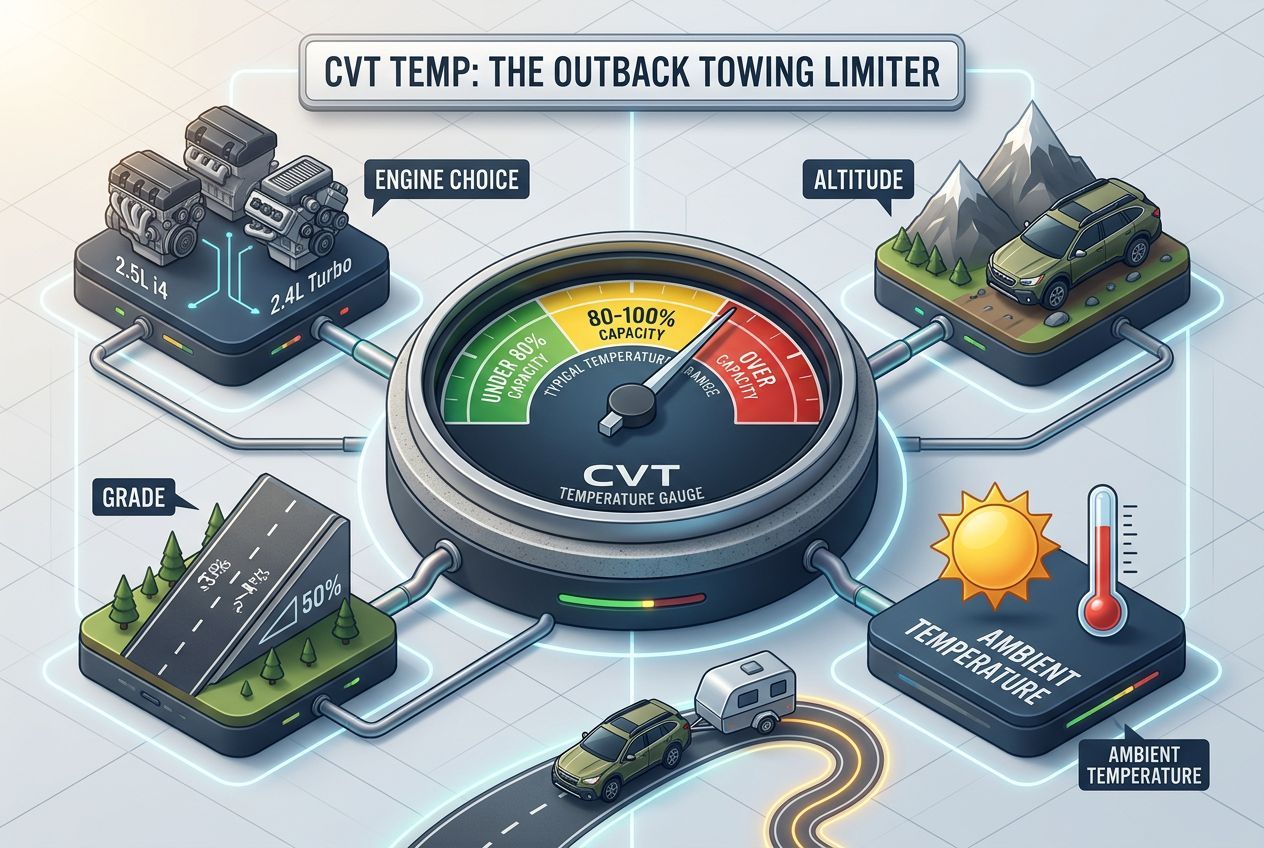
Two factors dominate: engine choice and CVT thermal management. The Outback's towing equation is simpler than most vehicles because there are no drivetrain options (AWD is standard) and no factory tow packages that change the rating.
Engine Choice Is Binary
The 2.5L base at 2,700 lbs or the 2.4L turbo at 3,500 lbs — those are your two options on the current 6th gen. No package or modification bridges the gap. The turbo's extra 101 lb-ft of torque (277 vs 176) is what earns the 800 lb increase.
CVT Temperature Is the Real Limit
Subaru's Lineartronic CVT uses a steel chain instead of a rubber belt, making it more durable under load than belt-driven CVTs. But it still generates more heat per pound of tow load than a conventional automatic. Subaru sets the tow rating based on CVT fluid temperatures during sustained 6% grade pulls at 65 MPH in 100°F ambient temperatures — the worst-case scenario.
In real-world towing, staying at or below 80% of the rated capacity (2,800 lbs on the turbo) keeps CVT temperatures well within normal range. Pushing to 100% of capacity on sustained mountain grades in summer is where temperature warnings become possible.
Payload and Tongue Weight
The Outback's payload is approximately 800–1,050 lbs depending on trim. That's notably lower than SUVs and trucks. With a 3,500 lb trailer, tongue weight at 10–15% equals 350–525 lbs — that's 33–66% of your payload before passengers and cargo. Understanding tongue weight is essential for safe Outback towing.
The relationship between towing capacity and payload matters more on the Outback than on most vehicles because the payload ceiling is relatively low.
⚠️ Warning: Adding a trailer to an Outback already loaded with four adults and cargo can push you past the GVWR (Gross Vehicle Weight Rating) even if the trailer weight is within the tow rating. Weigh your loaded Outback at a truck scale before your first tow with passengers.
Proper Hitch Selection
The Outback uses a Class II or Class III receiver hitch depending on the configuration. Matching the correct hitch type to your trailer's coupler and weight is essential — an undersized hitch is a safety hazard.
Use the Can I Tow This calculator to check your specific Outback against your planned load.
🚛
TRUCK TOWING CAPACITY
Should You Buy a Subaru Outback for Towing?
The Outback is an excellent choice for light, occasional towing — especially if you need to reach off-pavement destinations. It's not a towing vehicle first. It's an all-weather daily driver that happens to tow 3,500 lbs.
Buy the Outback for towing if:
- Your typical load stays under 3,000 lbs (teardrop campers, small boats, jet skis, utility trailers)
- You tow to off-pavement destinations — gravel campgrounds, forest service roads, boat ramps
- You want standard AWD without paying extra for a package or option
- You tow 5–10 times per year, not weekly
- Fuel economy matters — the turbo Outback gets 26–30 MPG highway when not towing
Don't buy the Outback for towing if:
- You need over 3,500 lbs — step up to a Forester Wilderness (3,500 lbs) or a midsize SUV
- You tow travel trailers of any size — even small ones push the Outback to its limit loaded
- You tow frequently or over long mountain passes — the CVT isn't designed for sustained heavy loads
- You carry more than two passengers while towing — payload gets tight quickly
💡 Pro Tip: If you're cross-shopping the Outback against the Subaru Forester Wilderness for towing, both cap at 3,500 lbs. The Outback has a longer wheelbase (better tow stability) and more cargo space. The Forester has slightly more ground clearance and visibility. For towing, the Outback's extra wheelbase is the better choice — check the boat towing guide for trailer stability considerations.