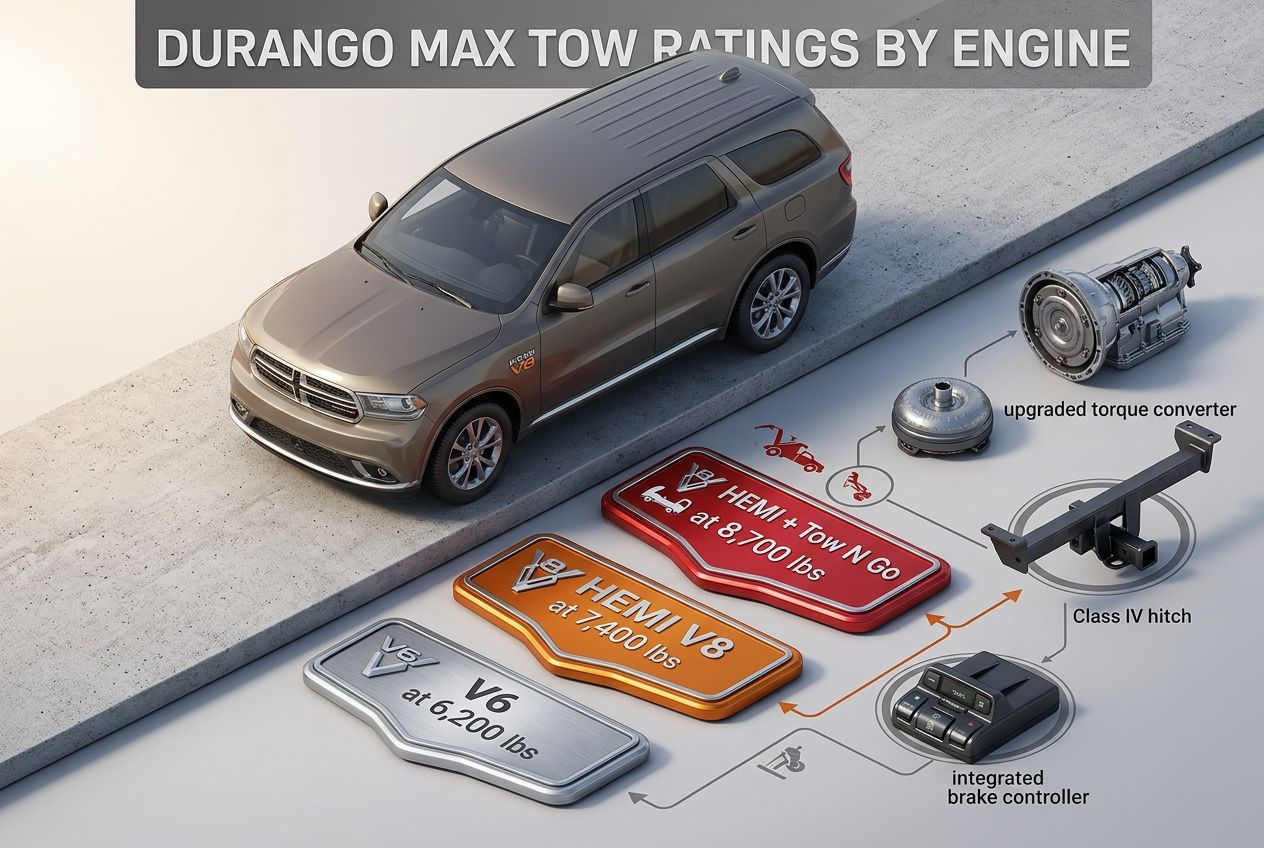
What Is the Dodge Durango Towing Capacity by Year? — data table
| Generation |
Years |
Engine |
Max Tow Rating |
GCWR |
| 3rd Gen |
2021–2025 |
5.7L HEMI V8 + Tow N Go |
8,700 lbs |
14,200 lbs |
| 3rd Gen |
2021–2025 |
5.7L HEMI V8 (standard) |
7,400 lbs |
13,100 lbs |
| 3rd Gen |
2021–2025 |
6.4L SRT V8 |
8,700 lbs |
14,200 lbs |
| 3rd Gen |
2021 only |
6.2L Hellcat V8 |
8,700 lbs |
14,200 lbs |
| 3rd Gen |
2021–2025 |
3.6L Pentastar V6 |
6,200 lbs |
11,400 lbs |
| 3rd Gen |
2014–2020 |
5.7L HEMI V8 + Tow Pkg |
7,400 lbs |
13,100 lbs |
| 3rd Gen |
2014–2020 |
3.6L Pentastar V6 |
6,200 lbs |
11,400 lbs |
| 3rd Gen |
2011–2013 |
5.7L HEMI V8 |
7,400 lbs |
13,100 lbs |
| 3rd Gen |
2011–2013 |
3.6L Pentastar V6 |
6,200 lbs |
11,400 lbs |
| 2nd Gen |
2004–2009 |
5.7L HEMI V8 |
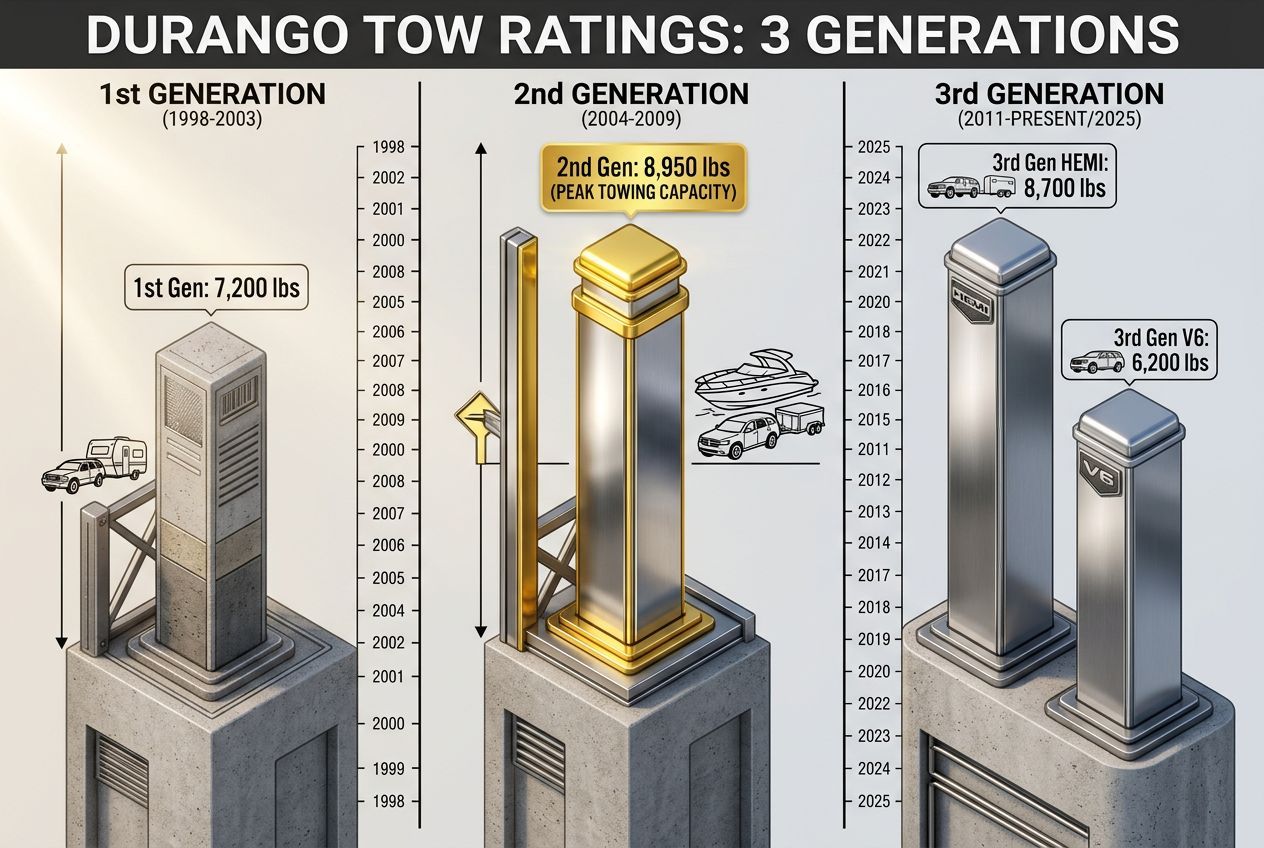
8,950 lbs |
14,500 lbs |
| 2nd Gen |
2004–2009 |
4.7L V8 |
7,400 lbs |
12,500 lbs |
| 1st Gen |
1998–2003 |
5.9L V8 |
7,200 lbs |
12,500 lbs |
| 1st Gen |
1998–2003 |
4.7L V8 |
6,700 lbs |
11,500 lbs |
Source: Stellantis/Dodge Towing & Payload Guides (dodge.com); Edmunds vehicle specifications (edmunds.com)
An interesting note: the 2nd generation Durango (2004–2009) with the 5.7L HEMI actually had a higher tow rating of 8,950 lbs — 250 lbs more than the current model. That's because the 2nd gen was body-on-frame, built on the same platform as the Dodge Ram. When Dodge moved to the unibody platform for 2011, the frame structure became the limiting factor despite improved engine performance.
💡 Pro Tip: If maximum towing is your priority and budget is flexible, the 2014–2020 HEMI Durango is a strong used option. These models share nearly identical towing hardware with the 2021+ models but can be found for $15,000–25,000 less. Just make sure the Tow Package is equipped — look for the trailer hitch receiver and 7-pin connector.
🔧
TRUCK TOWING CAPACITY
How Does the Durango V6 Compare to the HEMI V8 for Towing?
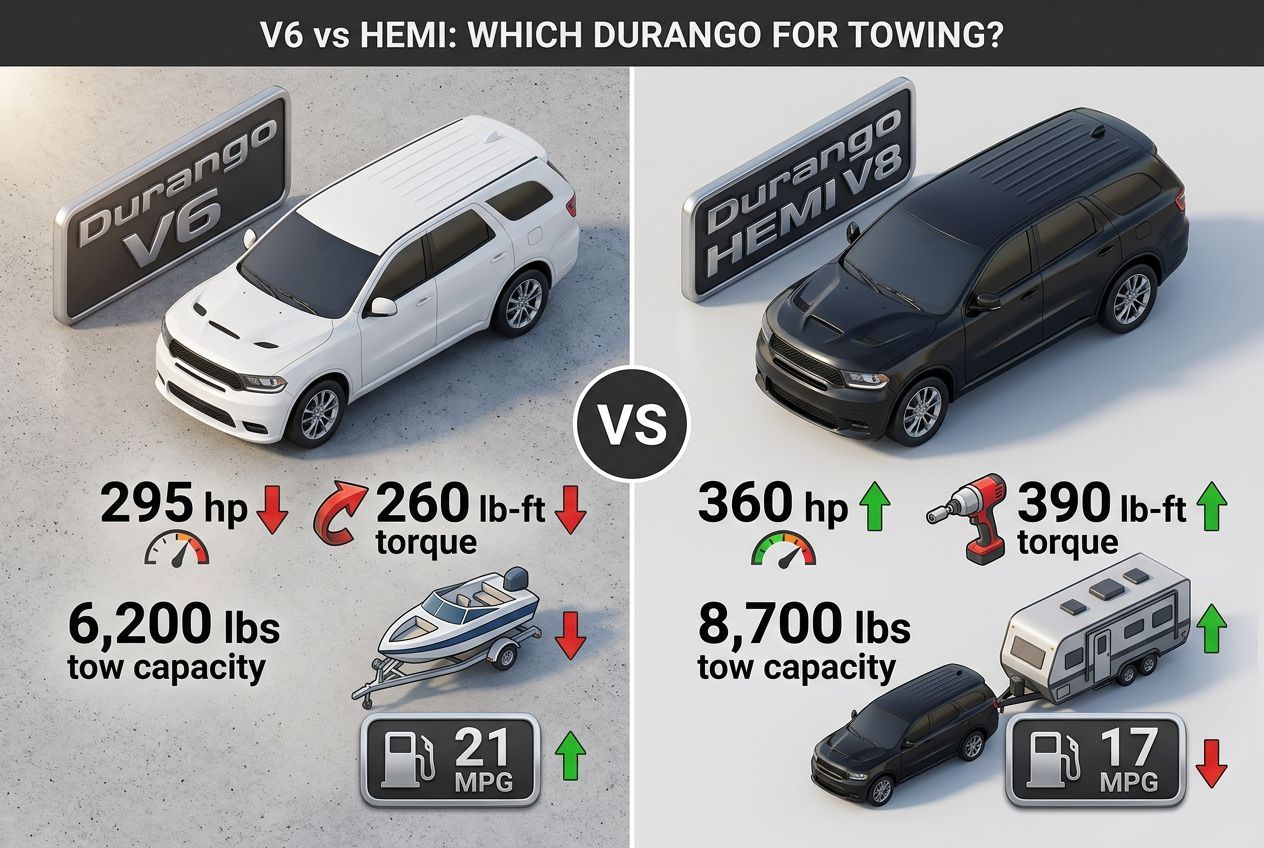
The gap between the V6 and HEMI V8 is 2,500 lbs — 6,200 vs 8,700 with Tow N Go. That's not a subtle difference. It's the gap between pulling a 20-foot travel trailer and pulling a 26-foot travel trailer, or between towing a small boat and towing a full-size pontoon.
The 3.6L Pentastar V6 produces 295 horsepower and 260 lb-ft of torque. It's paired with an 8-speed automatic transmission and standard AWD. On paper, those numbers are decent — the V6 actually produces more horsepower than the HEMI in some Toyota and Honda SUVs. But torque is what matters for towing, and the HEMI's 390 lb-ft (5.7L) dwarfs the V6's 260 lb-ft.
Where the V6 works well for towing:
- Utility trailers loaded under 4,000 lbs
- Jet skis and small watercraft (1,000–2,500 lbs on trailer)
- Pop-up campers and teardrops (1,500–3,000 lbs)
- Small enclosed cargo trailers (1,800–3,500 lbs)
- Lightweight travel trailers under 20 feet (loaded under 5,500 lbs)
Where you need the HEMI:
- Mid-size travel trailers 22–28 feet (5,500–8,000 lbs loaded)
- Large boat/trailer combos over 20 feet (5,000–8,000 lbs)
- Horse trailers (single or small double: 5,000–8,500 lbs)
- Frequent mountain towing where sustained torque matters
- Any load consistently over 5,500 lbs
💡 Key Insight: The fuel economy difference between the V6 and HEMI is roughly 4–5 MPG in combined driving (21 vs 17 MPG). Over 15,000 miles per year at $3.50/gallon, that's about $800 annually. If the HEMI's extra 2,500 lbs of towing capacity is worth $800/year to you, the math works out.
Understanding the relationship between towing capacity and payload is critical regardless of which engine you choose — tongue weight from the trailer counts against your payload ceiling.
🛡️
TRUCK TOWING CAPACITY
How Does the Dodge Durango Compare to Other SUVs for Towing?
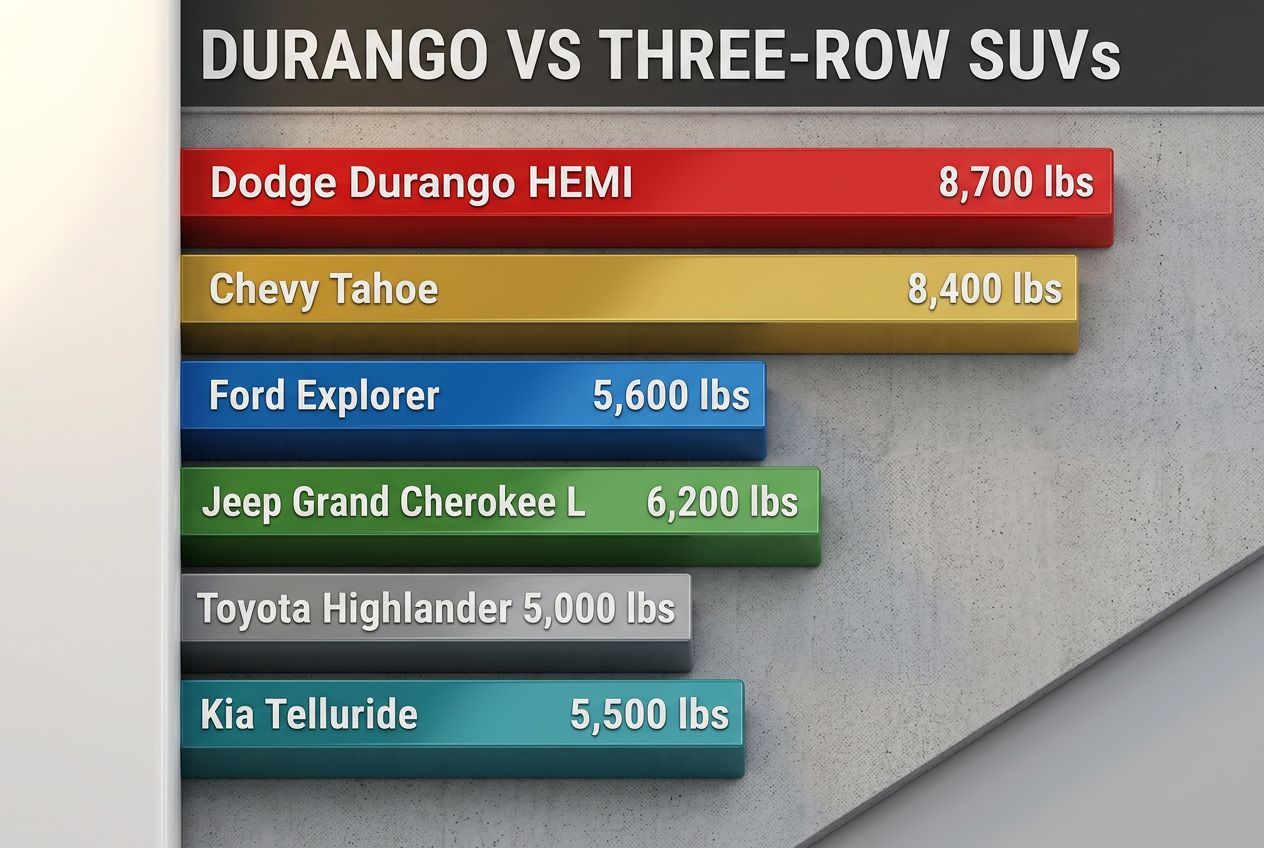
The Durango's HEMI V8 puts it in a class most three-row SUVs can't reach. At 8,700 lbs, it competes with full-size body-on-frame SUVs — not the mid-size crossovers in its price range. Here's how it stacks up.
How Does the Dodge Durango Compare to Other SUVs for Towing? — data table
| Vehicle |
Class |
Max Tow Rating |
Engine |
Base Price (2025) |
| Dodge Durango (HEMI + Tow N Go) |
Three-Row Mid-Size |
8,700 lbs |
5.7L V8 |
~$45,000 |
| Dodge Durango (V6) |
Three-Row Mid-Size |
6,200 lbs |
3.6L V6 |
~$40,000 |
| Chevy Tahoe (5.3L V8) |
Full-Size |
8,400 lbs |
5.3L V8 |
~$58,000 |
| Ford Explorer (2.3L Turbo) |
Three-Row Mid-Size |
5,600 lbs |
2.3L I-4 Turbo |
~$39,000 |
| Jeep Grand Cherokee L (V6) |
Three-Row Mid-Size |
6,200 lbs |
3.6L V6 |
~$42,000 |
| Toyota Highlander (V6) |
Three-Row Mid-Size |
5,000 lbs |
3.5L V6 |
~$40,000 |
| Kia Telluride |
Three-Row Mid-Size |
5,500 lbs |
3.8L V6 |
~$37,000 |
| Chevy Traverse (2.5L Turbo) |
Three-Row Mid-Size |
5,000 lbs |
2.5L I-4 Turbo |
~$37,000 |
Source: Manufacturer specifications via Edmunds (edmunds.com) and KBB (kbb.com)
The Durango HEMI at 8,700 lbs actually outpulls the Chevy Tahoe's base V8 at 8,400 lbs — a remarkable feat for a unibody SUV competing against a full-size body-on-frame truck platform. The Tahoe takes the lead with its 6.2L V8 (up to 10,000 lbs), but that trim costs significantly more.
The Ford Explorer at 5,600 lbs is the Durango's closest pricing competitor but tows 3,100 lbs less than the HEMI. The Explorer's turbocharged four-cylinder sacrifices low-end torque for fuel economy — fine for light towing, insufficient for heavy loads.
For a complete ranking of all three-row SUVs by tow rating, our SUV towing capacity rankings covers every major model.
📋
TRUCK TOWING CAPACITY
What Factors Affect Dodge Durango Towing Capacity?
Three main variables determine your Durango's tow rating: engine selection, the Tow N Go or Tow Package equipment, and how you manage payload. Unlike trucks with multiple cab and bed configurations, the Durango keeps it relatively simple.
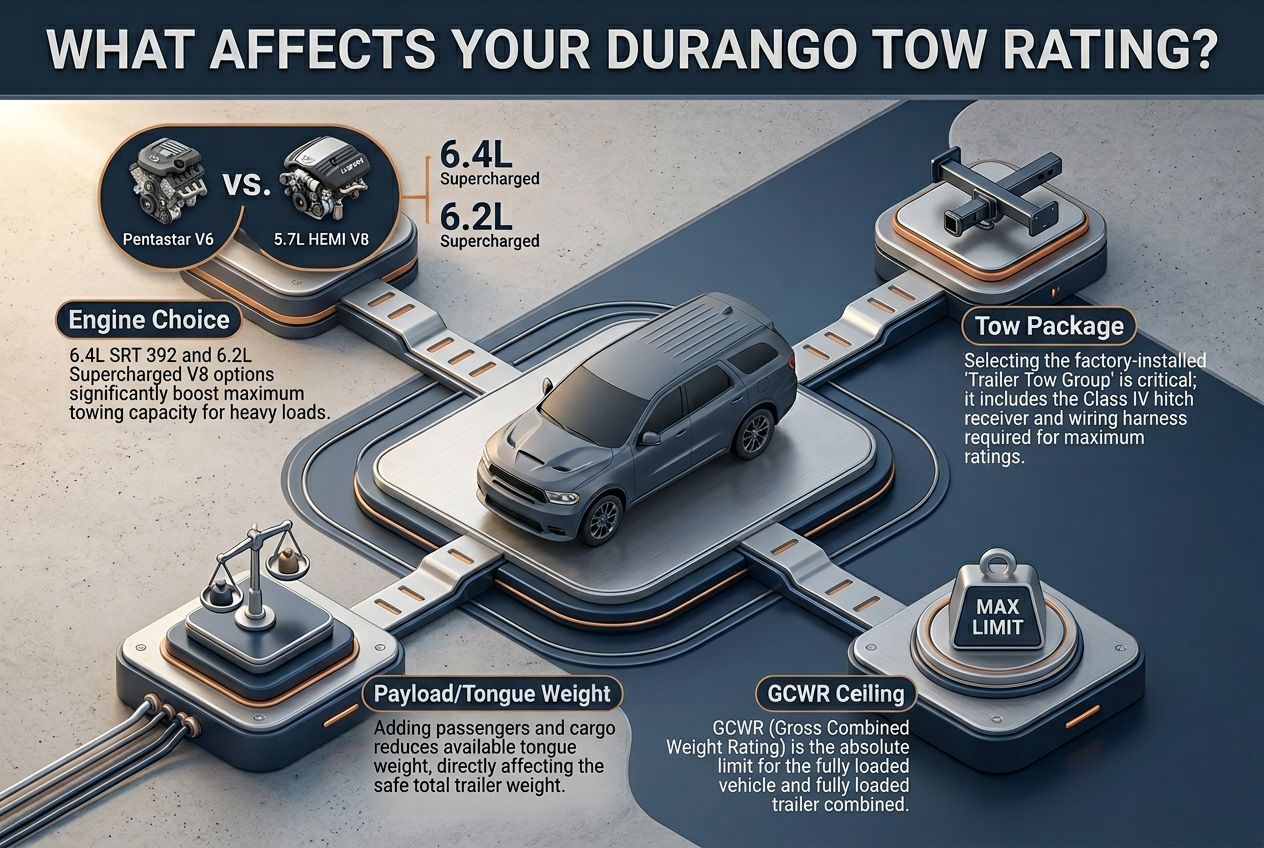
Engine Is the Primary Factor
The V6 at 6,200 lbs and the HEMI at 7,400–8,700 lbs are your two tiers. The SRT at 8,700 lbs matches the top HEMI rating. No aftermarket modification changes these factory-certified numbers.
Tow Package Equipment Matters
The Tow N Go package on 2021+ HEMI models adds 1,300 lbs to the base HEMI rating (7,400 → 8,700). On earlier models (2014–2020), the standard Tow Package includes the Class IV hitch and wiring but doesn't reach the 8,700 lb tier. Always verify which tow package your specific Durango has.
Payload and Tongue Weight
The Durango's payload ranges from approximately 1,200–1,570 lbs depending on trim and equipment. With a 8,700 lb trailer, tongue weight at 10–15% equals 870–1,305 lbs — that can consume nearly your entire payload before adding passengers. This is where a weight distribution hitch becomes essential. It redistributes tongue weight across all four wheels instead of concentrating it on the rear axle.
Understanding tongue weight and its effect on handling prevents the two most common Durango towing mistakes: rear sag from excessive tongue weight and trailer sway from too little.
GCWR Limits
The V6 Durango's GCWR is 11,400 lbs. The vehicle itself weighs approximately 4,900–5,200 lbs. That leaves roughly 6,200–6,500 lbs for trailer plus everything in the vehicle — which is why the V6 tow rating is 6,200, not higher. The HEMI's GCWR of 14,200 lbs provides more headroom. Full breakdown in our GCWR guide.
⚠️ Warning: The Durango's unibody construction handles towing well, but it's more sensitive to tongue weight distribution than a body-on-frame truck. If you're towing over 6,000 lbs, a weight distribution hitch isn't optional — it's mandatory for safe handling and to prevent premature rear suspension wear.
⚙️
TRUCK TOWING CAPACITY
Should You Buy a Dodge Durango for Towing?
The Durango is the best-value three-row SUV for towing, especially with the HEMI V8. No other mid-size three-row SUV matches its 8,700 lb rating at anywhere near its price point. A Chevy Tahoe tows similarly but costs $13,000+ more.
Buy the Durango for towing if:
- You need three-row seating AND serious towing capacity (7,000+ lbs)
- Your typical loads include travel trailers, boats, or horse trailers in the 5,000–8,000 lb range
- You want V8 torque without stepping up to a full-size SUV price
- You tow to paved destinations — campgrounds, marinas, equestrian events
- Budget matters — the HEMI Durango undercuts the Tahoe by $10,000+
Don't buy the Durango for towing if:
- You need over 8,700 lbs — a full-size truck or Suburban is required
- You tow over rough terrain regularly — the unibody platform is less durable than body-on-frame for off-road towing
- Fuel economy is critical — the HEMI gets 14–16 MPG while towing
- You need a truck bed for hauling loose materials alongside your trailer
💡 Pro Tip: If you're buying a used Durango specifically for towing, the 2021+ model year with the Tow N Go package is the sweet spot. The 2021 refresh brought updated safety tech, the available SRT models, and the full 8,700 lb rating on the HEMI. Pre-2021 HEMI models max at 7,400 lbs without aftermarket upgrades. For RV towing specifically, our RV towing guide covers route planning and fuel management strategies.
Use the Can I Tow This calculator to verify your specific Durango handles your planned load.