What Is the Ford Explorer Towing Capacity by Year? — data table
| Generation |
Years |
Engine |
Max Tow Rating |
GCWR |
| 6th Gen |
2020–2025 |
3.0L Twin-Turbo V6 (ST/Platinum) |
5,600 lbs |
12,100 lbs |
| 6th Gen |
2020–2025 |
2.3L EcoBoost I-4 + Tow Pkg |
5,300 lbs |
11,800 lbs |
| 6th Gen |
2020–2025 |
3.0L Hybrid |
5,000 lbs |
11,500 lbs |
| 6th Gen |
2020–2025 |
2.3L EcoBoost (no tow pkg) |
~3,000 lbs |
~9,500 lbs |
| 5th Gen |
2011–2019 |
3.5L V6 + Tow Pkg |
5,000 lbs |
11,100 lbs |
| 5th Gen |
2011–2019 |
3.5L EcoBoost V6 (Sport/Platinum) |
5,000 lbs |
11,100 lbs |
| 5th Gen |
2011–2019 |
2.3L/2.0L EcoBoost I-4 |
3,000 lbs |
~9,500 lbs |
| 4th Gen |
2006–2010 |
4.6L V8 |
7,310 lbs |
13,200 lbs |
| 4th Gen |
2006–2010 |
4.0L V6 |
5,010 lbs |
11,000 lbs |
| 3rd Gen |
2002–2005 |
4.6L V8 |
7,300 lbs |
13,100 lbs |
| 3rd Gen |
2002–2005 |
4.0L V6 |
5,460 lbs |
11,500 lbs |
| 2nd Gen |
1995–2001 |
5.0L V8 |
6,720 lbs |
12,500 lbs |
| 2nd Gen |
1995–2001 |
4.0L V6 |
5,440 lbs |
11,000 lbs |
Source: Ford Motor Company Towing Supplements (ford.com); Edmunds vehicle specifications (edmunds.com)
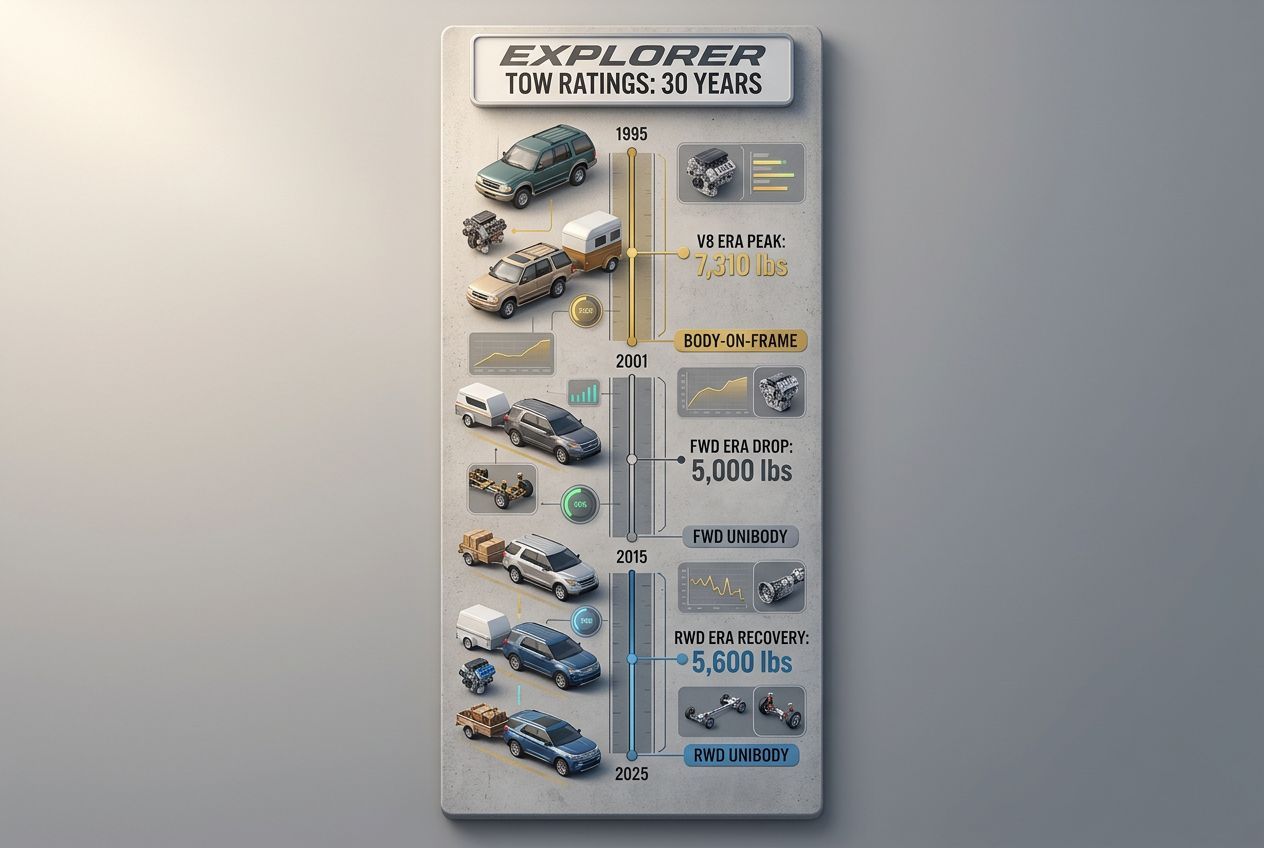
The V8 Explorers (2002–2010) actually towed more than current models. The 4.6L V8 was rated at 7,310 lbs — 1,710 lbs more than today's twin-turbo V6. The difference: those Explorers used body-on-frame construction (shared with the Ford Ranger), while the current Explorer uses a unibody platform. The frame could handle more tongue weight.
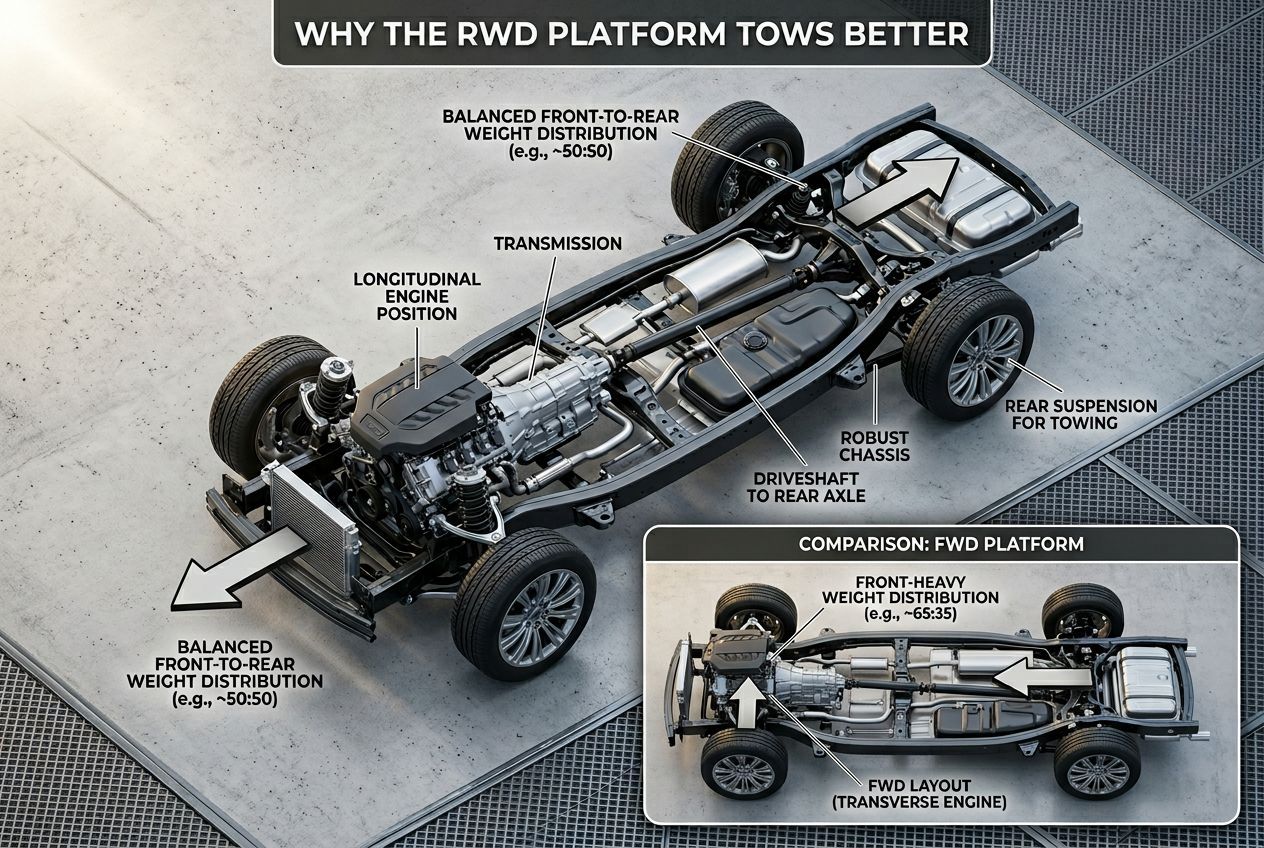
The 5th gen (2011–2019) was the low point for Explorer towing — the move to a FWD-based unibody dropped the max to 5,000 lbs. The 2020 switch to a RWD-based platform recovered some capability, pushing the V6 to 5,600 lbs.
💡 Pro Tip: If you want the most towing from an Explorer, the 2020+ ST is the best option. It pairs 5,600 lbs of towing with 400 hp, sport-tuned suspension, and a 10-speed automatic. Used 2020–2022 ST models run $32,000–40,000 — strong value for the performance and capability package.
🔧
TRUCK TOWING CAPACITY
How Does the Explorer Hybrid Compare for Towing?
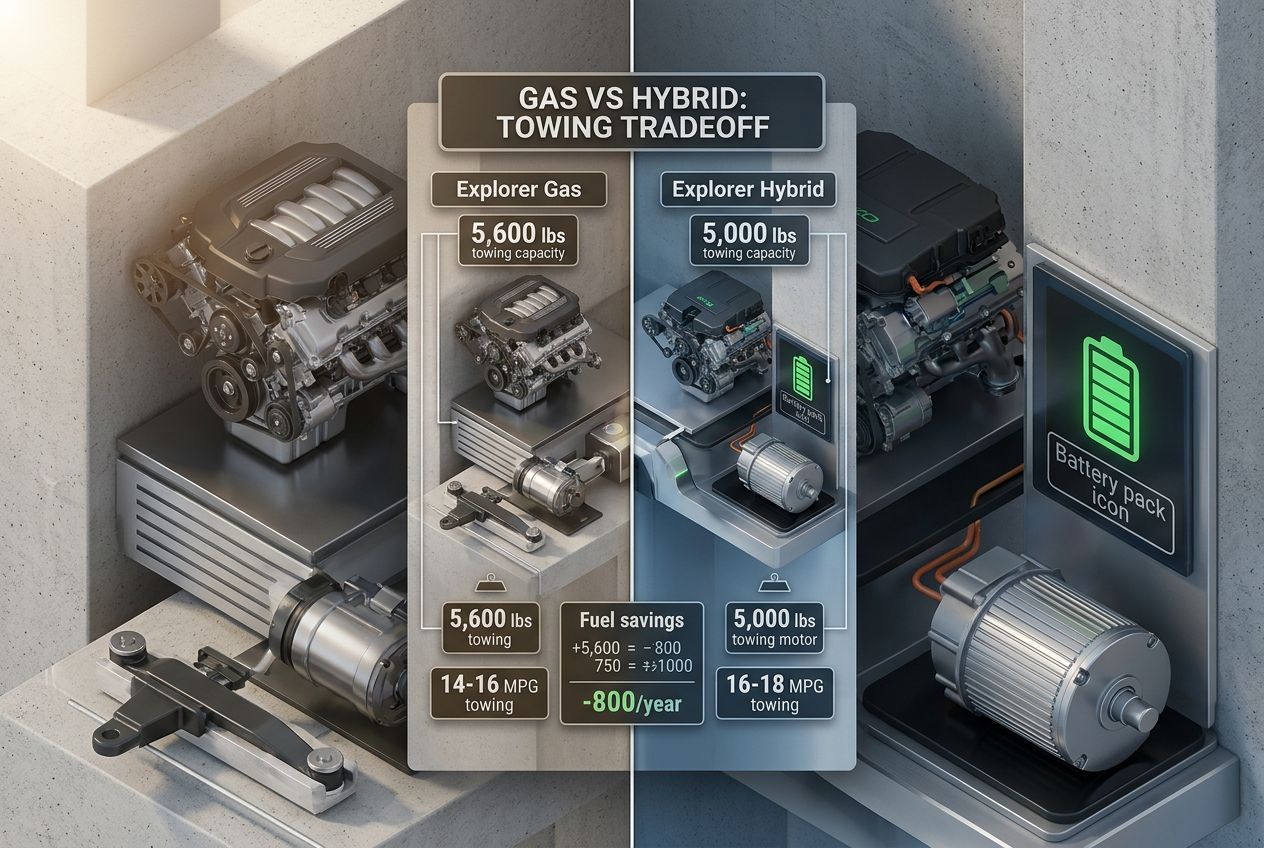
The Explorer Hybrid is rated at 5,000 lbs — a 300 lb reduction from the base 2.3L EcoBoost and 600 lbs less than the twin-turbo V6. The hybrid combines the 3.0L V6 with an electric motor for a combined output of 318 hp, but the battery pack weight and transmission thermal limits set a lower ceiling.
The hybrid's advantage is fuel economy: 27 combined MPG vs 21–24 for the gas models. When not towing, the hybrid saves roughly $600–800 per year in fuel costs over the V6. When towing, the hybrid gets approximately 16–18 MPG compared to the V6's 14–16 MPG — a smaller gap under load.
At 5,000 lbs, the Explorer Hybrid still handles most recreational towing needs — pop-up campers, small travel trailers under 20 feet, boats up to 18 feet, jet skis, and utility trailers. The 600 lb reduction from the V6 mainly eliminates heavier mid-size travel trailers.
💡 Key Insight: The Explorer Hybrid's 5,000 lb rating matches the Toyota Highlander V6, the Chevy Traverse, and the Honda Pilot. If you're choosing between the Explorer Hybrid and these competitors, towing capacity is a wash — pick based on fuel economy, interior space, and reliability preferences.
🛡️
TRUCK TOWING CAPACITY
How Does the Ford Explorer Compare to Other Three-Row SUVs for Towing?
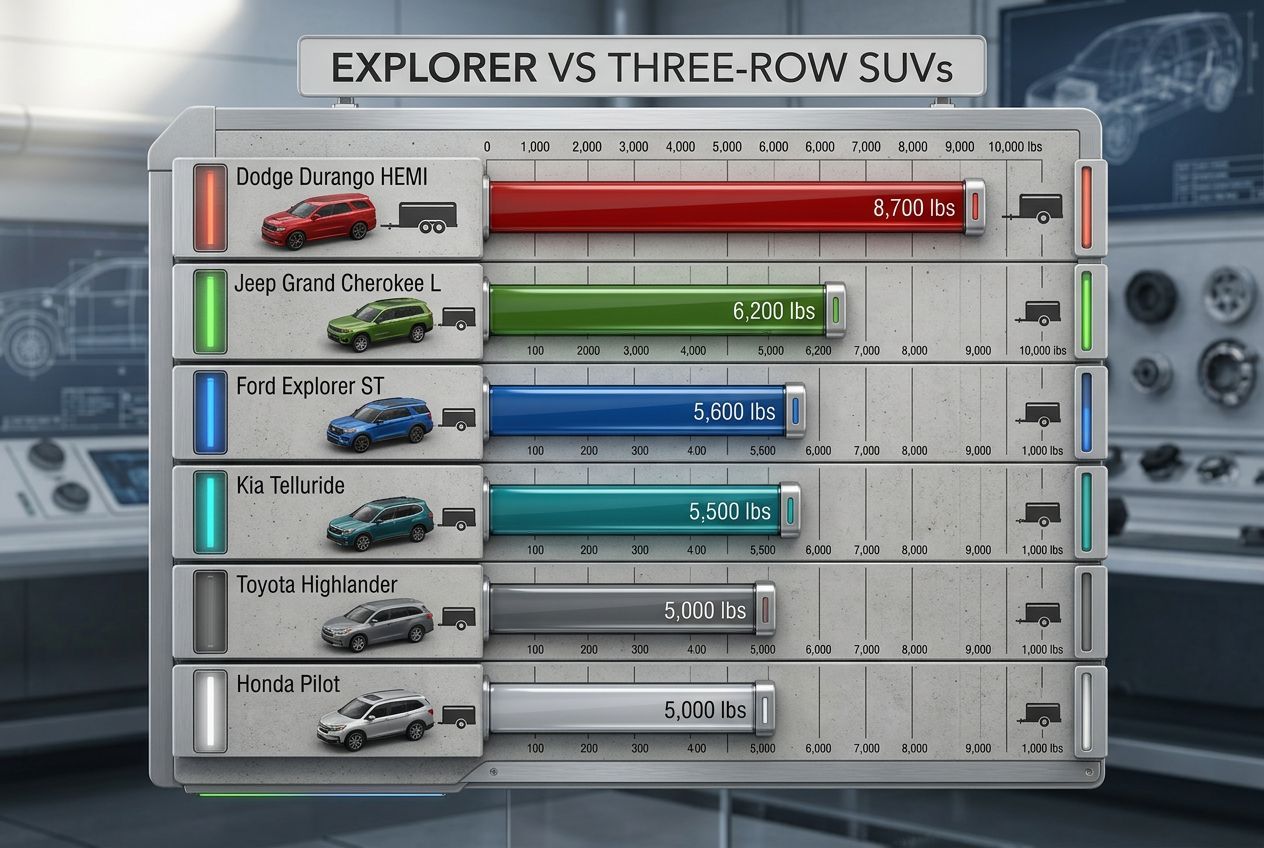
The Explorer leads most three-row crossovers in towing thanks to its RWD-based platform. Only the Dodge Durango HEMI significantly exceeds it.
How Does the Ford Explorer Compare to Other Three-Row SUVs for Towing? — data table
| Vehicle |
Max Tow Rating |
Engine |
Platform |
Base Price (2025) |
| Ford Explorer ST (3.0L V6) |
5,600 lbs |
3.0L Twin-Turbo V6 |
RWD-based |
~$47,000 |
| Ford Explorer (2.3L + Tow Pkg) |
5,300 lbs |
2.3L EcoBoost I-4 |
RWD-based |
~$39,000 |
| Dodge Durango (HEMI + Tow N Go) |
8,700 lbs |
5.7L V8 |
Unibody |
~$45,000 |
| Kia Telluride |
5,500 lbs |
3.8L V6 |
FWD-based |
~$37,000 |
| Toyota Highlander (Turbo + Tow Pkg) |
5,000 lbs |
2.4L Turbo I-4 |
FWD-based |
~$41,000 |
| Honda Pilot (TrailSport) |
5,000 lbs |
3.5L V6 |
FWD-based |
~$42,000 |
| Chevy Traverse (2.5L Turbo) |
5,000 lbs |
2.5L Turbo I-4 |
FWD-based |
~$37,000 |
| Jeep Grand Cherokee L (V6) |
6,200 lbs |
3.6L V6 |
Unibody |
~$42,000 |
Source: Manufacturer specifications via Edmunds (edmunds.com) and KBB (kbb.com)
The Dodge Durango HEMI at 8,700 lbs is in a different league — 3,100 lbs more than the Explorer ST. If towing over 5,600 lbs is a regular need, the Durango or a full-size SUV is the answer.
The Jeep Grand Cherokee L at 6,200 lbs edges the Explorer by 600 lbs with its V6. Both share unibody construction, but the Grand Cherokee's platform handles towing loads well.
For significantly more towing, step up to a truck. The Ford Ranger tows 7,500 lbs, and the F-150 reaches 13,500 lbs. Check our SUV towing capacity rankings for a full comparison.
💡 Pro Tip: The Explorer's RWD-based platform means the engine sits longitudinally (front-to-back) rather than transversely (side-to-side). This puts more weight over the rear axle than FWD-based competitors, which improves hitch weight handling and rear traction when starting from a stop with a loaded trailer.
📋
TRUCK TOWING CAPACITY
What Factors Affect Ford Explorer Towing Capacity?
Three variables control your Explorer's tow rating: the Trailer Tow Package, engine selection, and payload management.
Trailer Tow Package Is Essential
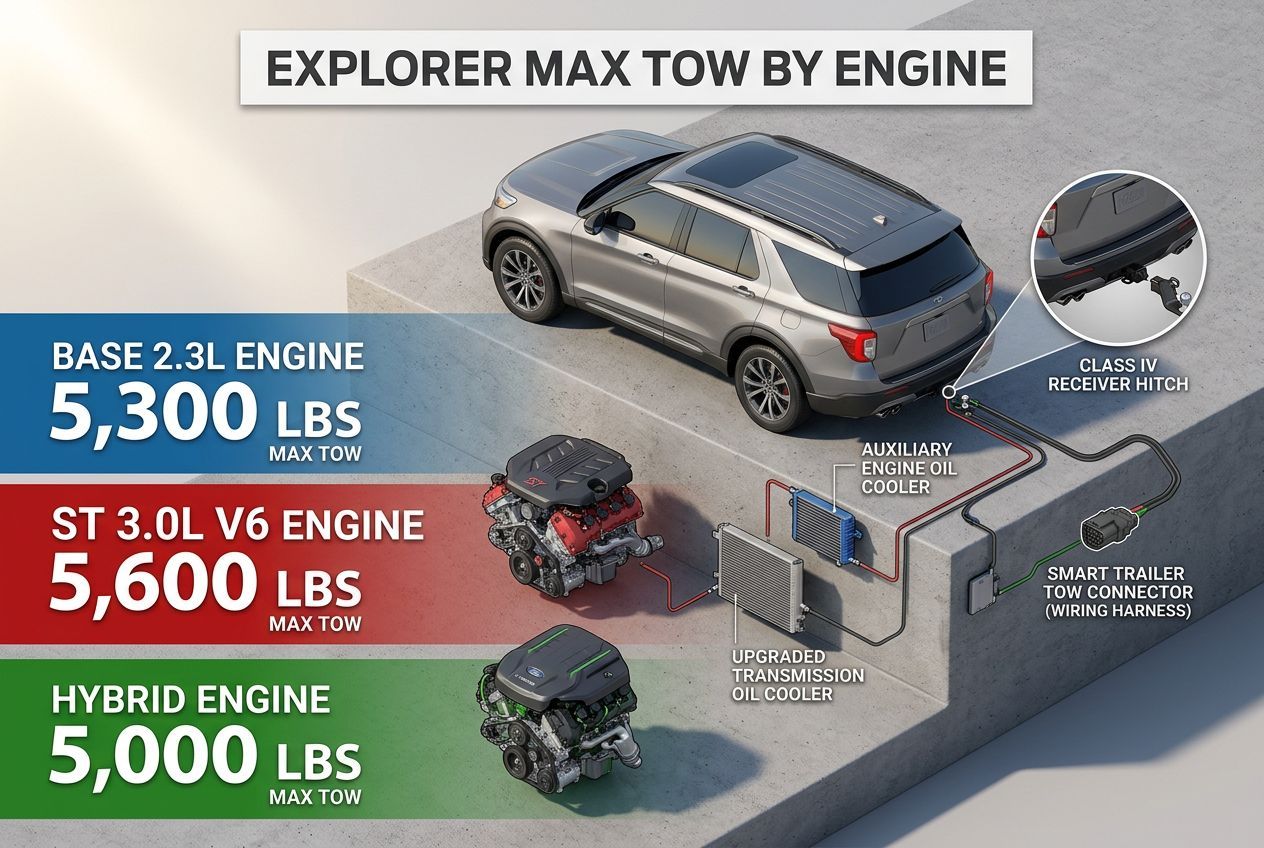
The Class IV Trailer Tow Package adds 2,300–2,600 lbs to the base rating. It's the single most impactful option on the Explorer. The cooling system upgrades — radiator, engine oil cooler, transmission cooler — allow the powertrain to sustain towing loads that would overheat the base cooling system within miles.
Engine Determines the Ceiling
The 2.3L EcoBoost at 5,300 lbs, the 3.0L twin-turbo at 5,600 lbs, and the hybrid at 5,000 lbs are your three tiers. The 300 lb gaps between tiers reflect the torque and cooling differences between each powertrain.
Payload and Tongue Weight
Explorer payload ranges from approximately 1,450–1,660 lbs. With a 5,600 lb trailer, tongue weight at 10–15% equals 560–840 lbs — consuming 34–58% of payload. A weight distribution hitch is recommended for loads over 4,000 lbs to prevent rear sag and maintain front-axle steering authority.
Understanding the relationship between towing capacity and payload is critical on the Explorer because its unibody construction distributes loads differently than body-on-frame trucks. The GCWR of 12,100 lbs on the V6 is the absolute ceiling — the Explorer weighs approximately 4,700–5,000 lbs, leaving roughly 7,100–7,400 lbs for trailer plus everything in the vehicle. Our GCWR guide explains the math.
⚠️ Warning: The Explorer's 10-speed automatic transmission runs hotter than older 6-speed units under towing loads. If your transmission temperature gauge climbs past the midpoint during sustained climbs, reduce speed and downshift. The tow/haul mode recalibrates shift points — always engage it before towing.
⚙️
TRUCK TOWING CAPACITY
Should You Buy a Ford Explorer for Towing?
The Explorer is a top-tier choice for three-row crossover towing, especially with the ST or Platinum V6 at 5,600 lbs.
Buy the Explorer for towing if:
- Your typical load is 3,000–5,000 lbs (small travel trailers, boats, campers, utility trailers)
- You want three-row family seating with genuine towing capability
- The RWD-based platform's handling and weight distribution matter to you
- You value the 10-speed automatic's smooth tow/haul performance
- Budget allows the ST or Platinum for the 5,600 lb ceiling and 400 hp
Don't buy the Explorer for towing if:
- You need over 5,600 lbs — a Durango HEMI, truck, or full-size SUV is required
- You tow in extreme conditions frequently — mountain passes in summer heat push the Explorer hard at max capacity
- You need off-road towing capability — the Explorer's low ground clearance limits unpaved access
- You want body-on-frame durability for sustained weekly towing
💡 Pro Tip: The Explorer Timberline trim adds off-road capability (raised suspension, skid plates, all-terrain tires) while maintaining a 5,300 lb tow rating with the Trailer Tow Package. If you need to reach unpaved boat ramps or campgrounds, the Timberline splits the difference between the base Explorer and a body-on-frame SUV.
For camper-specific sizing, our camper towing capacity guide matches trailer types to your Explorer's rating.