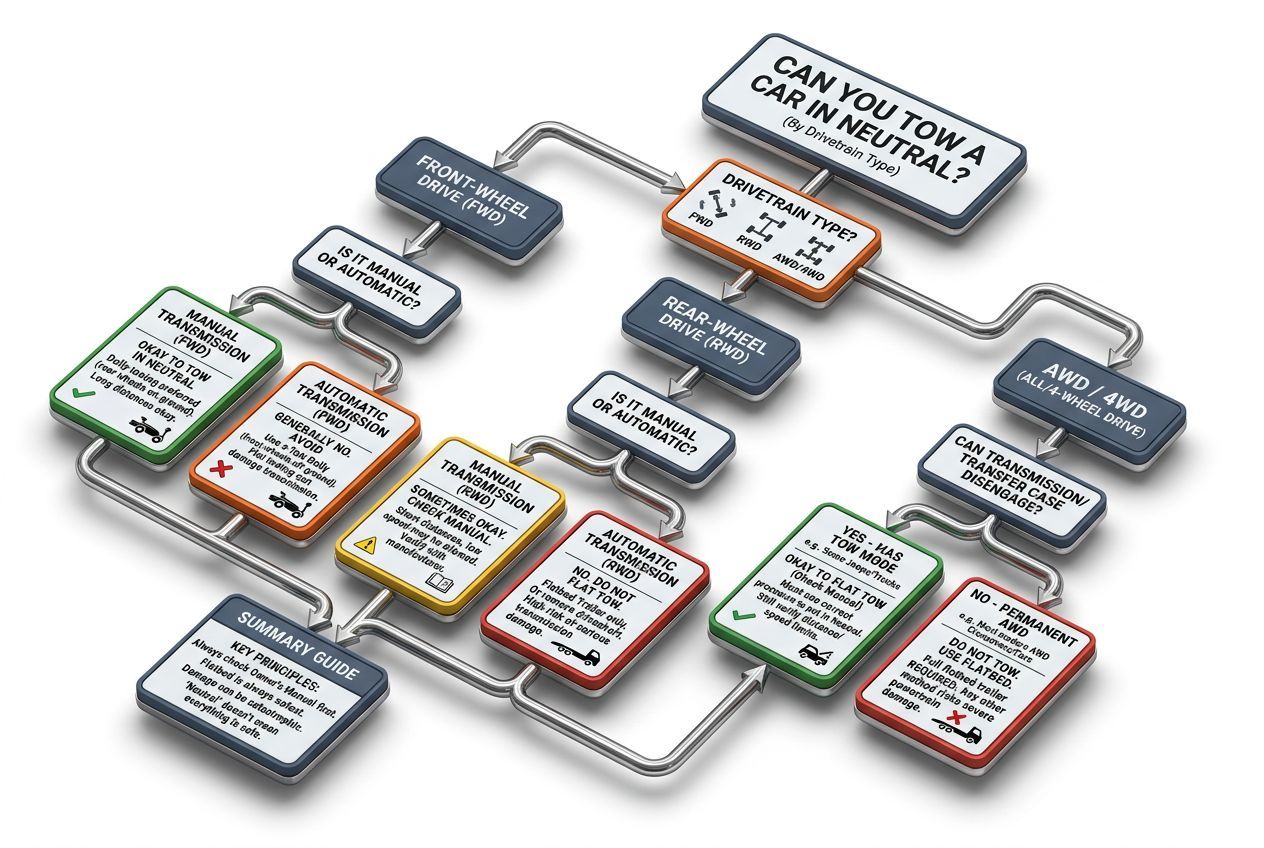
- Putting an automatic car in neutral does not protect the transmission during a flat tow — the oil pump needs the engine running to circulate fluid.
- AWD vehicles are the highest-risk scenario; most require flatbed-only transport, no exceptions.
- CVT-equipped vehicles (common on Nissan and Subaru models) are flatbed-only per manufacturer specs — zero flat-tow distance allowed.
- A small but reliable set of vehicles — Jeep Wrangler, Ford Bronco, certain Ram 1500 4x4s — are factory-approved for neutral flat towing behind an RV.
- Towing in Park instead of Neutral can shear the parking pawl and crack the transmission case in a single tow.
Can You Tow a Car in Neutral Without Damaging the Transmission?
Understanding automatic transmission vulnerability: Putting a car in neutral doesn't automatically protect your transmission during towing. In most automatic transmissions, the oil pump is driven by the engine's crankshaft — not the wheels. When the engine is off and the wheels are spinning, internal clutch packs and planetary gears rotate without any lubrication. Heat builds fast, and the damage is permanent.
⚠️ Warning: An automatic transmission's oil pump needs the engine running to circulate vital lubricating fluid. Towing an automatic vehicle in neutral with the engine off can quickly lead to permanent, expensive internal damage.
Manual transmissions handle neutral towing much better. Shifting to neutral fully disengages the gear pairs, so the input shaft can spin freely without grinding components together. That's why you'll see manual-transmission vehicles on the approved flat-tow lists far more often than automatics.
Always check your owner's manual first. The safest approach for any vehicle is to check your owner's manual before any tow. Many manufacturers publish a separate Trailer Towing Supplement — Ford and Toyota both do — that lists exact distance and speed limits for emergency neutral towing.
✅ Pro Tip: If you can't find specific towing guidelines in your owner's manual, defaulting to a flatbed tow truck eliminates the guesswork entirely and guarantees no drivetrain damage.
Can You Flat Tow a Front-Wheel-Drive Car in Neutral?
Flat towing automatic FWD vehicles is generally not recommended. The front wheels connect directly to the transmission output shaft. When these wheels roll without the engine running, internal components turn in a dry sump — fluid doesn't circulate, and metal-on-metal wear starts within minutes.
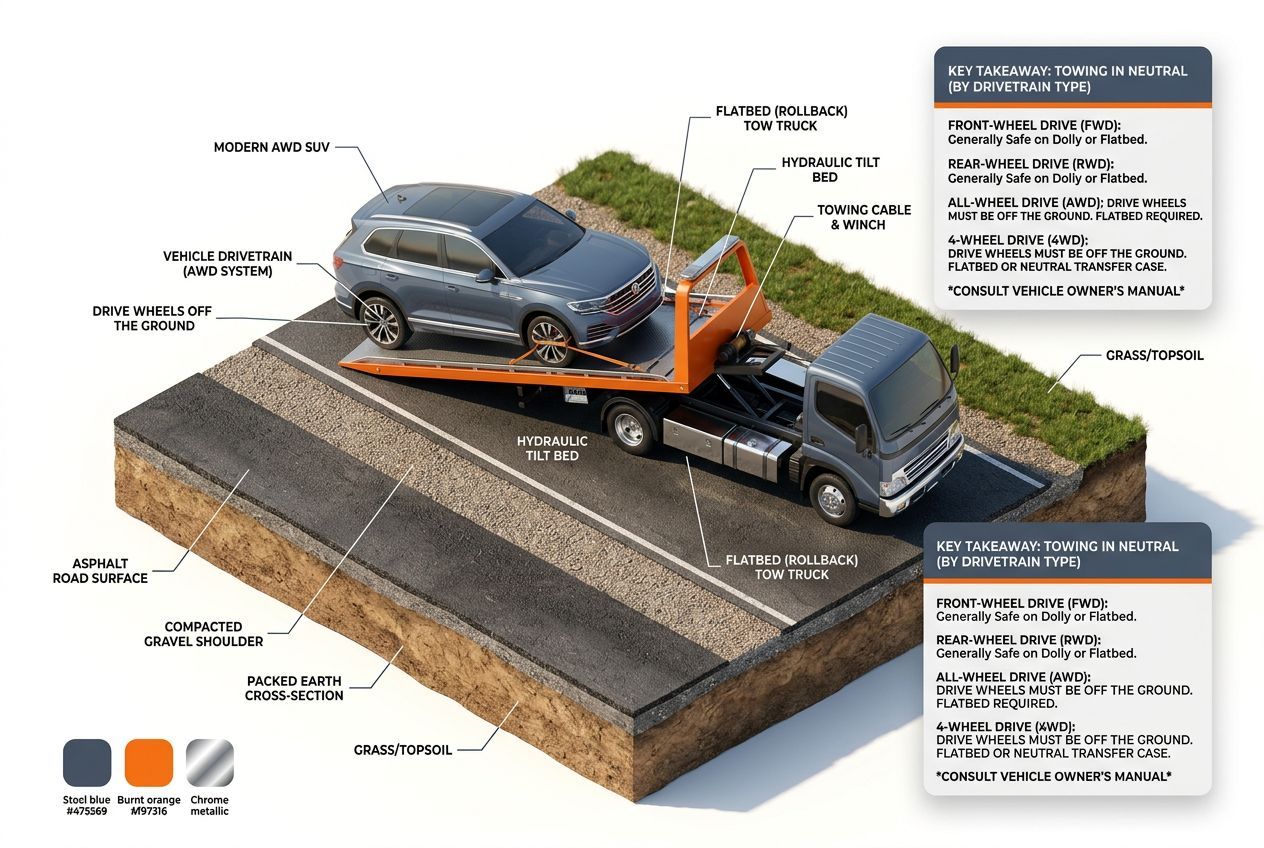
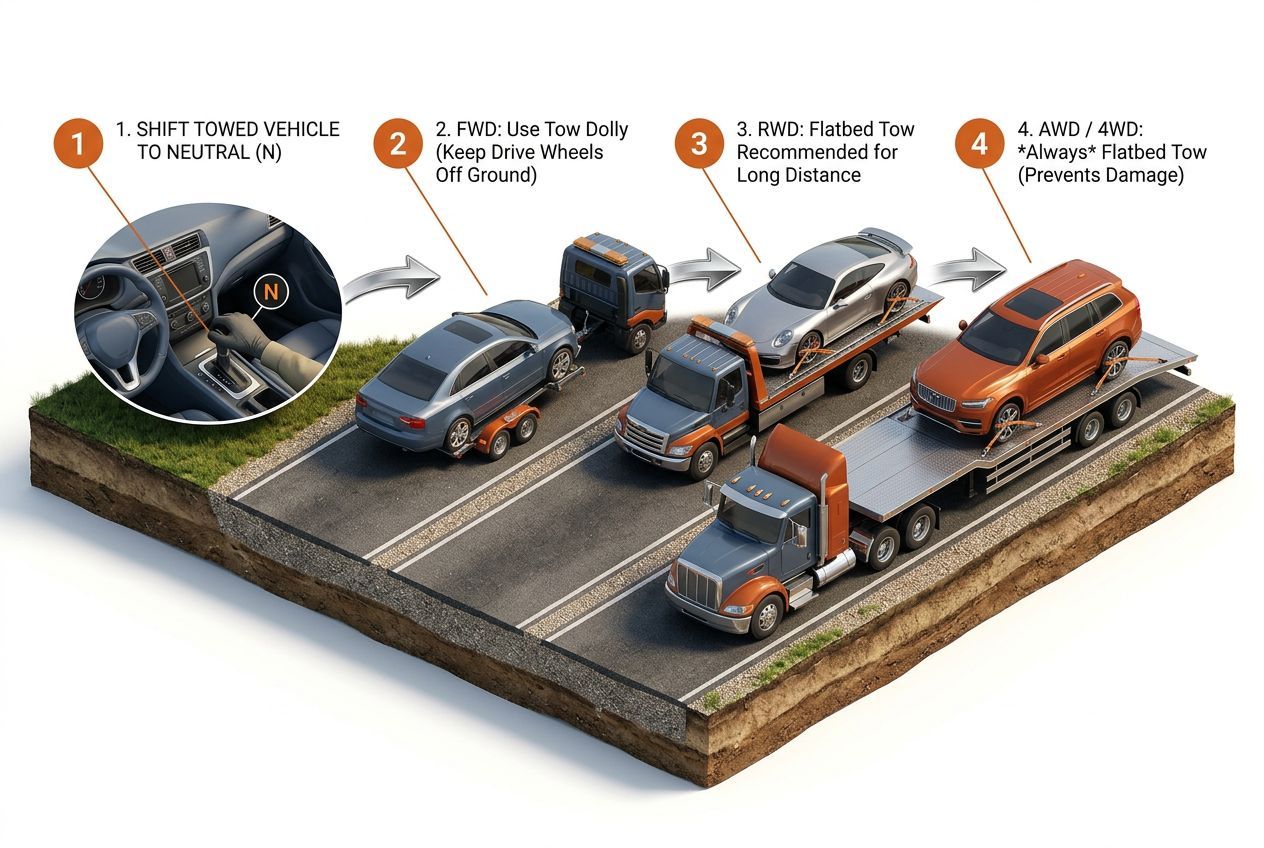
The safest method for FWD vehicles is a tow dolly. This is a two-wheel trailer that lifts the front (drive) wheels completely off the ground. With the driven wheels in the air, the transmission stays static and nothing gets damaged.
✅ Pro Tip: Compare typical towing costs for dolly vs. flatbed to determine the most cost-effective and safest option for your FWD vehicle before calling for assistance.
Manual FWD cars can be an exception. Some FWD cars with a manual transmission can be flat towed short distances in neutral per manufacturer guidelines. The Mazda MX-5 Miata (manual) is a classic example — Mazda has historically approved four-wheels-down neutral towing for the manual variant.
💡 Key Takeaway: Always confirm with the current model year's manual, because manufacturer approvals for flat towing manual FWD vehicles can change between generations.
Is It Safe to Tow an AWD Car in Neutral?
AWD towing in neutral is the riskiest scenario across all drivetrain types. AWD systems mechanically link all four wheels to the drivetrain through a center differential, transfer case, or viscous coupling. When any set of wheels rolls — even with the car in neutral — those components spin without lubrication from the engine-driven oil pump.
Most luxury AWD sedans require flatbed-only transport. Vehicles like the BMW 3 Series xDrive and Audi A4 quattro are universally flatbed-only.
📊 Quick Fact: NHTSA's vehicle safety data confirms that improper towing is one of the leading causes of drivetrain failure in AWD vehicles. BMW's owner manuals (all recent generations) explicitly state: "Do not tow with all four wheels on the ground."
Dedicated transfer case neutral modes are the only exception for AWD/4WD. This applies to trucks and SUVs with a dedicated neutral position on the transfer case — separate from transmission neutral. The Jeep Wrangler, for instance, has a transfer case neutral mode labeled "N" that mechanically disconnects the front and rear driveshafts, allowing all four wheels to roll freely without transmitting torque. Without that feature, a flatbed is your only safe option. For a deeper look at why AWD vehicles are so vulnerable, see our guide on AWD towing risks.
How Do You Tow a Rear-Wheel-Drive Car in Neutral?
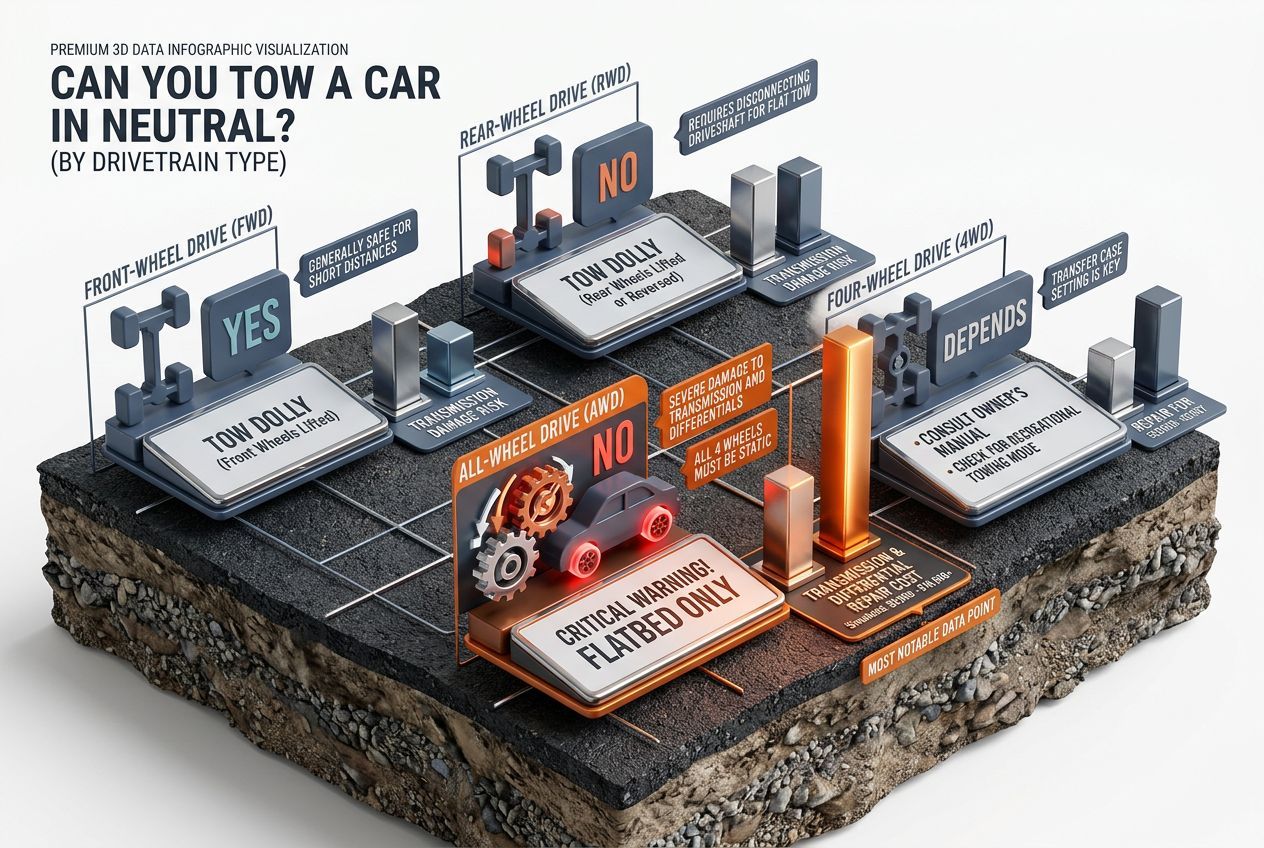
RWD vehicles are the most forgiving drivetrain type for neutral towing, but they still have limits. The safest RWD tow method is a wheel-lift wrecker or tow dolly that lifts the rear (drive) wheels off the ground, keeping the transmission and driveshaft static regardless of transmission type.
Manual-transmission RWD vehicles are generally okay for short flat tows. If you're flat towing all four wheels down, the input shaft spins freely and the drive wheels turn the driveshaft — but since nothing's under load, damage is minimal for short distances. Classic cars, sports cars, and older trucks with manual boxes are routinely flat towed this way.
Automatic RWD vehicles require more caution. If you're flat towing an automatic RWD vehicle with all four wheels down, the driveshaft turns the transmission's output shaft without fluid pressure. Professional RV towers often use a driveshaft coupling device (brands like Remco make them) or a quick-disconnect driveshaft, which runs $200–$500 installed. This physically breaks the connection between the rear wheels and the transmission, making flat towing safe even for automatics.
⚠️ Warning: Without a driveshaft disconnect, keep any automatic RWD flat tow under 15 miles at speeds below 25 mph. This should be treated as an emergency limit, not a routine practice.
Can You Tow an Automatic Transmission Car in Neutral?
Most automatic cars should not be flat towed in neutral beyond very short distances. The common OEM emergency limit is under 15 miles at speeds below 25 mph, and even that's pushing it on older transmissions. The reason is simple: the automatic transmission's oil pump is mechanically coupled to the engine's torque converter. No engine rotation means no fluid pressure, and therefore, no lubrication.
⚠️ Warning: Exceeding the very limited emergency towing specifications for an automatic transmission will almost certainly lead to internal damage, including burnt clutch packs and scored gears.
CVT-equipped vehicles are even more restrictive. Manufacturers like Nissan (Altima, Rogue, Sentra) and Subaru (Lineartronic CVT) rate their CVTs for zero flat-tow distance. The belt-and-pulley design of a CVT relies on hydraulic clamping force to function; without it, the steel push-belt can slip off the pulleys and destroy the unit in minutes. Replacement runs $3,500–$5,500 at a dealer. If you own a CVT vehicle, does towing damage your car explains exactly what happens internally.
Some newer automatics offer manufacturer-approved flat-tow modes. These are the exceptions, not the rule. Notably, the ZF 8HP (used in many BMW, RAM, and Dodge products) and select Ford Bronco models may have electronic auxiliary oil pumps or manufacturer-approved flat-tow modes.
💡 Key Takeaway: Always verify flat-tow approvals in the vehicle's specific towing supplement, not just the general owner's manual table of contents, as these features are highly model- and year-specific.
What Happens If You Tow a Car That Isn't in Neutral?
Towing in Park causes immediate, severe mechanical damage. In an automatic transmission, the parking pawl — a small metal pin that locks the output shaft — is designed to hold a stationary car on a hill. It's not designed to resist the rolling force of a moving tow.
⚠️ Warning: At tow speeds, the parking pawl will shear off, sending metal debris through the transmission. This can destroy valve bodies, clutch packs, and bearings in a single trip, often cracking the transmission case.
Towing a manual transmission in gear is equally destructive. If a manual transmission is towed in gear, it drags the clutch disc against the flywheel and forces synchros to grind continuously. You'll burn through the clutch in miles instead of years.
Repair costs for this kind of damage are substantial. They range from $1,500 for a clutch replacement to over $5,000 for a full automatic rebuild or replacement — and that doesn't include the original tow bill. If you're dealing with an impound situation and someone towed your car improperly, our guide on what to do when your car is towed covers your recovery rights.