Key Takeaways
- Gooseneck hitches carry more weight — most are rated 30,000–35,000 lbs GTW vs. 24,000–27,000 lbs for 5th wheels
- 5th wheel hitches offer better sway control and a smoother ride, making them the go-to for RV towing
- Gooseneck hitches cost less to buy and install ($400–$900 vs. $800–$2,500 for a 5th wheel)
- Both hitches mount over or near the rear axle — truck payload capacity, GVWR, and GCWR still set your real limit
- Adapters exist to cross-connect the two systems, but they add height and can reduce your effective weight rating
Despite their shared location in the truck bed, above the rear axle, the similarities between these two hitch types largely end there. Their coupling mechanisms, impact on bed space, trailer compatibility, and overall cost diverge sharply. Before committing to either system, it's crucial to understand which best suits your trailer, your truck, and your daily workflow. If you're still determining your truck's legal hauling limits, begin by consulting our towing capacity guide.
💰
TRAILER & PAYLOAD
What Is the Difference Between a 5th Wheel and a Gooseneck Hitch?
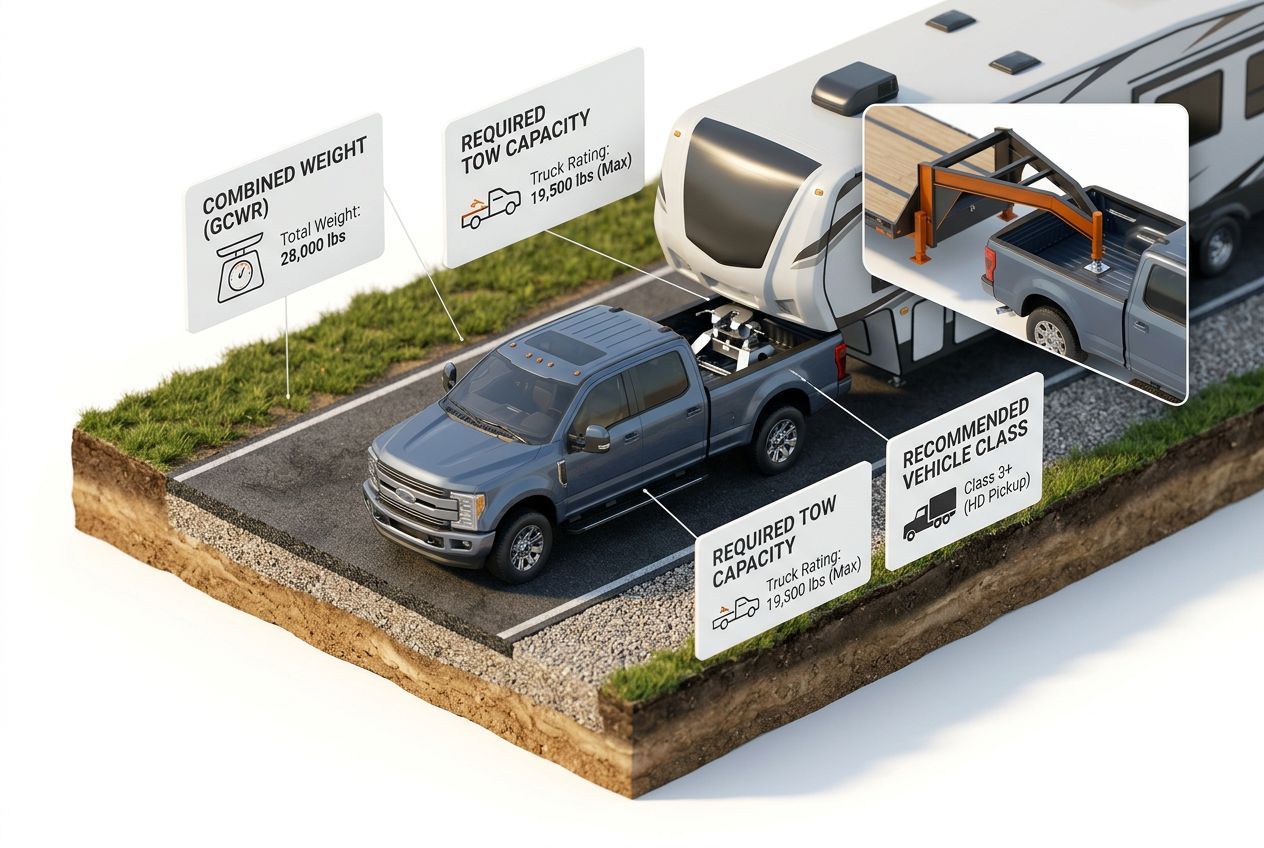
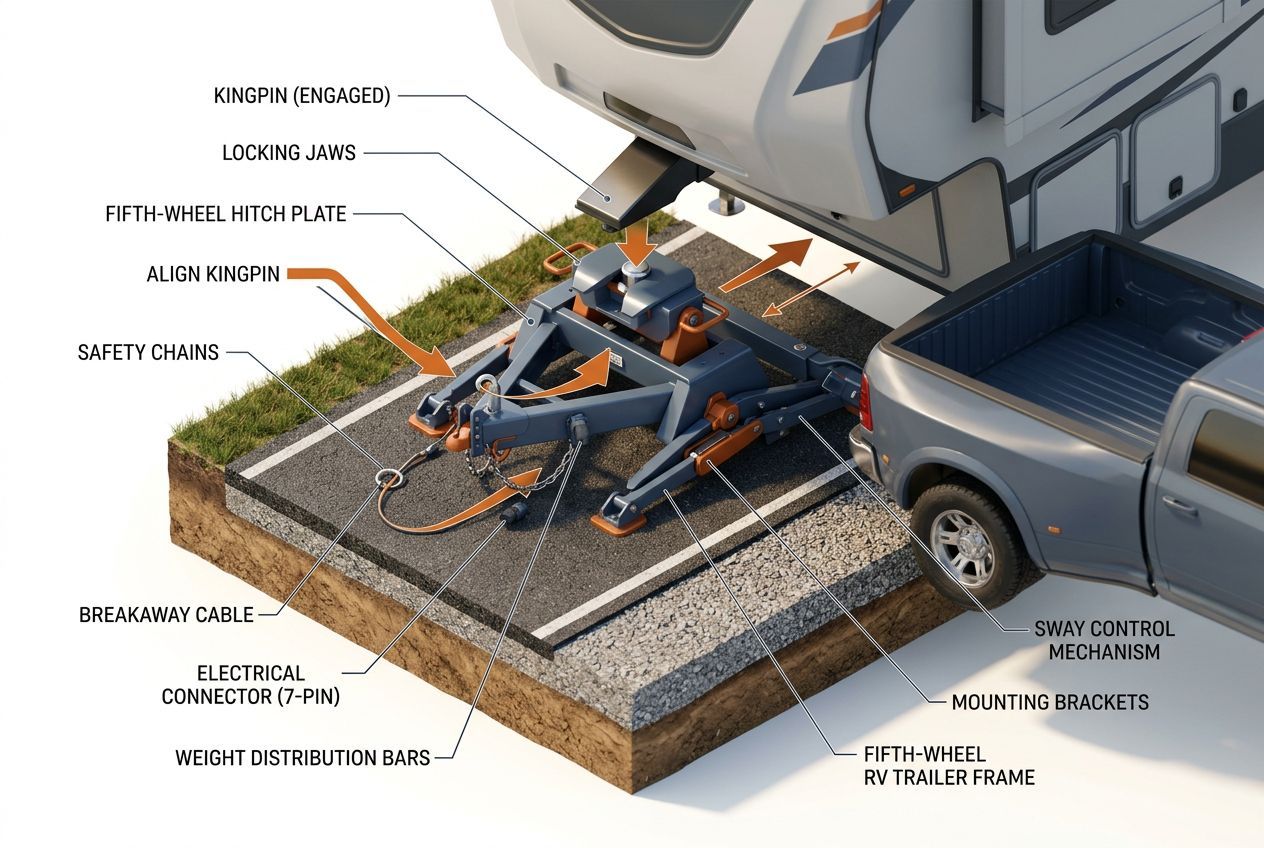
The fundamental difference lies in their coupling design: a 5th wheel hitch locks a horseshoe-shaped jaw around a 2-inch kingpin on the trailer's front overhang, whereas a gooseneck hitch accepts a coupler on a curved arm that drops down to a recessed ball in the truck bed floor. The core comparison between 5th wheel vs gooseneck revolves around these three aspects: coupling design, bed space utilization, and the types of trailers they support.
Here's a closer look at these differences in practice:
5th Wheel Hitch Anatomy
- Mounting: Rails bolt directly to the bed floor.
- Head Unit: A large head unit slides onto these rails.
- Coupling: The jaw assembly sits prominently 12–18 inches above the bed floor.
- Bed Clearance: This head unit typically remains in the truck bed, whether you're towing or not, unless you invest in a sliding or easily removable model.
Gooseneck Hitch Anatomy
- Mounting: The ball sits approximately 4 inches above the bed floor within a recessed housing.
- Coupling: The trailer connects directly to this ball.
- Bed Clearance: When the ball is removed (or flipped flush, as with brands like B&W Turnover Ball), the truck bed becomes completely clear and usable.
- Structural Support: The under-bed frame handles most of the structural load.
💡 Key Takeaway: The ability to clear the truck bed is a major differentiator. A contractor needing their truck bed for materials five days a week and towing an equipment trailer on weekends will find a gooseneck system far less intrusive. An RVer who tows frequently might not prioritize a clear bed as much.
Both hitch types strategically position the connection point over the rear axle to optimize weight distribution. This central placement is the primary reason why in-bed hitches significantly outperform conventional receiver hitches for managing heavy loads. For a more comprehensive understanding of how trailer weight impacts your truck, explore our trailer weight guide.
📊
TRAILER & PAYLOAD
Is a Gooseneck or 5th Wheel Safer for Towing?
For most highway towing scenarios, a 5th wheel hitch is generally considered safer due to its superior sway control. The jaw-and-kingpin coupling design distributes lateral forces across a wider contact surface, which effectively reduces trailer sway, especially at higher speeds. While gooseneck hitches are safe and widely proven in commercial applications, their single-ball connection necessitates more diligent attention to pin weight and load balance to achieve comparable sway resistance.
Consider the mechanics: A 5th wheel's kingpin is encased within a clamping jaw, providing several inches of robust contact. Any side forces must overcome this full jaw width before the trailer can begin to oscillate. In contrast, a gooseneck coupler pivots on a single 2-5/16-inch ball. While perfectly secure when loaded correctly, it can be more sensitive to imbalanced loads or challenging crosswind conditions.
This does not imply that gooseneck hitches are inherently dangerous. Ranchers and hotshot truckers consistently operate them daily, often with loads exceeding 35,000 lbs, without incident. The critical factors for safe gooseneck towing include maintaining proper pin weight (ideally 15–25% of the Gross Trailer Weight on the ball), using a high-quality coupler with a tight latch, and ensuring your truck is appropriately matched to the load. If trailer sway is a concern for you, our trailer sway causes and fixes guide offers a comprehensive prevention checklist.
⚠️ Warning: Neither hitch type can ever compensate for an overloaded truck. According to NHTSA, exceeding your truck's rear axle limits is a significant contributor to loss-of-control crashes while towing. Always verify your truck's door-jamb sticker for the GAWR (gross axle weight rating) before connecting any heavy load. Our overloaded truck risks article details the serious consequences of ignoring these crucial ratings.
🔧
TRAILER & PAYLOAD
Which Can Tow More Weight: 5th Wheel or Gooseneck?
When it comes to raw weight capacity, gooseneck hitches typically support higher gross trailer weights. Most reputable models are rated for 30,000–35,000 lbs, with heavy-duty commercial units capable of reaching 40,000 lbs. Conversely, most 5th wheel hitches generally max out at 24,000–27,000 lbs, although a select few premium models can extend to 30,000 lbs. For sheer maximum capacity, the gooseneck clearly holds the advantage.
Real-World Weight Scenario
Imagine you need to haul a 28,000-lb loaded flatbed equipment trailer, perhaps carrying a skid steer and its attachments. With a typical 15% pin weight, that translates to 4,200 lbs pressing down on the hitch ball. When you factor in your truck's curb weight, driver, and fuel, you're likely nearing your 3/4-ton truck's GCWR ceiling. A gooseneck hitch rated at 30,000 lbs would comfortably handle this load. However, a standard 5th wheel hitch rated at 24,000 lbs would not be sufficient—requiring either a higher-rated 5th wheel model or the use of a gooseneck setup.
The table below provides a concise comparison of the two systems across their key specifications:
Real-World Weight Scenario — data table
| Spec |
Gooseneck Hitch |
5th Wheel Hitch |
Notes |
| Typical GTW Rating |
30,000–35,000 lbs |
24,000–27,000 lbs |
Some 5th wheels reach 30,000 lbs |
| Max GTW (commercial) |
Up to 40,000 lbs |
Up to 30,000 lbs |
Varies by brand/model |
| Pin/Ball Weight (% of GTW) |
15–25% |
15–25% |
Both types, same target range |
| Ball/Kingpin Size |
2-5/16 in. ball |
2 in. kingpin |
Industry standard for each |
| Hitch Height Above Bed |
~4 in. (ball only) |
12–18 in. (assembly) |
Affects bed clearance when not towing |
Source: B&W Trailer Hitches product specifications; NHTSA towing guidelines
✅ Pro Tip: The hitch rating represents a maximum capacity, not an automatic green light for towing that weight. Your truck's payload capacity, rear GAWR, and GCWR are the actual limiting factors. A 35,000-lb rated gooseneck on a half-ton F-150, for example, does not grant permission to tow 35,000 lbs; the F-150's 9,900-lb max tow rating remains the binding constraint. Use our payload calculator to determine your true numbers before selecting a hitch. You can also learn more about the distinction between curb weight vs gross weight to fully grasp the importance of these truck ratings.
🛡️
TRAILER & PAYLOAD
Can You Use a 5th Wheel Hitch with a Gooseneck Trailer?
Yes, it is possible to bridge the two systems using adapters, which are available for both directions of connection. A gooseneck-to-5th-wheel adapter, for instance, bolts onto a 5th wheel hitch's kingpin plate and adds a gooseneck ball. This setup allows a truck equipped with a 5th wheel hitch to tow a gooseneck trailer. Brands like B&W and Reese manufacture such adapters, typically rated between 20,000 and 25,000 lbs. Conversely, a 5th-wheel-to-gooseneck adapter mounts onto the gooseneck ball and provides a receiver for a kingpin.
While adapters offer a practical solution, they do come with notable trade-offs:
- Added Height: Adapters typically add an extra 4–8 inches of stack height. This increased height can lead to coupler clearance issues, particularly with low-profile trailers.
- Reduced Rating: Most adapters derate the overall connection. A hitch originally rated for 27,000 lbs, for example, might be limited to 20,000 lbs when an adapter is in use.
- Impact on Ride Quality: The introduction of an additional articulation point can potentially introduce more movement or 'play' at highway speeds, affecting stability.
For occasional cross-connection of a borrowed trailer, an adapter serves as a practical short-term fix. However, if you anticipate regularly using an adapter, it is generally more advisable to equip your truck with the correct hitch type for your primary trailer. The cost of adapters ($150–$300) versus a new gooseneck hitch ($400–$900) can sometimes make a full hitch swap the more sensible and safer long-term investment.
📋
TRAILER & PAYLOAD
What Are the Best Use Cases for a Gooseneck Hitch?
Gooseneck hitches are the optimal choice for agricultural, commercial, and flatbed towing applications where maximum weight capacity and the versatility of a usable, clear truck bed are paramount. Industries like livestock hauling, equipment contracting, hotshot carriers, and car haulers frequently rely on gooseneck setups. This is because the flush-mount ball can disappear when not in use, and their higher GTW ratings are essential for handling demanding commercial loads.
Specific Applications Where Gooseneck Hitches Excel:
- Livestock Trailers: Horse and cattle trailers are almost universally designed as gooseneck-style. The entire agricultural industry, including farriers, veterinarians, and feed dealers, typically operates under the assumption of a gooseneck connection.
- Flatbed Equipment Trailers: When transporting heavy machinery such as skid steers, excavators, and tractors, a gooseneck's 35,000-lb rating is often critical for safely managing these significant weight loads.
- Hotshot Trucking: As per FMCSA regulations, hotshot loads on non-CDL setups are capped at a 26,000 lbs GCWR. Gooseneck setups are the standard in this segment due to their robust capacity.
- Dump Trailers and Car Haulers: Both of these trailer types are commonly manufactured with gooseneck couplers, making the gooseneck hitch the natural choice for towing them.
📊 Quick Fact: Geographic patterns indicate that regions like Texas, Oklahoma, Kansas, and Missouri exhibit a higher prevalence of gooseneck hitches than other parts of the country. This trend is largely driven by the demands of agriculture and oil-field hauling, where the gooseneck is essentially the default towing solution.
Still undecided on which hitch is the best fit for your truck and trailer combination? Our intuitive matchmaker tool can help! Simply answer a few questions about your trailer type, approximate load weight, and truck specifications, and it will guide you toward the most appropriate setup.