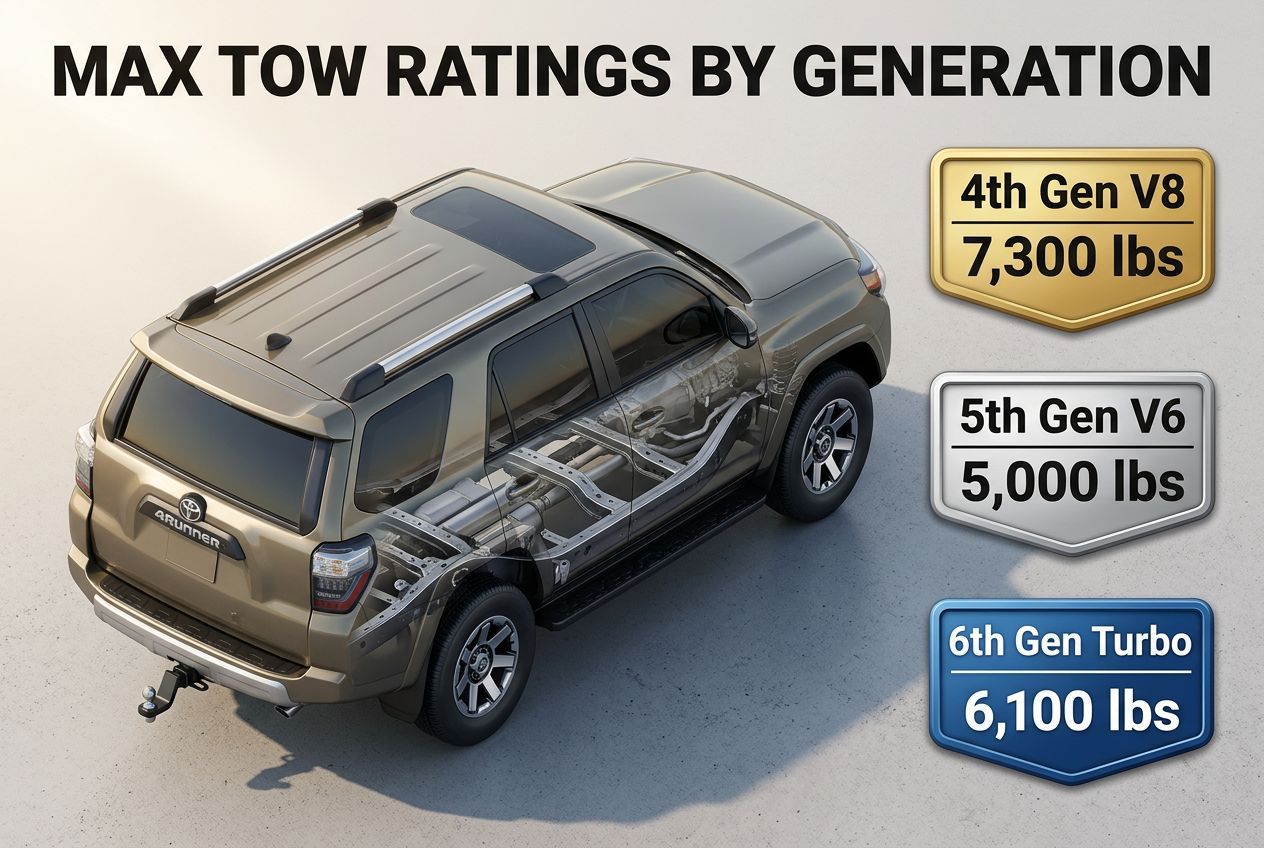
What Is the Toyota 4Runner Towing Capacity by Year? — data table
| Generation |
Years |
Engine |
Max Tow Rating |
GCWR |
| 6th Gen |
2025+ |
2.4L Turbo I-4 (i-FORCE) |
6,000–6,100 lbs |
~12,000 lbs |
| 6th Gen |
2025+ |
2.4L Turbo Hybrid (i-FORCE MAX) |
~6,000 lbs |
~12,000 lbs |
| 5th Gen |
2010–2024 |
4.0L V6 (1GR-FE) |
5,000 lbs |
11,500 lbs |
| 4th Gen |
2003–2009 |
4.7L V8 (2UZ-FE) |
7,300 lbs |
12,900 lbs |
| 4th Gen |
2003–2009 |
4.0L V6 (1GR-FE) |
5,000 lbs |
10,500 lbs |
| 3rd Gen |
1996–2002 |
3.4L V6 (5VZ-FE) |
5,000 lbs |
10,000 lbs |
| 3rd Gen |
1996–2002 |
2.7L I-4 (3RZ-FE) |
3,500 lbs |
8,500 lbs |
| 2nd Gen |
1990–1995 |
3.0L V6 (3VZ-E) |
3,500 lbs |
~9,000 lbs |
| 1st Gen |
1984–1989 |
2.4L I-4 (22R-E) |
2,000 lbs |
~6,500 lbs |
Source: Toyota Motor Corporation Towing & Payload Guides (toyota.com); Edmunds vehicle specifications (edmunds.com)
The 5th gen's 15-year run without a tow rating change is remarkable. From the 2010 launch to the 2024 final model year, every single 4Runner rolled off the line with the same 4.0L V6, 5-speed auto, and 5,000 lb rating. That consistency means a 2010 SR5 tows exactly the same as a 2024 TRD Pro.
💡 Pro Tip: The 4th gen V8 4Runner (2003–2009) is an overlooked used towing bargain. The 4.7L V8 with timing belt maintained is extraordinarily reliable, and 7,300 lbs of towing capacity beats most modern mid-size SUVs. Look for models with documented timing belt service around 90,000 miles.

🔧
TRUCK TOWING CAPACITY
Does the 2025 4Runner Tow More Than Previous Models?
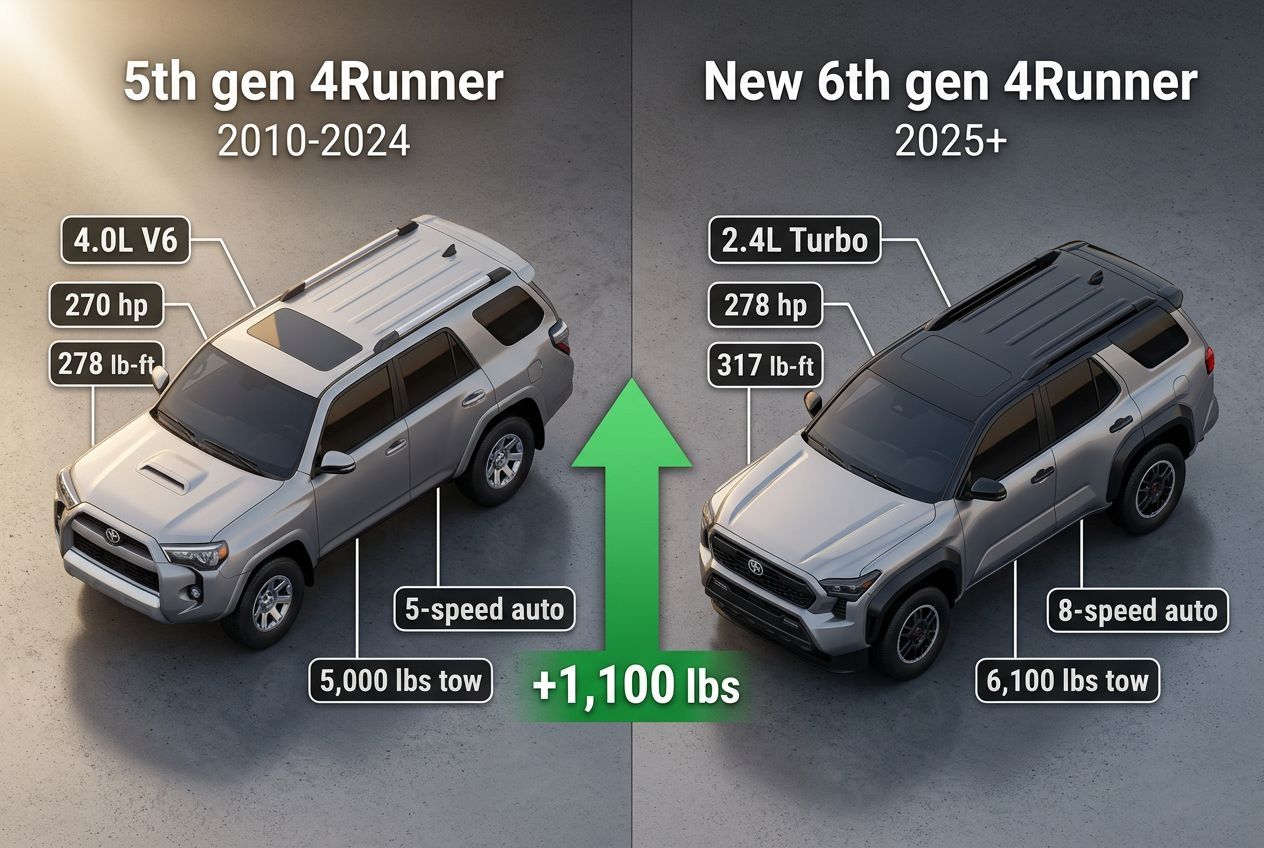
Yes — the 2025 6th generation 4Runner tows approximately 1,000 lbs more than the outgoing 5th gen. The jump from 5,000 to 6,000+ lbs comes from three engineering changes: a more powerful turbocharged engine, a modern 8-speed automatic with lower first-gear ratios, and an updated frame designed to handle higher tongue weights.
The 2.4L turbo-four might sound like a downgrade from a V6, but the numbers tell a different story. The new engine produces 278 hp and 317 lb-ft of torque. The old 4.0L V6 made 270 hp and 278 lb-ft. More importantly, the turbo engine delivers peak torque at 1,700 RPM compared to the V6's peak at 4,400 RPM — meaning the new 4Runner has significantly more pulling power at low speeds where towing actually happens.
Toyota also offers the i-FORCE MAX hybrid on the 2025 4Runner, combining the 2.4L turbo with an electric motor for a combined output near 326 hp and over 465 lb-ft of torque. The hybrid's tow rating is approximately 6,000 lbs — similar to the non-hybrid turbo — because the additional power is offset by the weight of the hybrid battery pack.
💡 Key Insight: The 2025 4Runner's 8-speed automatic is a bigger deal for towing than the engine change. The old 5-speed couldn't keep the V6 in its power band during hill climbs. The 8-speed gives the turbo more usable gears for maintaining speed under load, reducing transmission heat buildup.
One significant addition for 2025: Toyota integrated a trailer brake controller into higher trims. Previously, 4Runner owners had to install aftermarket brake controllers. The factory integration means plug-and-play compatibility with electric trailer brakes — a meaningful upgrade for anyone towing over 3,500 lbs.
🛡️
TRUCK TOWING CAPACITY
What Can You Actually Tow with a Toyota 4Runner?
A 4Runner handles a solid range of recreational and utility trailers, but it's not a truck. The 5,000–6,100 lb towing ceiling puts it in mid-weight territory — bigger than compact SUVs, smaller than full-size trucks.
What the 4Runner Tows Comfortably (5th Gen at 5,000 lbs)
- Pop-up campers: 1,500–2,800 lbs — well within capacity with room to spare
- Teardrop trailers: 1,000–2,500 lbs — the 4Runner's sweet spot for camping
- Small travel trailers (18–21 ft): 3,000–4,200 lbs — fits within limits when loaded carefully
- Aluminum bass boats (16–18 ft): 2,000–3,200 lbs on trailer
- Jet skis (single or double): 1,000–2,200 lbs on trailer
- Utility trailers with lawn equipment: Up to 3,500 lbs loaded
- Small enclosed cargo trailers (5×8): 1,800–2,800 lbs loaded
- Small horse trailers (single horse): 3,500–4,500 lbs loaded — at the limit
What Exceeds the 4Runner's Capacity
- Travel trailers over 24 feet: Typically 5,500–7,500 lbs loaded
- Mid-size boat/trailer combos (21+ ft fiberglass): Often 5,000–7,000 lbs
- Two-horse trailers: 5,500–7,500 lbs loaded
- Car hauler trailers: 5,500–8,000+ lbs with a vehicle
- Large pontoon boats (22+ ft): 5,000–6,500 lbs on trailer
⚠️ Warning: Travel trailer dry weight is not your tow weight. A trailer listed at 3,800 lbs dry often hits 4,800–5,200 lbs once you add water, propane, food, clothes, and gear. A 4Runner at 5,000 lbs capacity has zero margin for a trailer that weighs 5,200 lbs loaded.
For matching your camper to your 4Runner's rating, our camper towing capacity guide breaks down weights by camper type. If you're planning longer RV trips, the RV towing guide covers route planning and fuel economy considerations.
📋
TRUCK TOWING CAPACITY
How Does the 4Runner Compare to Other SUVs for Towing?
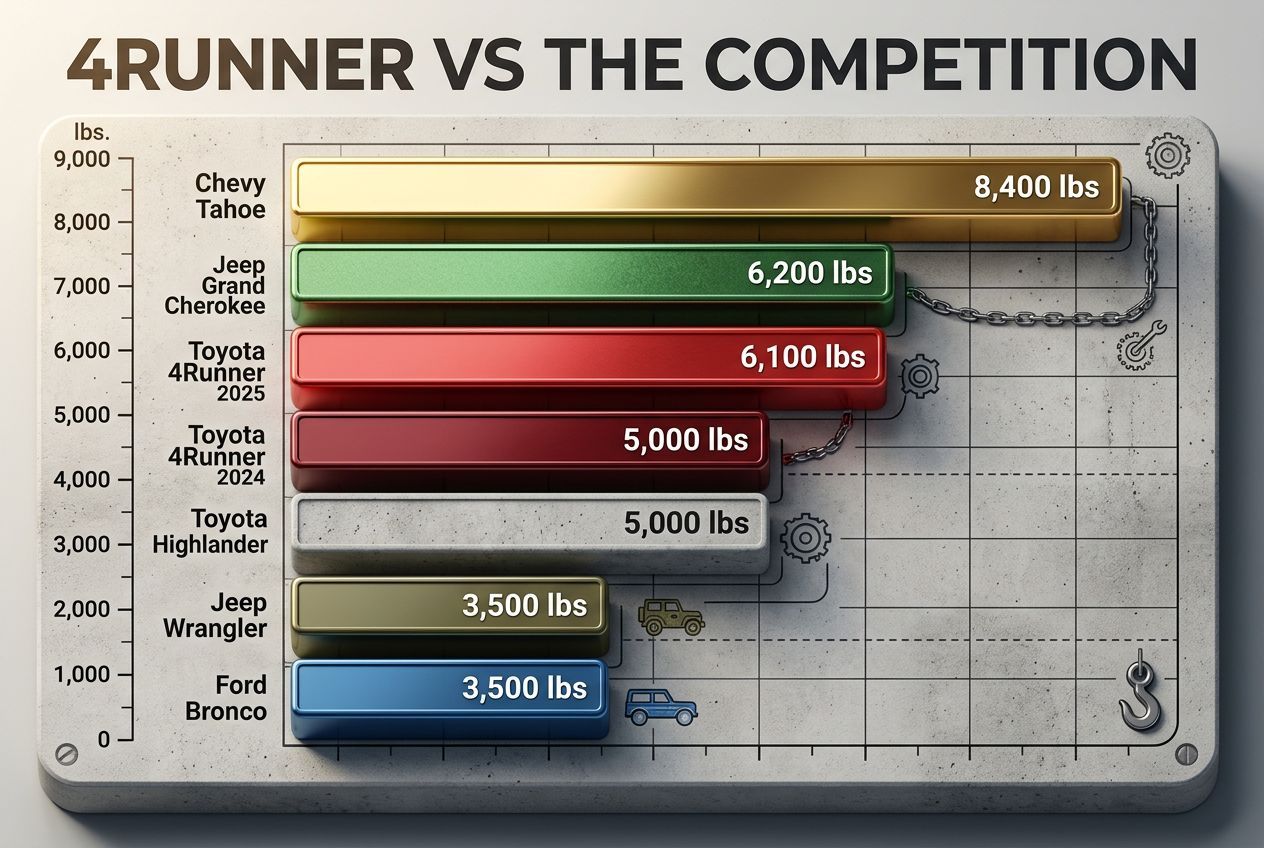
The 4Runner sits at the top of the mid-size SUV towing range, thanks to its body-on-frame construction. Most unibody mid-size SUVs top out at 3,500–5,000 lbs. The 4Runner's frame-based competitors — Jeep Wrangler, Ford Bronco — are in the same ballpark.
How Does the 4Runner Compare to Other SUVs for Towing? — data table
| Vehicle |
Construction |
Max Tow Rating |
Max Payload |
GCWR |
| Toyota 4Runner (2025 Turbo) |
Body-on-Frame |
6,100 lbs |
~1,600 lbs |
~12,000 lbs |
| Toyota 4Runner (2024 V6) |
Body-on-Frame |
5,000 lbs |
1,710 lbs |
11,500 lbs |
| Jeep Wrangler (V6) |
Body-on-Frame |
3,500 lbs |
1,300 lbs |
10,100 lbs |
| Jeep Grand Cherokee (V6) |
Unibody |
6,200 lbs |
1,600 lbs |
12,500 lbs |
| Ford Bronco (V6) |
Body-on-Frame |
3,500 lbs |
1,370 lbs |
10,100 lbs |
| Chevy Tahoe (5.3L V8) |
Body-on-Frame |
8,400 lbs |
1,778 lbs |
15,000 lbs |
| Toyota Highlander (3.5L V6) |
Unibody |
5,000 lbs |
1,545 lbs |
11,310 lbs |
Source: Manufacturer specifications via Edmunds (edmunds.com) and KBB (kbb.com)
The Jeep Grand Cherokee is the 4Runner's closest towing competitor at 6,200 lbs with the V6, slightly edging the 4Runner's 6,100. But the Grand Cherokee uses a unibody platform — less durable for sustained off-road towing on gravel roads and rough terrain.
The Jeep Wrangler is body-on-frame like the 4Runner but tows significantly less at 3,500 lbs. The Wrangler's short wheelbase and high center of gravity limit its towing stability. The 4Runner's longer wheelbase handles trailer sway much better.
If 5,000–6,000 lbs isn't enough, a Chevy Tahoe at 8,400 lbs or a full-size truck is the next step. Check our SUV towing capacity rankings for a complete comparison across all classes.
💡 Pro Tip: The 4Runner's real advantage over crossovers like the Highlander isn't the tow number — both rate at 5,000 lbs. It's the frame. Body-on-frame SUVs handle the sustained stress of towing with less structural fatigue. If you tow regularly (20+ times per year), the 4Runner will outlast a unibody platform.
⚙️
TRUCK TOWING CAPACITY
What Factors Affect Toyota 4Runner Towing Capacity?
Four key variables determine your 4Runner's real-world towing capability: generation/engine, payload management, tongue weight, and terrain. The 4Runner is simpler than most trucks — no cab configurations or axle ratio options to worry about — but the fundamentals still apply.
Engine and Generation Matter Most
The 4.0L V6 (5th gen) is locked at 5,000 lbs. The 2.4L turbo (6th gen) pushes to 6,000+. The old 4.7L V8 (4th gen) hit 7,300. Your engine dictates the ceiling — no packages or modifications change it.
Payload and Tongue Weight Are Connected
The 4Runner's payload capacity is approximately 1,710 lbs on the 5th gen. Tongue weight from a trailer (10–15% of trailer weight) eats into this. A 5,000 lb trailer puts 500–750 lbs of tongue weight on your hitch — that's 29–44% of your total payload before you count passengers and cargo.
Understanding tongue weight prevents overloading the rear axle. Too little tongue weight causes dangerous trailer sway. Too much compresses the rear suspension and lifts the front wheels, reducing steering control.
GCWR Is Your Hard Ceiling
The 5th gen 4Runner's GCWR is 11,500 lbs. The 4Runner itself weighs approximately 4,400–4,700 lbs depending on trim and options. Subtract that from 11,500 and your remaining capacity for trailer plus everything inside the truck is roughly 6,800–7,100 lbs. That's why the tow rating is 5,000, not 7,000 — Ford and Toyota account for passengers and cargo in the gap. Learn more in our GCWR guide.
⚠️ Warning: Aftermarket lift kits don't increase towing capacity, and they can actually reduce stability. A 3-inch lift raises the center of gravity, making trailer sway harder to control. Toyota's published tow ratings assume stock ride height.
Terrain and Altitude
The naturally aspirated 4.0L V6 loses roughly 3–4% of power per 1,000 feet of elevation above sea level. Towing a 4,500 lb trailer at 7,000 feet elevation feels noticeably different than at sea level. The 2025 turbo engine compensates better for altitude because the turbocharger forces more air into the combustion chamber, but cooling system demand still increases.
Use the Can I Tow This calculator to check your specific 4Runner against your planned load.
🚛
TRUCK TOWING CAPACITY
Should You Buy a Toyota 4Runner for Towing?
The 4Runner is one of the best mid-size SUVs for regular towing, especially if you also need off-road capability. Its body-on-frame construction, proven reliability, and consistent tow rating make it a strong choice for owners who tow 10–30 times per year.
Buy the 4Runner for towing if:
- Your typical load stays under 4,500 lbs (leaves 10%+ safety margin on the 5th gen)
- You tow to off-pavement destinations — campgrounds, boat ramps, hunting land
- Long-term reliability matters — the 4.0L V6 routinely hits 300,000+ miles
- You want one vehicle that handles daily driving, off-road, and towing
- You're pulling small travel trailers, boats, jet skis, or utility trailers
Don't buy the 4Runner for towing if:
- You need to pull over 6,000 lbs regularly — a Tahoe, Sequoia, or truck is better
- You want maximum fuel economy while towing — the 4Runner gets 14–16 MPG pulling a trailer
- You need crew cab space plus a truck bed for hauling and towing simultaneously
- Your trailer exceeds 24 feet — the 4Runner's wheelbase-to-trailer-length ratio gets marginal
💡 Pro Tip: If you're cross-shopping the 4Runner against the Toyota Tacoma for towing, the Tacoma tows 6,800 lbs with the V6 and Tow Package — 1,800 lbs more than the 5th gen 4Runner. But the 4Runner has more enclosed passenger and cargo space. Pick based on whether you need a bed or seats more. Check the Tacoma's full tow ratings for a direct comparison.
The relationship between towing capacity and payload is worth understanding before you buy — it changes how you load both the trailer and the 4Runner itself.