What Is the Chevy Colorado Towing Capacity by Year? — data table
| Generation |
Years |
Engine |
Max Tow Rating |
GCWR |
| 3rd Gen |
2023–2025 |
2.7L Turbo Plus I-4 + Trail Pkg |
7,700 lbs |
14,100 lbs |
| 3rd Gen |
2023–2025 |
2.7L Turbo Plus I-4 (base) |
3,500 lbs |
~10,000 lbs |
| 3rd Gen |
2023–2025 |
2.7L Turbo Plus I-4 (ZR2) |
6,000 lbs |
12,300 lbs |
| 2nd Gen |
2016–2022 |
2.8L Duramax Diesel I-4 |
7,700 lbs |
14,200 lbs |
| 2nd Gen |
2015–2022 |
3.6L V6 + Tow Pkg |
7,000 lbs |
13,500 lbs |
| 2nd Gen |
2015–2022 |
3.6L V6 (base) |
3,500 lbs |
~10,000 lbs |
| 2nd Gen |
2015–2022 |
2.5L I-4 |
3,500 lbs |
~9,500 lbs |
| 2nd Gen |
2017–2022 |
2.8L Diesel (ZR2) |
5,000 lbs |
11,500 lbs |
| 1st Gen |
2004–2012 |
5.3L V8 |
6,000 lbs |
12,000 lbs |
| 1st Gen |
2004–2012 |
3.7L I-5 |
4,000 lbs |
10,000 lbs |
| 1st Gen |
2004–2012 |
2.9L I-4 |
2,000 lbs |
7,500 lbs |
Source: General Motors Trailering Guides (chevrolet.com); Edmunds vehicle specifications (edmunds.com)
The 1st gen Colorado (2004–2012) offered a 5.3L V8 — yes, the same family of V8 found in the Silverado. It towed 6,000 lbs and was dropped after 2012 due to fuel economy regulations. The 2nd gen launched in 2015 with no V8, relying on the 3.6L V6 and later the diesel to hit competitive tow numbers.
The 3rd gen's single-engine strategy (2.7L turbo only) simplifies the lineup. No more choosing between V6, diesel, or four-cylinder — every Colorado gets the turbo, and the trailering package unlocks the full 7,700 lbs. This makes used 3rd gen shopping straightforward: check for the trailering package and you know the rating.
💡 Pro Tip: The 2nd gen diesel Colorado (2016–2022) is a strong used towing option. The 2.8L Duramax delivers 369 lb-ft of torque and gets 25–28 MPG highway — better fuel economy while towing than any gas Colorado. Used prices have dropped significantly since Chevy discontinued the diesel. Just budget for diesel maintenance (DEF fluid, fuel filter changes) and verify the emissions system is intact.
🔧
TRUCK TOWING CAPACITY
Why Does the Colorado ZR2 Tow Less?
The Colorado ZR2 is rated at 6,000 lbs — 1,700 lbs below the standard Colorado's 7,700 lb maximum. This reduction isn't about engine power (both use the same 2.7L turbo) — it's about weight and payload.
The ZR2 adds approximately 200–300 lbs of off-road equipment: Multimatic DSSV dampers, front and rear electronic locking differentials, wider track width, 33-inch Goodyear Wrangler Territory MT tires, underbody skid plates, and a raised suspension. That extra weight reduces the payload capacity, which directly reduces the tow rating because every pound the truck gains is a pound it can't allocate to trailer tongue weight.
The wider tires and raised ride height also affect tow stability calculations. A higher center of gravity increases lateral sway forces when towing, and the wider track changes the weight transfer dynamics during lane changes with a trailer.
💡 Key Insight: The ZR2 at 6,000 lbs still out-tows most midsize SUVs and compact trucks. If you want both off-road capability and towing, 6,000 lbs handles pop-up campers, small travel trailers, boats, and utility trailers. You only lose access to the heavier loads (6,000–7,700 lbs) that require the standard trailering package.
For a direct comparison with other midsize trucks, the Ford Ranger maxes at 7,500 lbs, and the Toyota Tacoma hits 6,500 lbs with the V6 tow package.

🛡️
TRUCK TOWING CAPACITY
What Can You Tow with a Chevy Colorado?
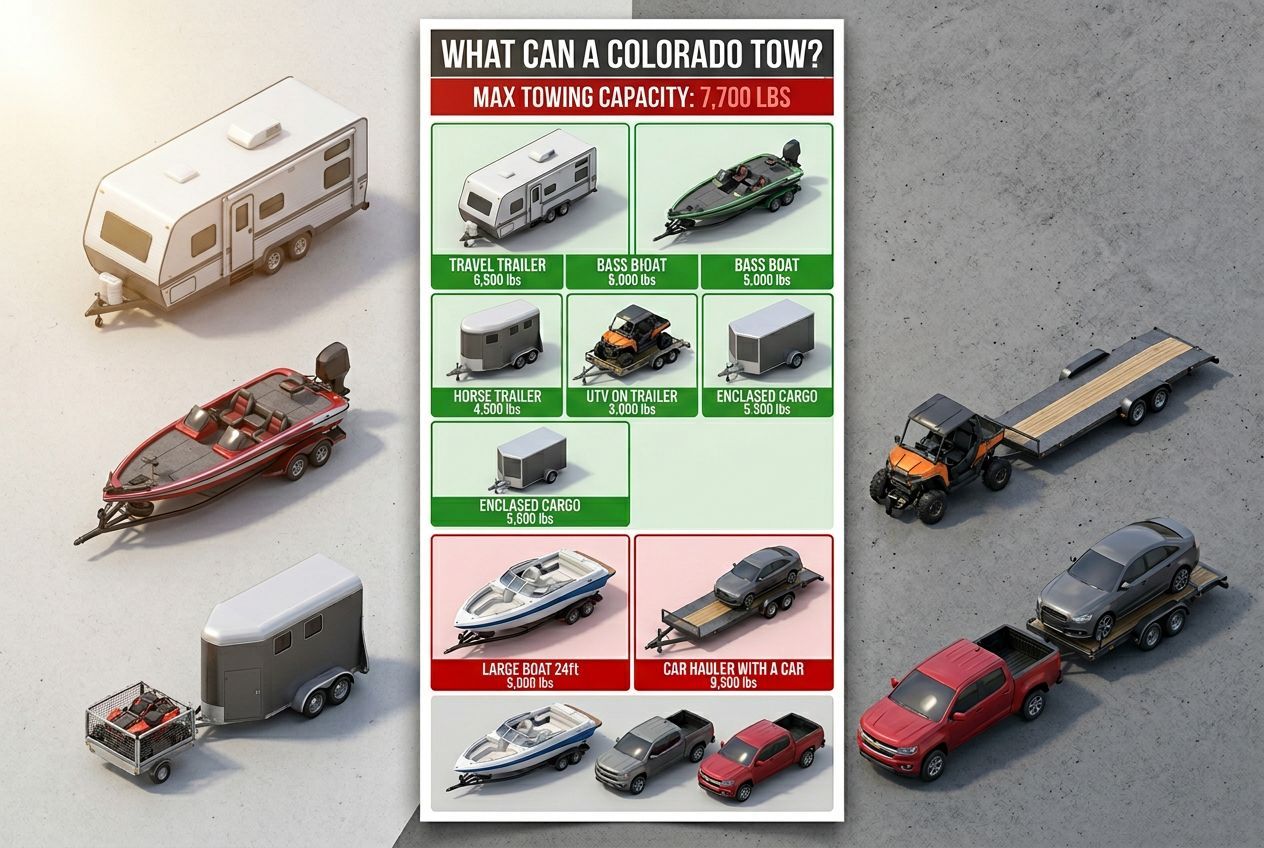
The Colorado at 7,700 lbs handles a broad range of recreational and work trailers — wider than any midsize SUV and approaching half-ton truck territory for lighter loads.
Colorado with Trailering Package (7,700 lbs)
- Travel trailers (20–26 ft): 4,000–7,000 lbs loaded — the Colorado's primary towing strength
- Bass and ski boats (18–21 ft): 3,500–6,000 lbs on trailer
- Pontoon boats (18–22 ft): 3,500–5,500 lbs on trailer
- Single-horse trailers: 3,500–4,500 lbs loaded
- Enclosed cargo trailers (6×12): 3,500–6,000 lbs loaded
- Car dolly with vehicle: 4,000–6,500 lbs
- UTV/ATV on trailer: 2,000–3,500 lbs
- Large utility trailers: Up to 6,000 lbs loaded
Colorado ZR2 (6,000 lbs)
- Pop-up campers: 1,500–2,800 lbs
- Small travel trailers (18–22 ft): 3,500–5,500 lbs loaded
- Aluminum bass boats (16–18 ft): 2,000–3,500 lbs on trailer
- Utility trailers: Up to 4,500 lbs loaded
What Exceeds the Colorado's Capacity
- Travel trailers over 28 feet: Most exceed 7,700 lbs loaded
- Large boat/trailer combos (24+ ft fiberglass): Often 7,500–10,000 lbs
- Two-horse trailers loaded: 6,000–8,000 lbs
- Car hauler with full-size vehicle: 7,500–10,000+ lbs
⚠️ Warning: Travel trailer dry weight is deceiving. A trailer advertised at 5,500 lbs dry typically hits 6,800–7,200 lbs once you add fresh water (8.3 lbs/gallon), propane, food, clothes, and gear. At 7,200 lbs, you're at 93% of the Colorado's 7,700 lb max — leaving almost no margin. For a weight distribution hitch recommendation when towing heavy loads, see our weight distribution hitch guide.
📋
TRUCK TOWING CAPACITY
How Does the Chevy Colorado Compare to Other Midsize Trucks?
The Colorado leads the midsize truck segment in towing capacity at 7,700 lbs, edging the Ford Ranger by 200 lbs and the Toyota Tacoma by 1,200 lbs.
How Does the Chevy Colorado Compare to Other Midsize Trucks? — data table
| Vehicle |
Max Tow Rating |
Engine |
Torque |
GCWR |
| Chevy Colorado (2.7T + Trail Pkg) |
7,700 lbs |
2.7L Turbo I-4 |
430 lb-ft |
14,100 lbs |
| Ford Ranger (V6 + Tow Tech Pkg) |
7,500 lbs |
2.7L EcoBoost V6 |
400 lb-ft |
14,000 lbs |
| Toyota Tacoma (V6 + Tow Pkg) |
6,500 lbs |
3.5L V6 |
265 lb-ft |
11,430 lbs |
| Toyota Tacoma (2.4L Turbo, 2024+) |
6,500 lbs |
2.4L Turbo I-4 |
317 lb-ft |
~12,000 lbs |
| Nissan Frontier (V6) |
6,720 lbs |
3.8L V6 |
281 lb-ft |
12,270 lbs |
| GMC Canyon (2.7T + Trail Pkg) |
7,700 lbs |
2.7L Turbo I-4 |
430 lb-ft |
14,100 lbs |
| Jeep Gladiator (V6) |
7,700 lbs |
3.6L V6 |
260 lb-ft |
12,510 lbs |
Source: Manufacturer specifications via Edmunds (edmunds.com) and KBB (kbb.com)
The GMC Canyon matches the Colorado exactly at 7,700 lbs — both are built on the same platform with the same engine and transmission. The Canyon adds premium interior materials and a different grille for roughly $3,000–5,000 more.
The Ford Ranger at 7,500 lbs is the Colorado's direct competitor. The Ranger uses a 2.7L EcoBoost V6 with 400 lb-ft of torque — 30 lb-ft less than the Colorado's turbo-four. In practice, the 200 lb tow rating difference is negligible. Read the full Ford Ranger tow breakdown for a detailed comparison.
The Toyota Tacoma at 6,500 lbs trails both by over 1,000 lbs. The Tacoma's strength is resale value and off-road reputation, not towing. Check the Tacoma's full tow ratings for year-by-year data.
For more towing than any midsize, step up to a half-ton. The half-ton truck towing capacity guide covers the F-150, Silverado 1500, Ram 1500, and Tundra.
💡 Pro Tip: The Colorado's 430 lb-ft of torque is the segment's standout number. More torque than the Ranger's V6, Tacoma's V6, and the Frontier's V6. Torque matters most when launching from a stop, merging onto highways, and climbing sustained grades with a loaded trailer.

⚙️
TRUCK TOWING CAPACITY
What Factors Affect Chevy Colorado Towing Capacity?
Three variables control your Colorado's tow rating: the trailering package, cab/bed configuration, and how you manage payload. The single-engine lineup simplifies things compared to the 2nd gen's three engine choices.
Trailering Package Is the Biggest Factor
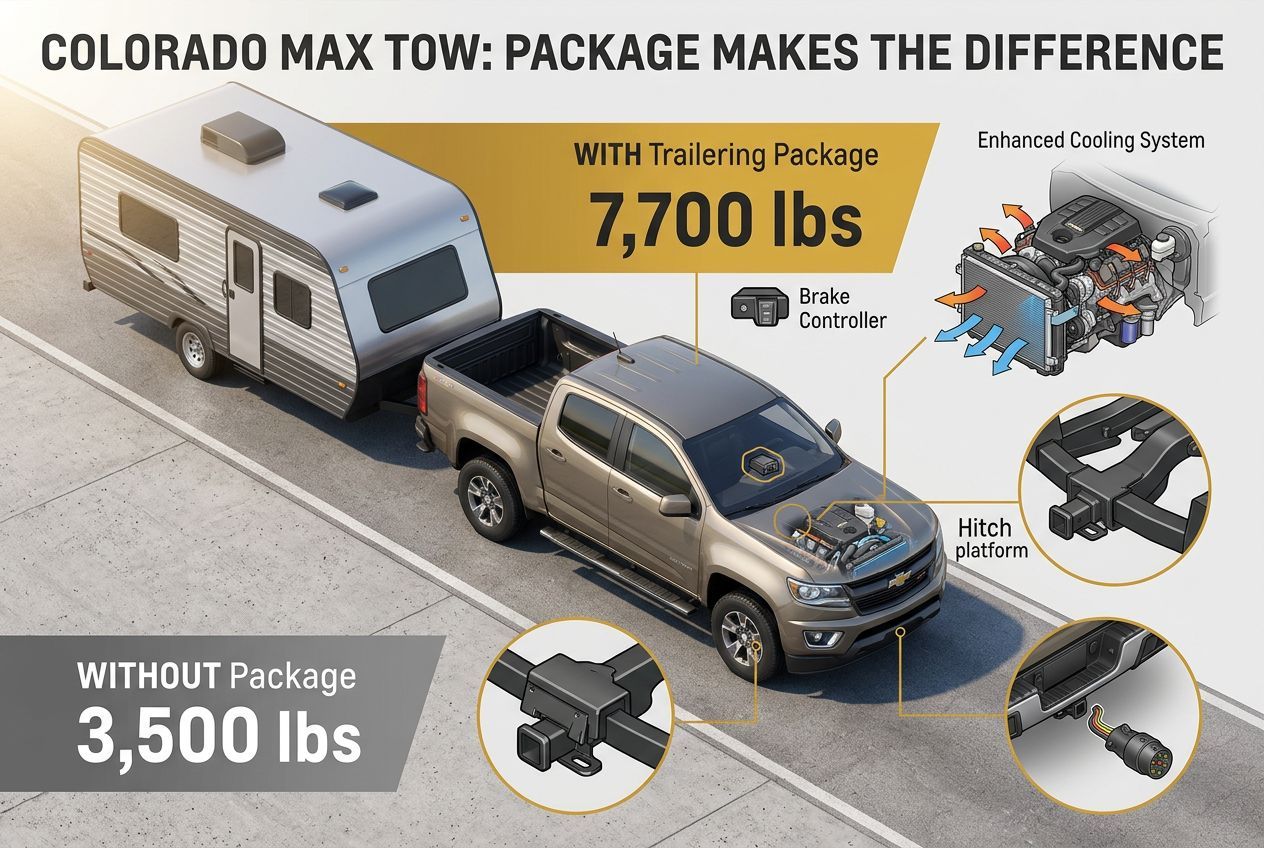
The trailering package (RPO Z82) takes the Colorado from 3,500 lbs to 7,700 lbs. It adds a heavy-duty cooling system, integrated trailer brake controller, trailer hitch platform, 7-pin wiring, and auto-locking rear diff. Without it, you have an SUV-level tow rating in a truck body.
Cab and Bed Configuration
The 3rd gen Colorado comes in Extended Cab (long bed) and Crew Cab (short or long bed). Crew Cab short bed models may have slightly different payload ratings, which affects the published tow rating by 100–200 lbs in edge cases. The Extended Cab with the long bed typically offers the highest tow rating configuration.
Payload and Tongue Weight
Colorado payload ranges from approximately 1,300–1,578 lbs depending on configuration. A 7,700 lb trailer at 10–15% tongue weight puts 770–1,155 lbs on the hitch — that's 49–87% of payload before passengers and gear. Understanding tongue weight is critical when towing near the Colorado's maximum.
The relationship between towing capacity and payload determines your real-world margin. GCWR of 14,100 lbs is the combined ceiling — the Colorado weighs approximately 4,400–4,800 lbs, leaving 9,300–9,700 lbs for trailer plus everything in the truck. Our GCWR guide breaks down this calculation.
⚠️ Warning: When towing over 5,000 lbs with a Colorado, a weight distribution hitch is strongly recommended. The Colorado's shorter wheelbase compared to full-size trucks means trailer tongue weight has a more pronounced effect on front axle unloading. Front tires losing traction equals losing steering control.
🚛
TRUCK TOWING CAPACITY
Should You Buy a Chevy Colorado for Towing?
The Colorado is the best midsize truck for maximum towing capacity, and one of the best values in the truck market for buyers who don't need a full-size.
Buy the Colorado for towing if:
- Your typical load is 4,000–7,000 lbs (travel trailers, boats, horse trailers, utility loads)
- You want truck towing in a more manageable daily-driver size
- Fuel economy matters — the 2.7L turbo gets 22–28 MPG highway when not towing
- You want the segment's highest torque (430 lb-ft) for confident hill climbing under load
- Parking, garage fit, or maneuverability in tight spaces rules out a full-size truck
Don't buy the Colorado for towing if:
- You need over 7,700 lbs — a half-ton Silverado, F-150, or Ram 1500 starts at 10,000+ lbs
- You frequently tow at maximum capacity — the Colorado works hard at 7,700 lbs on grades
- You need crew cab space AND a full-length bed AND maximum towing — the Colorado makes you choose between bed length and cab size
- You tow in extreme heat at altitude regularly — a V8 half-ton handles thermal stress better
💡 Pro Tip: If you're cross-shopping the Colorado against the Silverado 1500, the Silverado adds 5,600 lbs of towing capacity (up to 13,300) for roughly $6,000–10,000 more. But if your heaviest load is under 7,000 lbs, the Colorado saves you money on purchase price, fuel, insurance, and maintenance without sacrificing real-world capability. Check the Silverado's full tow ratings before deciding.