Skip to content
⚖️ TOWING LAWS & REGULATIONS

Private Property Towing Rules: What Owners Can (and Can't) Do

Published · Updated · 13 min read
MarkUpdated Sep 18, 2026Texas Occupations Code Chapter 2308
Key Takeaways
  • Property owners can tow unauthorized vehicles in every state — but only after meeting signage, notice, and licensing requirements.
  • Missing one requirement (wrong sign size, no written notice) can make the tow illegal and expose you to civil liability.
  • Tenants have strong protections — landlords generally need 48–72 hours written notice before removing a registered tenant's vehicle.
  • If your car was wrongfully towed, document everything and file a complaint with your local consumer protection office or small claims court.
  • State rules differ dramatically — California, Texas, and Florida have the most detailed statutes and are the best benchmarks to understand.

💰
TOWING LAWS & REGULATIONS

What Are Private Property Towing Rules?

Private property towing rules form the legal framework governing vehicle removal from non-public land. Every state grants property owners the right to remove unauthorized vehicles, but this authority is not unlimited. To ensure a legal tow, you must have compliant signage, a contract with a licensed towing company, and adhere to your state's procedural requirements. Skipping even one step can render the tow illegal.

Nonconsensual tows generate a large share of towing complaints. Many consumer complaints involve private property situations such as parking lot disputes, apartment complex removals, and HOA enforcement actions, which is why many state legislatures and cities regulate these tows closely.

Most states follow a core framework for private property towing:

  • Signage: Must be posted at every entrance before any tow can occur.
  • Licensed Operator: Only a state-licensed operator can perform the removal; property owners cannot hook up a vehicle themselves.
  • Notice: Specific notice may be required before (and is always required after) the tow.
  • Fee Caps: Many states impose limits on towing and daily storage fees.
  • Release Windows: Tow yards are typically required to release a vehicle within a set number of hours after it's requested.

Understanding this framework is essential for everyone. It protects you whether you're a property manager striving to keep your lot clear or a driver who got towed and needs to determine if the action was legal. For a broader look at how these rules interact with state law, the towing laws by state guide covers every jurisdiction.

💡 Key Takeaway: Strict adherence to all state and local private property towing rules is paramount. Any deviation can result in an illegal tow and significant legal repercussions for the property owner.
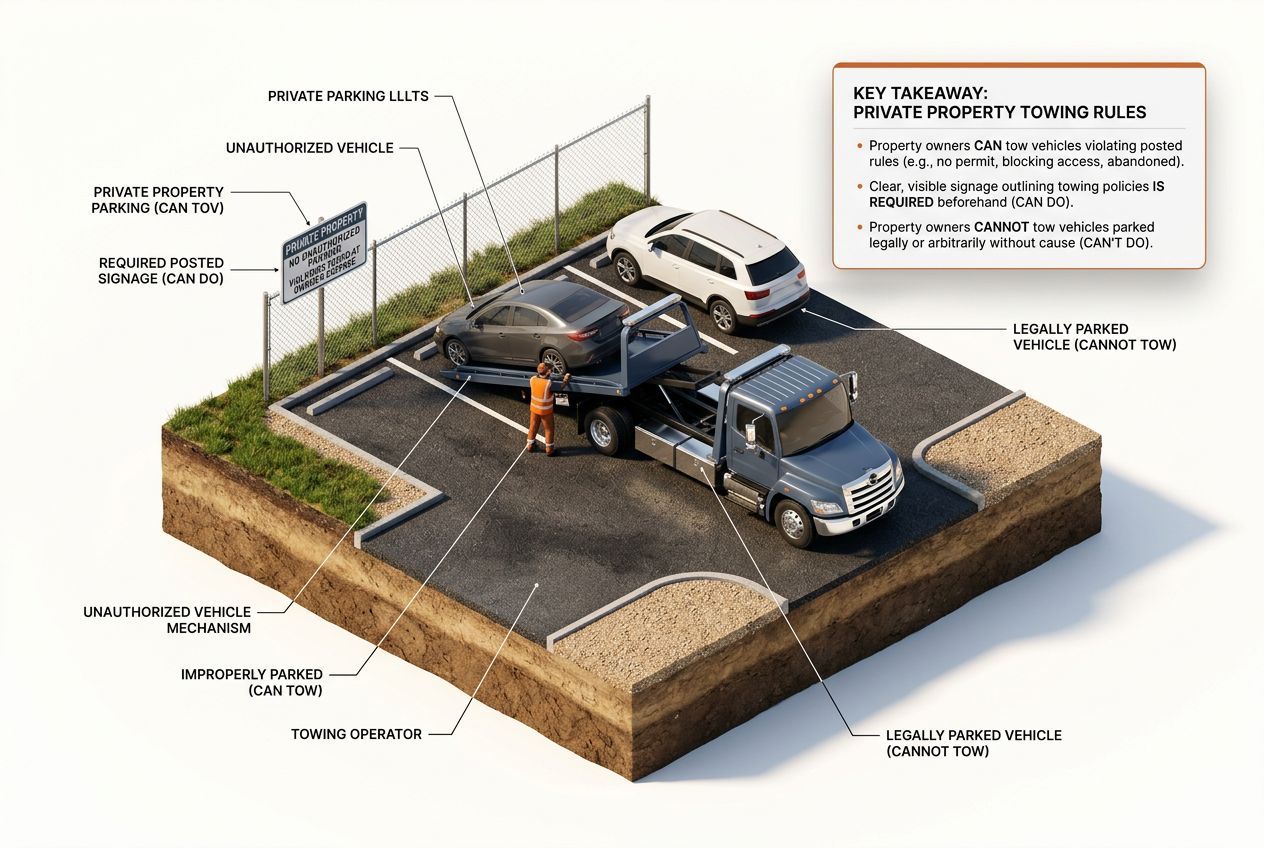

3D isometric overview diagram for private property towing rules: what owners can (and can't) do
📊
TOWING LAWS & REGULATIONS

Can You Legally Tow a Car From Private Property?

Yes, towing from private property is legal in all 50 states, but only when specific legal conditions are met. A property owner (or their authorized agent) must meet several prerequisites: compliant no-parking or tow-away signage must be posted, a state-licensed towing company must be used, and all state-specific notice requirements must be followed. Failing to complete any of these steps can lead to wrongful towing claims.

Consider a real-world scenario: You manage a 40-space retail parking lot in Dallas. A vehicle has been parked in a fire lane for six hours, so you call a licensed tow company—which is the correct first step. However, your signs are the old 16×20-inch format, not the 18×24-inch minimum required under Texas Transportation Code §684. If the tow is challenged, the driver could recover their fees, and you, as the property manager, could be liable for the towing and storage costs. Although the tow was initiated by a legal authority, it lacked a legally compliant trigger (the signs).

The lesson here is clear: your authority to tow is only as strong as your documentation and compliance. Nonconsensual towing rights for vehicle owners are activated the moment a procedural step is overlooked.

What private property towing cannot do:

  • Tow a legally parked vehicle: Even if it's on your private lot, you cannot tow a vehicle that is legally parked under a municipal easement.
  • Discriminate: You cannot tow a car simply because you dislike the driver or the vehicle type, as this can lead to discriminatory enforcement claims.
  • Self-tow: You are absolutely prohibited from towing a vehicle yourself without being a licensed operator. Unauthorized towing by a property owner exposes you to conversion claims and potential criminal liability.

⚠️ Warning: Never attempt to tow a vehicle yourself from private property unless you are a licensed towing operator. Doing so can result in significant legal and criminal penalties.


🔧
TOWING LAWS & REGULATIONS

What Signs Are Required Before Towing From Private Property?

Most states mandate clearly visible tow-away zone signs at every entrance to the property before any unauthorized vehicle removal is legal. These sign requirements typically include minimum dimensions, reflective lettering, and prominently displaying the towing company's name and phone number. Failing to meet these signage specifications is the single most common reason private property tows are ruled illegal.

Here's what three major states specifically require:

What Signs Are Required Before Towing From Private Property? — data table
State Min. Sign Size Key Content Required Unique Requirement
Texas 18×24 inches Red towing symbol, "Towing Enforced," 24-hour phone number Posted at each entrance; bottom edge 5–8 ft above ground
California 17×22 inches Towing company name & phone, local police phone Posted in plain view at all entrances; 1-inch lettering
Florida No overall size set; "tow-away zone" in 4-inch letters Tow company name & phone, removal at owner's expense Posted at each driveway or curb cut, 3–6 ft above ground
New York No state minimum Varies by municipality NYC requires 48-hr notice for most non-emergency tows
Georgia 17×22 inches Tow fees, operator contact Signs must be visible from roadway

Sources: Texas Occupations Code §2308.301–.302; California Vehicle Code §22658; Florida Statute §715.07; New York Vehicle & Traffic Law §1203-c; Georgia Code §44-1-13

California Vehicle Code §22658 stands out as one of the most detailed statutes in the country. It goes beyond sign specifications by limiting towing and storage charges to approved rates and requiring storage facilities to accept a valid bank credit card or cash. A facility that refuses a valid credit card commits a misdemeanor and is liable to the owner for four times the towing and storage charges. This demonstrates how specific and protective these laws can be.

✅ Pro Tip: Beyond state minimums, always check your local municipal ordinances for additional signage requirements. Cities often have their own specific rules for size, placement, and content that supersede state general statutes.

For the full cost picture, towing typically runs $150–$500 for the initial pull, plus $20–$75 per day in storage. See the towing cost guide or use the towing cost calculator to estimate fees in your state.


3D data visualization showing key figures for private property towing rules: what owners can (and can't) do
🛡️
TOWING LAWS & REGULATIONS

What Are the Rules for Towing From Private Property?

The rules for towing from private property encompass a comprehensive checklist of requirements. These include strict signage compliance, proper operator licensing, adherence to specific notice periods, and transparent fee structures. State law governs each of these elements, and local ordinances can add further layers of complexity, particularly in major cities like Los Angeles, Houston, and Miami, which often have their own unique towing codes layered on top of state statutes.

📊 Quick Fact: Over 60% of private property towing complaints stem from violations of signage requirements or improper notice, highlighting the critical importance of these specific rules.

Use this tool to look up the exact rules that apply where you are:
Try Our Free State Towing Law Lookup

The towing laws by state tool compiles current statutes for all 50 states, highlighting notice periods, sign requirements, and fee caps in a single, convenient lookup.


📋
TOWING LAWS & REGULATIONS

What Are Apartment Towing Rules for Landlords and Tenants?

Apartment towing rules require landlords to explicitly include towing policies within lease agreements and to post compliant signage before removing any vehicle. Most states also mandate written notice—often 24 to 72 hours—before a non-emergency tow can occur from a residential property. This means tenants generally benefit from stronger protections compared to visitors on commercial properties.

A clear lease agreement is critical. If your lease doesn't include a towing clause, you might not be able to legally tow a tenant's vehicle at all. Courts in states like California and Florida have ruled that a parking enforcement policy must be "reasonably communicated" to the tenant. A sign posted after a tenant moves in, which they may never have seen, doesn't always meet this communication standard.

Apartment complex towing frequently peaks during specific times of the year. These periods include college move-in and move-out seasons (typically August–September and May), when increased overflow parking and unfamiliar visitors can lead to enforcement conflicts. If you manage a complex located near a university, it is especially vital that your signage is current and your towing policy is clearly detailed in every lease addendum.

HOA towing rules follow a similar framework but add another layer of complexity. Covenants, Conditions, and Restrictions (CC&Rs) must explicitly authorize towing enforcement before the Homeowners Association can legally take action, as detailed in our HOA towing rules article.


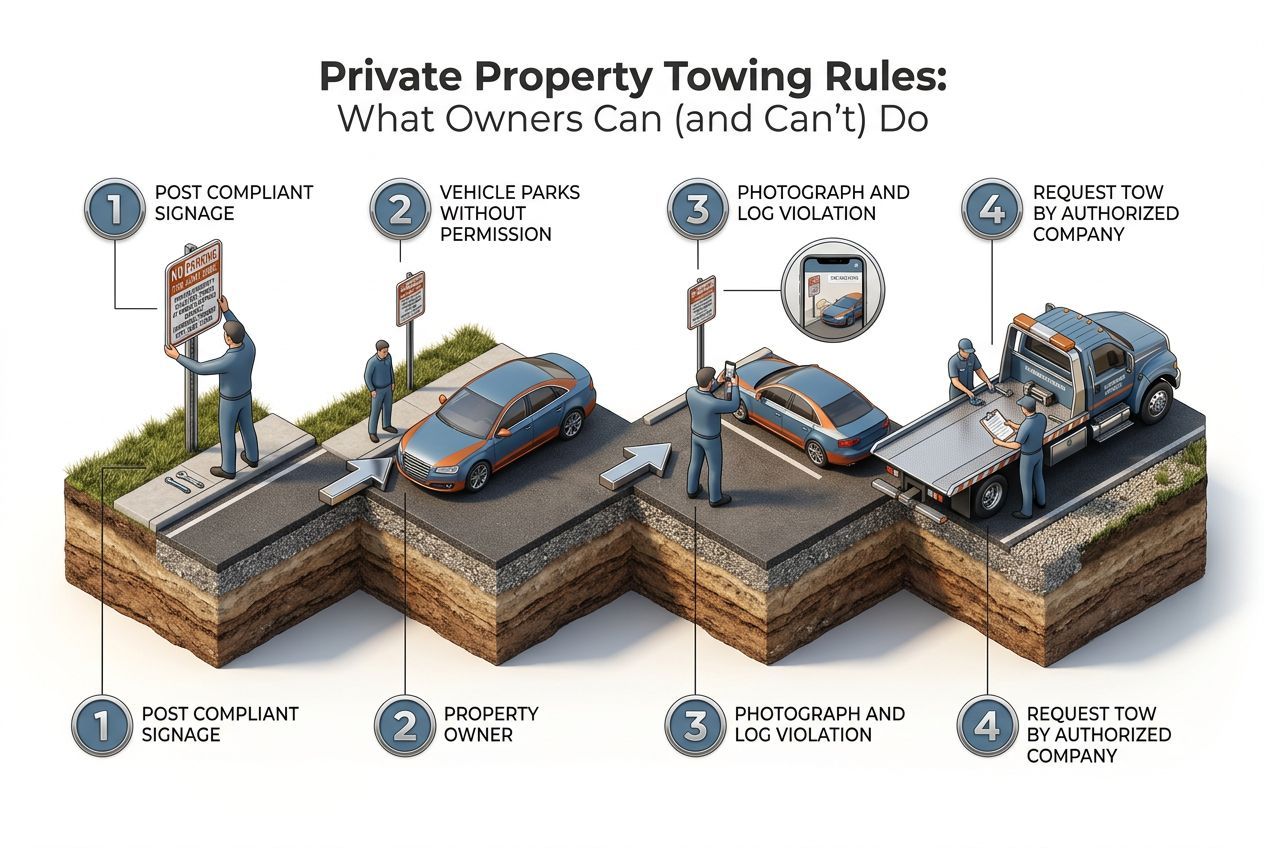
3D step-by-step process visualization for private property towing rules: what owners can (and can't) do
⚙️
TOWING LAWS & REGULATIONS

Can a Landlord Tow a Tenant's Car?

A landlord can tow a tenant's car only under specific, legally defined circumstances. These typically include expired registration, documented lease violations, or abandonment. Even in these cases, most states require a 48–72 hour written notice before the tow. Towing without proper notice, or without a specific lease clause explicitly authorizing it, places the landlord in serious legal jeopardy.

The potential liability for landlords is substantial. Under the legal theory of "conversion"—which means unauthorized interference with someone's property—a landlord who tows a current tenant's vehicle without proper notice can be sued for:

  • The full towing and storage costs incurred by the tenant.
  • Lost wages if the tenant was unable to get to work due to the tow.
  • Punitive damages in states with strong consumer protection statutes.

📊 Quick Fact: Some states add statutory damages. In Texas, a towing company or parking facility owner that intentionally, knowingly, or recklessly violates the towing law is liable for $1,000 plus three times the fees (Occupations Code §2308.404). In Florida, a person who improperly causes a vehicle to be removed is liable for the costs, damages, and attorney's fees.

Predatory towing laws in many states were written specifically to deter this kind of abuse. If you're a tenant who has been impacted by an unjustified vehicle removal, filing an illegal towing complaint is often the fastest route to recovering your money.

Special considerations for oversized vehicles: RVs, boats, and trailers parked in apartment lots often have shorter tow timelines. Many lease agreements and state statutes classify oversized vehicles separately, allowing for shorter notice periods, sometimes as little as 24 hours.


🚛
TOWING LAWS & REGULATIONS

How Do Private Property Towing Laws Vary by State?

Private property towing laws exhibit dramatic variations by state in aspects such as notice periods, sign specifications, fee caps, and required tow company response times. California, Texas, and Florida represent the three most detailed—and most frequently searched—jurisdictions. Using these states as benchmarks can provide a solid foundational understanding before researching the specific laws in your particular state.

California (Vehicle Code §22658)

Key features of California's law include:

  • Limits towing and storage charges to the rates in the local law enforcement towing agreement or the rate the CHP approved for the operator.
  • Requires the towing company to notify local police within 60 minutes after removal (or 15 minutes after arriving at the storage facility, if sooner).
  • Mandates that storage facilities accept a valid bank credit card or cash—no cash-only demands are permitted.

Texas (Occupations Code Chapter 2308)

Texas law outlines these critical points:

  • Signs must be at least 18 inches wide and 24 inches tall, posted at each entrance, with a 24-hour phone number for locating a towed vehicle.
  • TDLR caps a nonconsent tow of a light-duty vehicle (up to 10,000 lbs) at $272 and storage at $22.85 per day.
  • A knowing, intentional, or reckless violation makes the company liable for $1,000 plus three times the fees.

Florida (Statute §715.07)

Florida's key requirements:

  • The towing company must notify local police within 30 minutes after the tow and release the vehicle within 1 hour after it is requested. If you arrive before the vehicle is removed, it must be released for no more than half the posted rate. Without these steps, the tow is highly vulnerable to challenge.

✅ Pro Tip: If you're dealing with a towing dispute that crosses state lines—for instance, a vehicle registered in Georgia towed in Tennessee—towing lien laws quickly become relevant. States handle lien sales differently, and the timeline to reclaim a vehicle before it goes to auction typically ranges from 30 to 90 days, depending on the jurisdiction.

Altitude and winter weather can add complexities in mountain states like Colorado and Utah. Temporary snow emergency no-parking orders can sometimes overlap with private property, leading to confusion about whether a tow was a municipal action or a private one. The towing speed limits article covers some of these regional nuances in more detail.


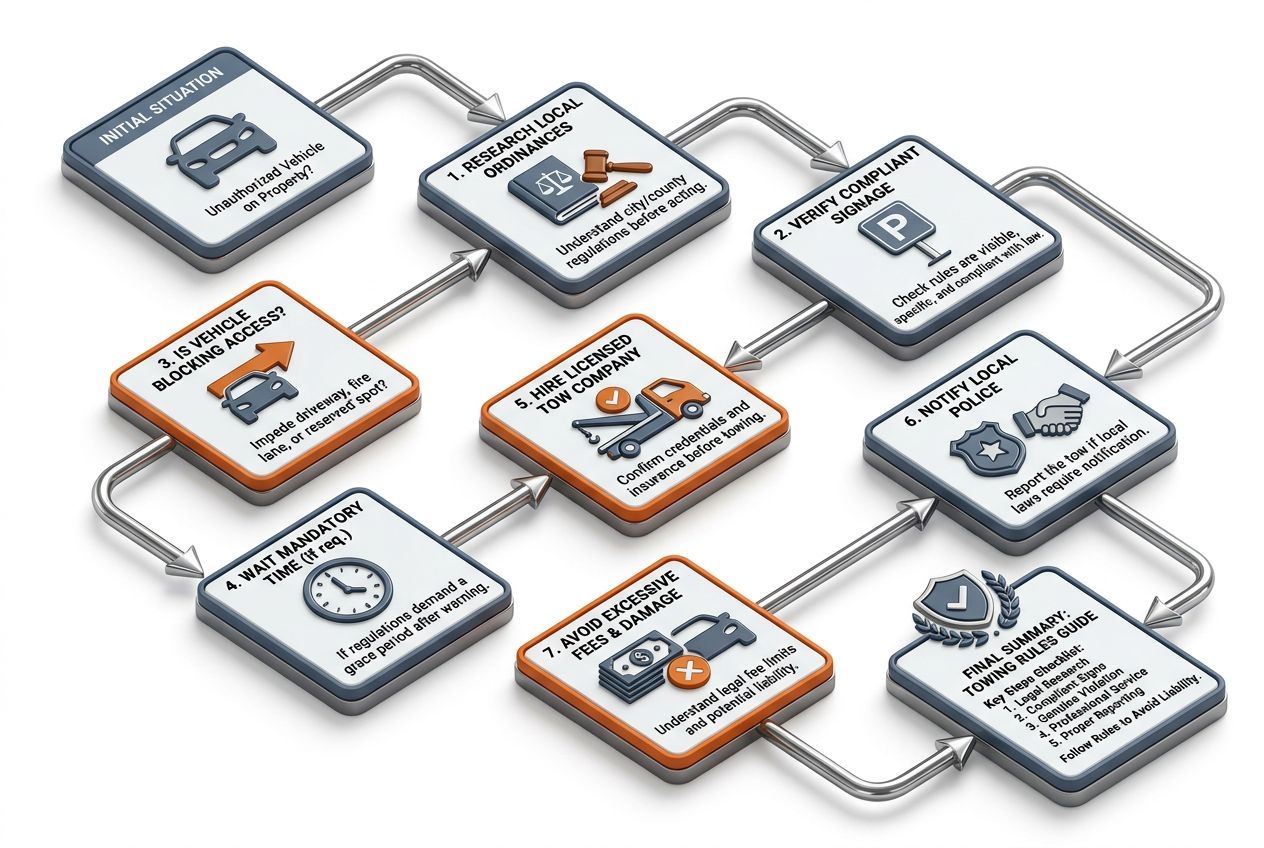
3D flowchart of practical tips and decisions for private property towing rules: what owners can (and can't) do
📝
TOWING LAWS & REGULATIONS

What Can You Do If Your Car Was Wrongfully Towed?

If your car was wrongfully towed from private property, your immediate priority should be thorough documentation. First, photograph the location immediately, specifically noting the presence or absence of signage, or any noncompliance with sign requirements. Next, contact the towing company. If direct resolution isn't possible, file a complaint with your city or county consumer protection office, and consider small claims court if necessary.

Here's a detailed documentation checklist to follow:

  1. Photograph the parking spot: Capture images showing the signs (or their absence), their size, and their visibility from where your car was parked.
  2. Obtain the tow slip: The towing company is legally required to provide this document in most states.
  3. Note the exact time: Storage fees accrue daily, so every hour can impact the total cost.
  4. Save all receipts: Keep records of the tow fee, storage fee, and any transportation costs you incurred to retrieve your vehicle.
  5. Retrieve your lease or any posted rules: You'll need to demonstrate your right to park in that location.

💡 Key Takeaway: Comprehensive documentation is your strongest tool when disputing a wrongful tow. Without photo evidence and records, your claim will be significantly harder to prove.

Consumers have rights. According to the U.S. Department of Transportation (transportation.gov), consumers have the right to dispute nonconsensual towing charges through state consumer protection channels. The FTC also tracks towing complaints as part of broader consumer fraud reporting.

Additional leverage may exist. If the tow company is uncooperative, DOT towing regulations can provide additional federal-level leverage, especially if a commercial vehicle or interstate commerce is involved. Furthermore, if you're experiencing a pattern of aggressive enforcement in your building or lot, predatory towing laws in some states may offer a class-action-style remedy.

Sources & Methodology

Research for this article draws on the following sources:

  1. 1.
    Texas Occupations Code Chapter 2308 — sign requirements, civil liability, and tow company obligations for private property towing in Texas (statutes.capitol.texas.gov)
  2. 2.
    California Vehicle Code §22658 — rate limits, credit card acceptance requirements, police notification, and sign specifications (leginfo.legislature.ca.gov)
  3. 3.
    Florida Statute §715.07 — sign requirements, police notification, and property owner obligations (leg.state.fl.us)
  4. 4.
    U.S. Department of Transportation — consumer rights framework for nonconsensual towing (transportation.gov)

State statutes were cross-referenced against current legislative databases as of March 2026. Fee ranges reflect published state fee schedules and industry surveys. Laws change — verify current statutes in your jurisdiction before acting.

TowingServiceHub is reader-supported: we may earn money from ads and from some links on this page. See our editorial policy.

Mark — Founder & Editor

Mark

Founder & Editor

Mark is the founder and editor of TowingServiceHub, which he launched in 2026 after struggling to find clearly sourced towing costs and truck specs. He works in enterprise technology and tows his own boats, trailers, and equipment, so he knows the questions drivers actually ask.

Read full bio →

Need a tow truck right now?

Browse vetted local providers in your area. Real Google ratings, verified business info, free to use.

Or browse all 50 states from our directory

Frequently Asked Questions

The key difference lies in authorization and location. Public towing is authorized by law enforcement on public roads, such as for traffic violations or accidents. Private property towing, however, is initiated by the property owner or their authorized agent on non-public land due to unauthorized parking. Different laws apply: private property tows require posted signage and licensed operators, while public tows are ordered by police under municipal codes.

Most states require a standing written agreement between the property owner and the towing company authorizing enforcement. Additionally, some states also require the owner or their agent to sign a tow authorization slip for each individual vehicle removed, especially for residential properties, to ensure specific approval for each action.

Notification periods vary by state. Most states require the towing company to notify local law enforcement within 30–60 minutes of completing a private property tow, allowing owners to locate their vehicle quickly. The vehicle owner should also receive written notice, either directly or via public record. For example, Florida requires police notification within 30 minutes of the tow, and California requires it within 60 minutes after removal (or 15 minutes after the vehicle arrives at the storage facility, if sooner).

State law always sets the minimum standard for tenant protections. Your lease agreement can add more restrictive rules for tenants (e.g., specific parking spots) but it cannot waive your statutory rights. For instance, if your state requires 48 hours notice before towing a tenant's vehicle, a lease clause stating "vehicles may be towed without notice" does not override that state-mandated requirement.

You have options if you can't afford the fees or believe the tow was illegal. Most states allow you to dispute the fees before paying if you believe the tow was unlawful. You can also request an administrative hearing in many jurisdictions to challenge the charges. If you lose the dispute and cannot pay, unpaid storage fees can eventually lead to a lien sale of your vehicle—typically after 30–90 days, depending on state law.

Related Articles

Explore More Towing Guides

Browse all 157 expert guides and 10 free tools.